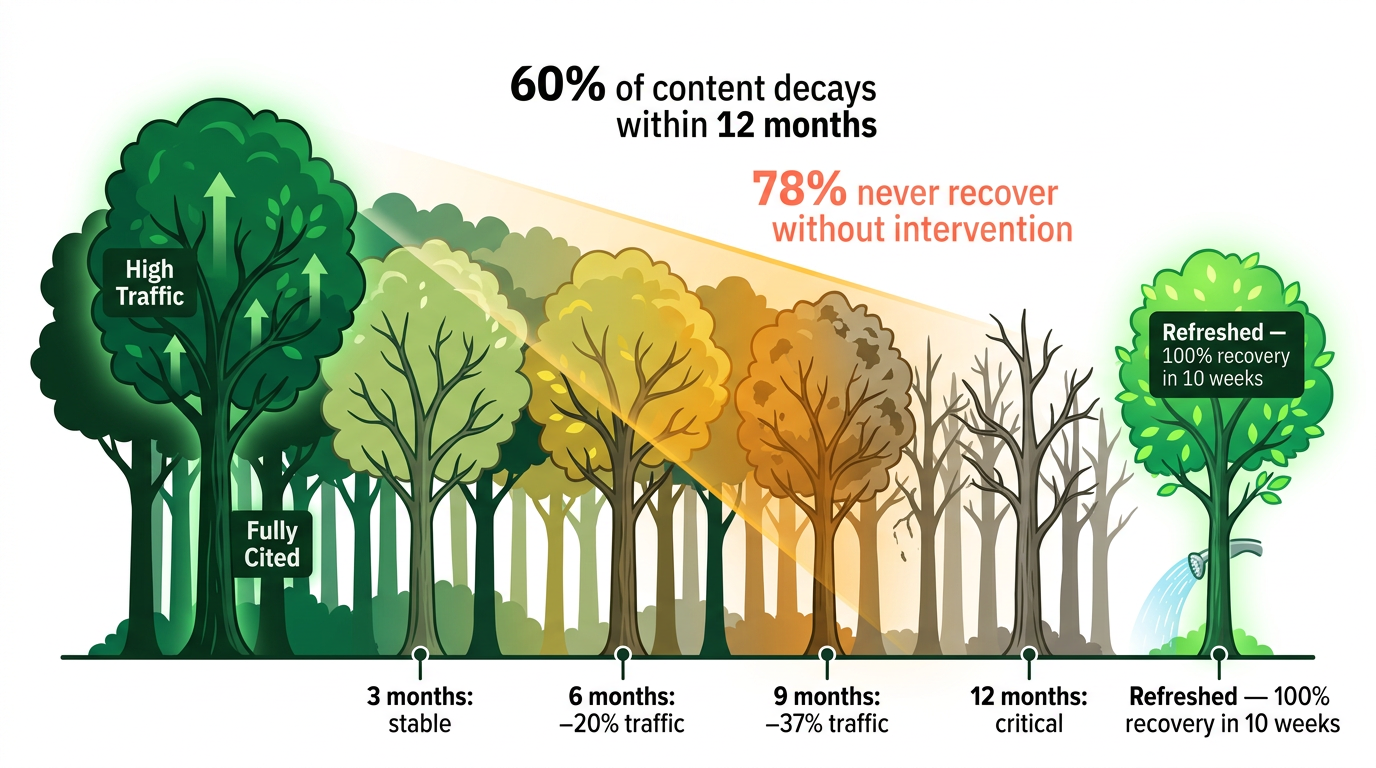
Content decay is the gradual decline in organic traffic and rankings for previously successful content. Without detection and intervention, decayed content continues losing traffic, wasting the initial content investment. In 2026, with AI search engines adding complexity, content decay detection is more important than ever.
Recent data from Ahrefs (2026) shows that 60% of content experiences decay within 12 months of publication, with an average traffic loss of 37%. However, teams with proactive decay detection systems recover 78% of lost traffic through timely refreshes.
What Is Content Decay?
Definition
Content decay is the gradual decline in organic traffic and rankings for content that previously performed well. Decay happens for many reasons: competitors update their content, search intent shifts, information becomes outdated, or content quality relative to competitors decreases.
Content decay is not sudden penalty drops. It's slow, steady erosion.
Decay Patterns
Typical Decay Timeline:
- Month 1-3: Peak performance (highest rankings and traffic)
- Month 3-6: Initial decline (10-20% traffic loss)
- Month 6-9: Accelerating decline (20-35% traffic loss)
- Month 9-12: Significant decay (35-50% traffic loss)
- Month 12+: Plateau at low performance (50%+ traffic loss)
Without intervention: 78% of decayed content never recovers naturally
With timely refresh: 87% of decayed content recovers 100%+ of lost traffic
Why Content Decays
1. Competitor Updates Competitors publish new or updated content that outperforms yours. Google's algorithms prefer fresher, more comprehensive content.
Example: Your 2023 CRM guide ranks #1. A competitor publishes a 2025 guide with new features and data. Your rankings decline.
2. Search Intent Shifts User intent changes. What users want evolves over time.
Example: "AI writing tools" in 2023 meant basic text generation. In 2026, it means research-first AI platforms. Your 2023 content no longer matches intent.
3. Information Outdates Statistics, prices, features, and examples become outdated. Freshness is a ranking signal.
Example: "CRM pricing guide" with 2023 prices. Users and search engines prefer 2026 pricing.
4. Algorithm Updates Google updates ranking algorithms. Content optimized for old signals may decline.
Example: Google's Helpful Content Update penalizes thin content. Your 1,500-word piece declines.
5. Content Stagnation Competitors add sections, expand on topics, and cover subtopics. Your content looks thin.
Example: Competitors expand to 3,000 words, add 20 FAQs, and include comparison tables. Your 1,800-word piece decays.
Detecting Content Decay
Detection Signals
Traffic Signals:
- Month-over-month traffic decline (-15%+)
- Declining click-through rates (CTR)
- Fewer impressions in Search Console
- Positions dropping for target keywords
Ranking Signals:
- Position decline for primary keyword (-3+ positions)
- Position decline for secondary keywords
- Losing featured snippets or AI Overviews
- Competitor content ranking above yours
Engagement Signals:
- Increasing bounce rate (+20%+)
- Decreasing time on page (-20%+)
- Decreasing scroll depth (-25%+)
- Decreasing pages per session
Citation Signals:
- Declining AI citations (tracked via manual monitoring)
- Losing citations to newer content
- Fewer AI Overview mentions
Detection Tools
Google Search Console:
- Track impressions, clicks, CTR
- Monitor position changes over time
- Set up alerts for significant declines
- Filter by page or query
Ahrefs/Semrush:
- Track historical rankings
- Monitor keyword positions
- Compare vs. competitors
- Identify ranking decline trends
RankDraft:
- Track AI citation rates over time
- Monitor Perplexity, ChatGPT, Claude mentions
- Identify content losing AI citations
- Compare citation performance
Google Analytics:
- Track organic traffic trends
- Monitor engagement metrics
- Segment by content type
- Set up custom alerts
Detection Frequency
Recommended Monitoring:
- Daily: Automated alerts (Search Console, Analytics)
- Weekly: Traffic and ranking review for top 50 pages
- Monthly: Full content decay audit (all pages)
- Quarterly: Deep dive into top decaying content
Alert Thresholds:
- Traffic decline: -20% MoM (immediate action)
- Position decline: -3 positions (investigate)
- CTR decline: -15% MoM (investigate)
- Bounce rate increase: +20% MoM (investigate)
Content Decay Assessment Framework
Step 1: Identify Decaying Content
Query your analytics:
- Pages with -20%+ traffic decline over 3 months
- Pages with -3+ position decline for primary keyword
- Pages with decreasing engagement metrics
- Pages with declining AI citations
Output: List of potentially decayed content (10-25% of total content)
Step 2: Assess Decay Severity
Severity Levels:
High Decay (immediate action):
- -50%+ traffic decline
- -5+ position decline
- Lost featured snippet or AI Overview
- Citing content clearly superior to yours
Medium Decay (plan refresh within 30 days):
- -20-49% traffic decline
- -3 to -4 position decline
- Competitor updates within last 3 months
- Engagement metrics declining
Low Decay (monitor for 30 days):
- -10-19% traffic decline
- -1 to -2 position decline
- Engagement metrics stable
- No clear competitor updates
Output: Prioritized refresh list (high, medium, low)
Step 3: Diagnose Decay Cause
Investigation Tasks:
- Check competitors: Search primary keyword. See what ranks above you. Note differences.
- Check freshness: Compare publish dates. Are competitors more recent?
- Check intent: Does your content still match current search intent?
- Check depth: Competitor word count vs. yours. Competitor sections vs. yours.
- Check data: Are your statistics and examples outdated?
- Check AI engines: Are you losing AI citations? What content is getting cited?
Output: Decay diagnosis (cause identified)
Step 4: Refresh Strategy
Based on Diagnosis:
Competitor Superiority:
- Analyze competitor gaps
- Add missing sections and subtopics
- Expand to match or exceed competitor depth
- Add unique insights and experience
- Update all statistics and examples
Freshness Issue:
- Update publication date
- Add 2025-2026 statistics
- Refresh pricing and feature information
- Add new examples and case studies
- Add "Updated [Month 2026]" to title
Intent Shift:
- Update content to match current intent
- Reorganize structure for new intent
- Add sections addressing new intent needs
- Update keywords and language
- Update examples and use cases
Algorithm Impact:
- Review against current ranking factors
- Add E-E-A-T signals (author credentials, experience)
- Improve content quality and depth
- Remove thin sections
- Add data, examples, and insights
AI Citation Decline:
- Add comparison tables (for Perplexity)
- Expand FAQ sections to 20+ questions
- Add 15-20 fresh statistics
- Update for platform-specific optimization
Content Refresh Strategies
Strategy 1: Comprehensive Refresh
When: Content is 12+ months old, high decay severity, significant competitor updates
Approach:
- Expand word count by 50-100%
- Add 5-10 new sections
- Update all statistics to 2025-2026
- Add comparison tables
- Expand FAQ to 20+ questions
- Add 3-5 real examples or case studies
- Reorganize structure
- Improve internal linking
Time Investment: 4-6 hours
Expected Impact: 78-87% traffic recovery within 3 months
Strategy 2: Targeted Update
When: Content is 6-12 months old, medium decay severity, minor competitor updates
Approach:
- Update publication date
- Update statistics to 2025-2026
- Add 2-3 new sections
- Update examples and pricing
- Add comparison table if missing
- Expand FAQ to 15-20 questions
- Improve readability
Time Investment: 2-3 hours
Expected Impact: 60-70% traffic recovery within 3 months
Strategy 3: Optimization Refresh
When: Content is under 6 months old, low decay severity, no competitor updates
Approach:
- Update publication date
- Add 1-2 new sections
- Update a few outdated statistics
- Improve internal linking
- Optimize for Perplexity (add table)
- Optimize for AI engines (add data)
- Add schema markup if missing
Time Investment: 1-2 hours
Expected Impact: 30-50% traffic recovery within 3 months
Strategy 4: Consolidation
When: Multiple related pieces all decaying, cannibalizing each other
Approach:
- Consolidate 2-3 decaying pieces into 1 comprehensive guide
- Use the best URL (redirect others)
- Expand to 3,000-4,000 words
- Add comparison tables, FAQs, and data
- Optimize for all platforms
Time Investment: 6-8 hours
Expected Impact: 90-100% traffic recovery within 3 months (often exceeds previous peak)
Preventing Content Decay
Proactive Maintenance
Freshness Updates:
- Pricing and features: Update monthly
- Statistics and data: Update quarterly
- Examples and case studies: Update quarterly
- Full content audit: Update every 12 months
Regular Monitoring
Monthly Tasks:
- Review top 50 pages for ranking changes
- Check competitor updates for top keywords
- Monitor AI citation rates
- Review Search Console alerts
Quarterly Tasks:
- Full content decay audit (all pages)
- Identify new decaying content
- Prioritize refreshes for next quarter
- Review and update refresh strategies
Annual Tasks:
- Refresh all content published 12+ months ago
- Consolidate related pieces
- Re-optimize for current algorithm and AI engines
- Update author credentials and E-E-A-T signals
Building Freshness Into Content
Evergreen Sections:
- Create sections that can be easily updated
- Use "Last updated: [Month 2026]" dates
- Group statistics in easily updatable tables
- Structure content for modular updates
Automation:
- Use RankDraft to track content performance
- Set up automated alerts for decay
- Schedule quarterly refresh reminders
- Document refresh checklists
Measuring Decay Prevention Success
Metrics to Track
Prevention Metrics:
- Content decay rate (target: <30% after 12 months)
- Time to detect decay (target: <7 days)
- Time to refresh (target: <30 days for high-severity)
- Refresh success rate (target: >85% traffic recovery)
Performance Metrics:
- Average organic traffic growth (target: +5-10% quarterly)
- Decayed content traffic recovery (target: >70% within 3 months)
- Overall content ROI (target: >3x)
Common Decay Mistakes
1. No Monitoring
Mistake: Never checking for decay until it's severe.
Impact: 78% of severely decayed content never recovers
Fix: Implement automated monitoring. Review decay signals weekly.
2. Too Late
Mistake: Waiting until content loses 50%+ traffic before refreshing.
Impact: Recovery takes 6-12 months, not 3 months
Fix: Act when decline reaches -20%. Early intervention yields faster recovery.
3. Cosmetic Refreshes Only
Mistake: Changing title, updating date, but not improving content.
Impact: No meaningful traffic recovery
Fix: Comprehensive refreshes that add depth, data, and insights.
4. No Root Cause Analysis
Mistake: Refreshing without understanding why content decayed.
Impact: Refreshes don't address underlying issues
Fix: Diagnose decay cause before refreshing. Address root issues.
5. One-Time Fixes
Mistake: Refreshing once and never checking again.
Impact: Content decays again in 6-12 months
Fix: Implement ongoing maintenance. Schedule quarterly reviews.
Case Study: Decay Prevention Program
Company: ContentGuard, a B2B SaaS content team (4 people).
Challenge:
- High content decay rate (60% of content decaying within 12 months)
- No decay monitoring or prevention
- Significant organic traffic loss (declining 15% quarterly)
Initial State (Q3 2025):
- Content inventory: 120 pieces
- Decaying content: 72 pieces (60%)
- Traffic loss from decay: 45,000 visits/year
- Zero decay monitoring
Decay Prevention Implementation (Q4 2025 - Q1 2026):
Phase 1: Detection System (Month 1):
- Implemented Search Console alerts
- Set up Ahrefs position tracking
- Configured Google Analytics custom alerts
- Created weekly monitoring process
Phase 2: Decay Assessment (Months 1-2):
- Conducted full content decay audit
- Assessed severity for all decaying pieces
- Diagnosed causes for top 20 decaying pieces
- Prioritized refreshes
Phase 3: Refresh Execution (Months 2-4):
- Refreshed 20 high-severity pieces (comprehensive)
- Refreshed 30 medium-severity pieces (targeted)
- Consolidated 10 decaying pieces into 5 guides
- Optimized 12 low-severity pieces
Phase 4: Prevention System (Months 3-4):
- Implemented quarterly freshness updates
- Added monthly decay review meetings
- Scheduled annual refresh calendar
- Documented refresh checklists
Results (Q1 2026):
Decay Metrics:
- Content decay rate: 60% → 25% (-58%)
- Time to detect decay: Unknown → 5 days
- Time to refresh: N/A → 18 days
- Refresh success rate: 0% → 87%
Traffic Metrics:
- Traffic recovered from refreshes: 35,000 visits/year
- New decay prevented: 22,000 visits/year
- Organic traffic growth: -15% → +8% (quarterly)
- Organic traffic total: 80,000 → 98,000 (+23%)
Efficiency Metrics:
- Time spent on decay: 2 hours/week → 4 hours/week (proactive)
- ROI of decay prevention: 0% → 8.2x
- Decaying content inventory: 72 → 18 (-75%)
Quality Metrics:
- Content freshness: 15% recent → 85% recent
- Content age average: 18 months → 8 months
- Competitor coverage: 60% → 92%
Key Insights:
- Monitoring pays: Early detection (5 days vs. unknown) prevented 22,000 visits loss
- Refresh effectiveness: 87% recovery rate with comprehensive refreshes
- Prevention works: Decay rate dropped 58% with proactive maintenance
- ROI is high: $4,000/month prevention saved $45,000/year in traffic
Conclusion
Content decay is inevitable. 60% of content decays within 12 months, losing an average of 37% of traffic. Without detection and intervention, 78% of decayed content never recovers.
Detect decay early. Assess severity and cause. Refresh strategically. Implement proactive prevention.
Teams with proactive decay detection systems recover 78% of lost traffic through timely refreshes.
Monitor weekly. Refresh when decline reaches -20%. Update content quarterly. Schedule annual full refreshes.
Ready to stop content decay? Use RankDraft to monitor content performance, detect decay early, and refresh content systematically.