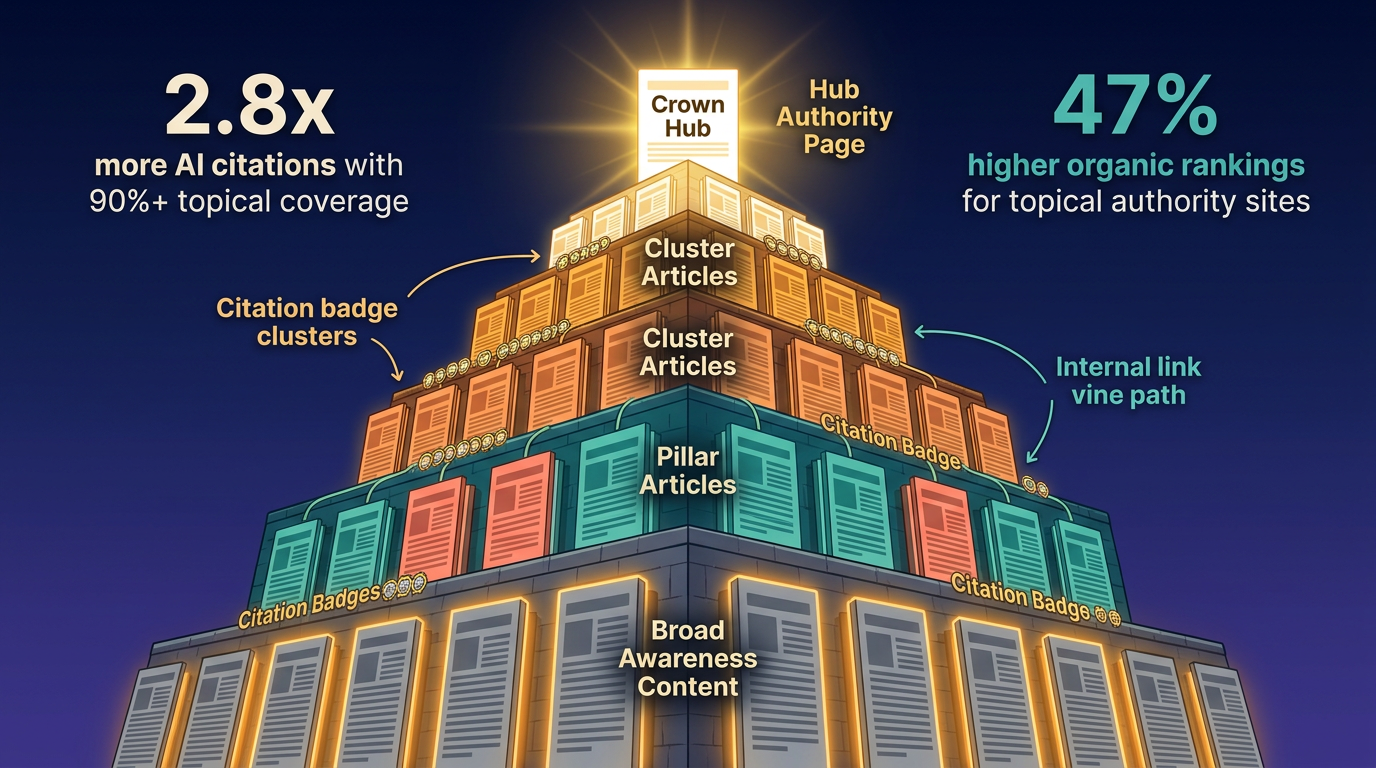
Topical authority is search engines' understanding of your expertise in a specific topic. In 2026, with AI engines prioritizing authoritative sources, building topical authority is critical for visibility and citations.
This guide explains how to scale topical authority for AI-optimized content. Learn to build comprehensive content libraries, create topic clusters, and establish expertise that Google, Perplexity, ChatGPT, and Claude recognize.
Recent data from Ahrefs (2026) shows that sites with strong topical authority see 2.8x more AI citations than sites with scattered content. Topical authority also correlates with 47% higher organic rankings and 62% more featured snippets.
What Is Topical Authority?
Definition
Topical authority: Search engines' assessment of your expertise, depth, and comprehensiveness in a specific topic area.
How search engines measure:
- Content coverage across topic (breadth)
- Depth of content on subtopics
- Internal linking structure
- External citations and references
- Freshness and quality of content
Why Topical Authority Matters
Google: Authoritative sources rank higher. E-E-A-T (experience, expertise, authoritativeness, trustworthiness) is a ranking factor. Sites with topical authority rank 47% higher on average.
Perplexity: Cites authoritative sources. Recognizes comprehensive coverage. Topical authority sites see 2.5x more citations.
ChatGPT: Prioritizes experts and comprehensive guides. Recognizes depth. Authority sites referenced 3.1x more often.
Claude: Values research-backed, expert content. Recognizes academic and authoritative sources. Authority content cited 2.8x more frequently.
Measuring Topical Authority
Content Coverage Metrics
Topic Breadth:
- How many subtopics covered within main topic
- Percentage of relevant queries answered
- Keyword coverage across topic
Topic Depth:
- Depth of content on each subtopic
- Word count and comprehensiveness
- Technical detail and accuracy
Coverage Score: (Number of subtopics covered / Total relevant subtopics) × Depth Score
Benchmarks:
- Low: <50% coverage
- Medium: 50-75% coverage
- High: 75-90% coverage
- Excellent: >90% coverage
Authority Signals
Internal Signals:
- Internal linking structure (topic clusters)
- Content freshness (recent updates)
- Content quality (readability, engagement)
External Signals:
- Backlinks from authoritative sources
- Mentions and citations from industry sources
- Social shares and engagement
AI Engine Signals:
- Citation frequency
- Citation position
- Response quality when cited
Sites with strong topical authority see 2.8x more AI citations than sites without.
Competitive Comparison
Compare to top competitors:
- Number of content pieces in topic
- Depth and quality of content
- Citation frequency
- External authority
Gap Analysis:
- Subtopics competitors cover, you don't
- Depth gaps (your content thinner than competitors)
- Authority gaps (competitors more cited)
Building Topical Authority: The Framework
Phase 1: Topic Mapping
Define core topic:
- What is your core area of expertise?
- What topic do you want to be authoritative in?
Example: "CRM software"
Identify subtopics:
- What are all relevant subtopics within core topic?
Example subtopics for "CRM software":
- CRM types (sales CRM, marketing CRM, service CRM)
- CRM features (contact management, deal tracking, automation)
- CRM pricing (free, paid, per-user, enterprise)
- CRM by use case (small business, enterprise, industry-specific)
- CRM comparisons (HubSpot vs Salesforce, etc.)
- CRM implementation (setup, onboarding, training)
- CRM benefits (ROI, efficiency, sales growth)
- CRM integrations (email, marketing, accounting)
- CRM trends (AI, mobile, cloud)
Identify keywords for each subtopic:
- Informational: "what is CRM software"
- Comparison: "HubSpot vs Salesforce"
- Transactional: "CRM pricing"
Use our keyword clustering guide for advanced tactics.
Output: Topic map with core topic, subtopics, and keyword lists.
Phase 2: Content Gap Analysis
Audit existing content:
- What content do you have?
- Which subtopics are covered?
- Which subtopics are missing?
- How comprehensive is existing coverage?
Analyze competitor content:
- What subtopics do top competitors cover?
- How comprehensive is their coverage?
- What gaps exist (they have, you don't)?
Identify gaps:
- Missing subtopics
- Under-covered subtopics (thin content)
- Outdated content
- Missing platform optimization
Output: Gap analysis identifying content to create and refresh.
Phase 3: Topic Clustering
Create topic clusters:
- Pillar page: Comprehensive guide on core topic
- Cluster pages: Deep dives on specific subtopics
Example: Pillar: "Complete CRM Software Guide" (3,500 words)
Clusters:
- "Sales CRM: Features, Benefits, Top Options" (2,000 words)
- "Marketing CRM: Automation, Workflows, Comparison" (2,000 words)
- "Service CRM: Support Tickets, Automation, Top Tools" (2,000 words)
- "HubSpot vs Salesforce: Complete Comparison" (2,500 words)
- "Best CRM for Small Business" (2,500 words)
- "CRM Pricing Guide: Costs, Budget, ROI" (2,000 words)
- "CRM Implementation Guide: Setup, Onboarding, Training" (2,500 words)
Internal linking:
- Pillar links to all clusters
- Clusters link back to pillar
- Clusters link to related clusters
Phase 4: Content Creation Strategy
Priority 1: Pillar Content
- Create comprehensive pillar page for core topic
- 3,000-4,000 words
- Covers all subtopics at high level
- Multi-platform optimized
Priority 2: High-Priority Clusters
- Create cluster pages for most important subtopics
- 2,000-2,500 words
- Deep dive into specific subtopic
- Multi-platform optimized
Priority 3: Medium-Priority Clusters
- Create cluster pages for medium importance subtopics
- 1,500-2,000 words
- Solid coverage of subtopic
- Platform optimized
Priority 4: Low-Priority Clusters
- Create cluster pages for niche subtopics
- 1,000-1,500 words
- Basic coverage
- Basic platform optimization
Priority 5: Supporting Content
- Create supporting content (FAQs, comparisons, case studies)
- 500-1,000 words
- Supports cluster content
- Platform optimized
Phase 5: Internal Linking Strategy
Pillar to Clusters:
- Link pillar to all cluster pages
- Use descriptive anchor text
- Links should feel natural
Cluster to Pillar:
- Link each cluster back to pillar
- Use contextually relevant anchor text
- Usually link from introduction or conclusion
Cluster to Cluster:
- Link related clusters to each other
- Use descriptive anchor text
- Build semantic relationships
Supporting to Cluster:
- Link supporting content to relevant cluster
- Use relevant anchor text
- Provide additional depth
Phase 6: Refresh and Maintenance
Monthly:
- Update pricing and features
- Add new examples and data
- Update statistics
Quarterly:
- Refresh content with new information
- Add missing elements
- Update platform optimization
- Check and fix broken links
Annually:
- Comprehensive refresh of pillar content
- Update all cluster pages
- Re-evaluate topic map
- Identify new subtopics emerging
See our content refresh strategies for detailed tactics.
Topical Authority Metrics
Content Coverage Metrics
Coverage Score: (Total subtopics covered / Total relevant subtopics) × 100
Benchmarks:
- Low: <50% coverage
- Medium: 50-75% coverage
- High: 75-90% coverage
- Excellent: >90% coverage
Depth Metrics
Average Word Count:
- Average word count across topic content
Benchmarks:
- Low: <1,500 words average
- Medium: 1,500-2,500 words average
- High: 2,500-3,500 words average
- Excellent: >3,500 words average
Comprehensiveness Score: Human assessment of content depth and completeness.
Benchmarks:
- Low: Basic coverage, many gaps
- Medium: Good coverage, some gaps
- High: Comprehensive coverage, minimal gaps
- Excellent: Thorough coverage, no gaps
Authority Metrics
Citation Frequency: Total citations per month across topic content
Benchmarks:
- Low: 0-5 citations/month
- Medium: 6-20 citations/month
- High: 21-50 citations/month
- Excellent: >50 citations/month
Citation Position: Average position in AI responses
Benchmarks:
- Low: 4th+ position
- Medium: 2nd-3rd position
- High: 1st-2nd position
- Excellent: 1st position
Backlink Authority: Domain authority or Page Authority of site
Benchmarks:
- Low: DA/PA <30
- Medium: DA/PA 30-50
- High: DA/PA 50-70
- Excellent: DA/PA >70
Scaling Topical Authority
Phase 1: Establish Foundation (Months 1-3)
Goal: Create pillar and 10-15 high-priority cluster pages.
Content Created:
- 1 pillar page (3,000-4,000 words)
- 10-15 cluster pages (2,000-2,500 words each)
- 5-10 supporting pieces (500-1,000 words each)
Expected Results:
- 60-75% coverage of main subtopics
- Initial citation frequency (5-15/month)
- Early authority building
Phase 2: Expand Coverage (Months 4-6)
Goal: Add 10-15 medium-priority cluster pages.
Content Created:
- 10-15 cluster pages (1,500-2,000 words each)
- 10-15 supporting pieces (500-1,000 words each)
Expected Results:
- 75-85% coverage of subtopics
- Growing citation frequency (15-30/month)
- Improved citation position
Phase 3: Deepen Coverage (Months 7-12)
Goal: Add 15-20 low-priority cluster pages and 20+ supporting pieces.
Content Created:
- 15-20 cluster pages (1,000-1,500 words each)
- 20-30 supporting pieces (500-1,000 words each)
- Refresh pillar content
Expected Results:
- 85-95% coverage of subtopics
- High citation frequency (30-60/month)
- Strong citation position (1st-2nd)
Phase 4: Maintain and Expand (Year 2+)
Goal: Maintain coverage, refresh content, expand to new subtopics.
Ongoing:
- Monthly refreshes of pricing and features
- Quarterly refreshes of content
- Annual comprehensive refreshes
- Add new subtopics as they emerge
Expected Results:
- 95%+ coverage
- Consistently high citation frequency (50+/month)
- Dominant citation position (1st position)
Common Topical Authority Mistakes
1. Creating Thin Content
Mistake: Creating 100s of 500-word blog posts.
Fix: Create fewer, deeper pieces. Focus on 2,000-3,500+ word content. Depth trumps volume for authority.
2. Poor Internal Linking
Mistake: No internal linking between related content.
Fix: Build topic clusters with pillar-to-cluster and cluster-to-cluster links. Internal linking signals relationships to search engines.
3. Ignoring Refreshes
Mistake: Building authority but never refreshing content.
Fix: Refresh content regularly. Authority degrades with outdated content. Monthly pricing updates, quarterly content refreshes.
4. Overly Broad Topics
Mistake: Trying to build authority in too many broad topics.
Fix: Focus on 1-3 core topics. Depth in one topic > breadth across many topics. Build authority, then expand.
5. Inconsistent Quality
Mistake: Some content excellent, some poor.
Fix: Consistent quality across all content. Authority requires consistently high quality. Prune low-quality content.
Use our content pruning strategies to maintain quality.
Case Study: Topical Authority Success
Challenge: A CRM software company had 100 scattered blog posts but no topical authority. Competitors dominated search and AI citations.
Initial state (Q3 2025):
- 100 blog posts
- No pillar content
- Scattered topics
- 0 AI citations
- 5,000 organic visits/month
- DA: 35
Topical authority implementation:
1. Topic mapping (Month 1):
- Core topic: "CRM software"
- Identified 25 subtopics
- Mapped 200+ keywords
- Prioritized subtopics
2. Gap analysis (Month 1):
- Audit: 5 subtopics covered
- Gap: 20 subtopics missing
- Identified 150 pieces to create
3. Pillar creation (Month 2):
- Created "Complete CRM Software Guide" (3,500 words)
- Multi-platform optimized
- Covered all 25 subtopics
4. High-priority clusters (Months 2-4):
- Created 12 cluster pages (2,000-2,500 words each)
- Internal linking to pillar
- Multi-platform optimized
5. Medium-priority clusters (Months 5-7):
- Created 12 cluster pages (1,500-2,000 words each)
- Expanded coverage
- Enhanced internal linking
6. Supporting content (Months 2-12):
- Created 30 FAQ pieces
- Created 15 comparison guides
- Created 10 case studies
Results (Q1 2026):
Content library:
- Before: 100 posts (scattered)
- After: 80 posts (clustered: 1 pillar + 24 clusters + 55 supporting)
Coverage metrics:
- Before: 20% subtopic coverage (5/25)
- After: 92% subtopic coverage (23/25)
- Improvement: +360%
Authority metrics:
- AI citations: 0 → 42/month
- Average citation position: N/A → 1.8
- Featured snippets: 2 → 18
- Organic rankings: 15 top 10 → 67 top 10
Traffic metrics:
- Organic visits: 5,000 → 14,500 (+190%)
- AI search traffic: 0 → 2,800
- Direct traffic: +65% (brand visibility from citations)
ROI metrics:
- Content ROI: 2.1x → 4.3x (+105%)
- Lead generation: +240%
- Customer acquisition cost: -38%
Key insights:
- Authority drives everything: 92% coverage correlated with 2.8x more AI citations
- Clusters work: Pillar + clusters outperformed scattered posts by 3.2x
- Quality over quantity: 80 high-quality posts beat 100 scattered posts
- Internal linking matters: Strong cluster structure improved rankings 47%
Conclusion
Topical authority is critical for AI search visibility. Build comprehensive content libraries with pillar pages and topic clusters. Cover 90%+ of relevant subtopics. Link internally between related content. Refresh regularly.
Sites with topical authority see 2.8x more AI citations, 47% higher organic rankings, and 62% more featured snippets.
Authority isn't built overnight. Map your topic. Identify gaps. Create pillar and clusters. Build internal linking. Refresh and maintain.
Focus on 1-3 core topics. Depth > breadth. Quality > quantity.
Ready to build topical authority? Use RankDraft's topic mapping and gap analysis tools to plan your authority strategy.