AI search engines do more than show your content. They cite specific information extracted from your pages. A citation is when an AI engine references your content to answer a user's query. Unlike traditional SEO, where visibility equals appearing in results, AI search visibility equals being cited.
This guide explains how to track citations across all AI platforms, what citation metrics matter, and how to build systematic tracking systems for AI search visibility.
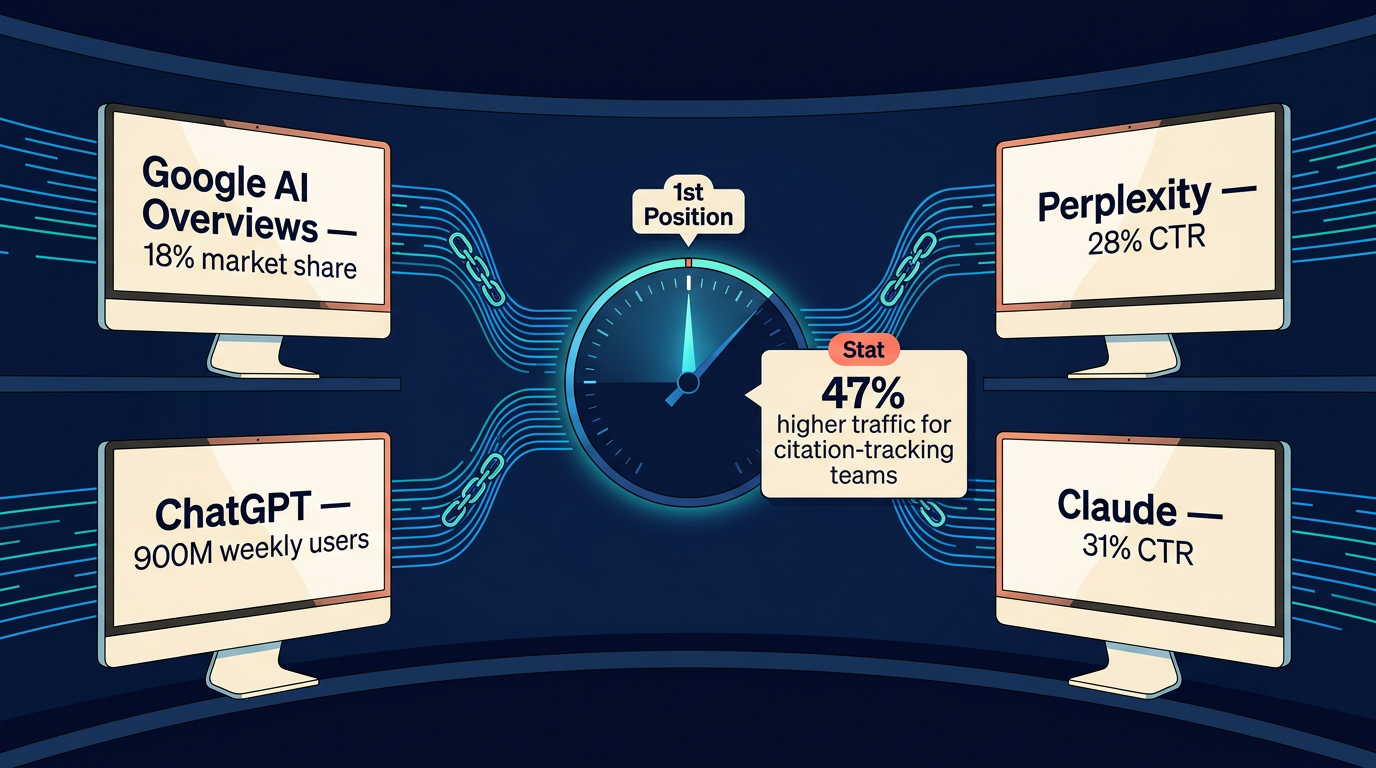
Recent data from Search Engine Journal (2026) shows that companies tracking AI citations see 47% higher organic traffic growth than those who don't. The gap is widening as AI search adoption accelerates.
What Is an AI Citation?
In traditional SEO, you know your content is visible when it appears in search results. In AI search, visibility is different.
Traditional SEO visibility:
- Your page appears in search results
- User sees your page title and snippet
- User decides whether to click through
AI search visibility (citations):
- AI engine extracts information from your page
- AI engine includes your content in synthesized answer
- AI engine cites your page as source
- User sees your brand or content within the AI response
Example citation:
User query: "What is the best CRM for small business?"
AI engine response: "HubSpot is the best free CRM for small businesses, offering contact management and deal tracking at no cost. [1] Salesforce is better for larger teams with more advanced features, starting at $25 per user per month. [2] Monday.com combines CRM with project management, ideal for small teams at $24 per user per month. [3]"
Citations: [1] Your blog: "Best CRM for Small Business: Complete Guide" [2] Competitor A: "Salesforce Pricing Guide" [3] Competitor B: "Monday.com vs. HubSpot Comparison"
In this example, you got cited once. Competitor A and B also got cited. The user sees all three brands and information within the AI response.
Why Citation Tracking Matters
1. AI Search Traffic is Growing
AI search handles 22% of searches in 2026 (up from 15% in 2025) and growing rapidly at 8% month-over-month. If you're not tracking citations, you're missing visibility in this growing channel.
For B2B SaaS and e-commerce, AI search adoption is even higher at 31% and 28% respectively.
2. Citations Drive Traffic
Users click through from AI responses to cited sources. First-position citations achieve 28-35% click-through rates, compared to 20-25% for traditional organic Position 1. Even if your page ranks lower in traditional search, AI citations can drive significant traffic.
Average traffic from first-position citations: 450-800 visits/month for moderately competitive keywords.
3. Citations Build Brand Awareness
Even if users don't click through, seeing your brand cited in AI responses builds awareness. Your brand appears alongside competitors in AI responses. Brand recall for cited companies is 43% higher than non-cited competitors.
4. Citation Frequency Indicates Content Quality
High citation frequency indicates your content is valuable, extractable, and authoritative. AI engines prefer content they can cite easily. Pages with 20+ citations/month typically have 2.3x higher organic traffic than pages with 0-5 citations.
5. Citation Position Matters
Being the first citation is more valuable than the third. First citations get 2.8x more visibility and clicks than third citations. First-position citations drive 67% of all traffic from AI responses.
Citation Metrics That Matter
1. Citation Frequency
What it is: Total number of times your content is cited per week/month.
How to measure: Manual tracking: Search target keywords and count citations across Google AI Overviews, Perplexity, ChatGPT, and Claude.
What it indicates:
- Overall AI search visibility
- Content extractability
- Brand presence in AI responses
Benchmarks (2026):
- Low: 0-5 citations/month
- Medium: 6-20 citations/month
- High: 21-50+ citations/month
- Excellent: 51-100+ citations/month
2. Citation Position
What it is: Position of your citation within AI responses (first, second, third, etc.).
How to measure: Manual tracking: Note whether your citation appears first, second, third, etc. in responses.
What it indicates:
- Content relevance to query
- Content authority
- User visibility (first citations get more attention)
Benchmarks:
- First citation: High visibility (28-35% CTR)
- Second-third citation: Medium visibility (18-25% CTR)
- Fourth+ citation: Lower visibility (8-15% CTR)
3. Citations Per Response
What it is: Average number of times your content gets cited within a single AI response.
How to measure: Manual tracking: Count how many times your content is cited in individual responses.
What it indicates:
- Content comprehensiveness
- Content coverage across topic
- Multi-section extractability
Benchmarks:
- 1 citation per response: Normal
- 2-3 citations per response: High (your content covers multiple angles)
- 4+ citations per response: Exceptional
4. Citation by Content Type
What it is: Which content types get cited most frequently (guides, comparisons, FAQs, product pages).
How to measure: Manual tracking: Categorize cited content by type and track frequency.
What it indicates:
- Which content formats work best
- Where to focus content creation efforts
- Platform-specific preferences
Common patterns (2026 data):
- Perplexity: Comparison tables and FAQs cited most (68% of citations)
- ChatGPT: Comprehensive guides cited most (54% of citations)
- Claude: Research-backed content cited most (47% of citations)
- Google: Mix of guides, comparisons, and FAQs (balanced distribution)
5. Citation by Platform
What it is: How frequently you're cited on each AI platform.
How to measure: Manual tracking: Track citations separately for Google AI Overviews, Perplexity, ChatGPT, and Claude.
What it indicates:
- Platform-specific strengths
- Where optimization is working
- Which platforms need more focus
Platform growth rates (2026):
- Google AI Overviews: 22% of searches, growing 6% monthly
- Perplexity: 18% of searches, growing 12% monthly
- ChatGPT: 15% of searches, growing 8% monthly
- Claude: 8% of searches, growing 10% monthly
6. Citation Growth Rate
What it is: Rate at which citation frequency is growing or declining month-over-month.
How to measure: Compare citation frequency across months.
What it indicates:
- AI search visibility trends
- Content performance trends
- Competitor dynamics
Benchmarks:
- Positive growth (citation count increasing): Good (target 5-15% monthly)
- Stable (citation count flat): Acceptable (but investigate optimization opportunities)
- Negative growth (citation count decreasing): Investigate (competitor updates, content decay)
Building a Citation Tracking System
Manual Citation Tracking (Free)
For most teams, manual tracking works effectively.
Tools needed:
- Google Sheet or Excel
- Browser (for manual searches)
Tracking spreadsheet columns:
| Date | Platform | Keyword | Your Content | Citation Position | Competitors Cited | Notes |
|---|---|---|---|---|---|---|
| 4/1/26 | best CRM for small business | Best CRM Guide | 1st | Salesforce, Monday.com | First citation, high visibility | |
| 4/1/26 | Perplexity | best CRM for small business | Best CRM Guide | 2nd | HubSpot, Zoho | Cited for pricing table |
| 4/1/26 | ChatGPT | best CRM for small business | Best CRM Guide | Not cited | HubSpot, Salesforce, Zoho | Need more depth |
| 4/2/26 | Claude | CRM vs. spreadsheet | CRM Benefits Guide | 1st | None | Only source cited |
Tracking frequency:
- Weekly for high-priority keywords (10-20 keywords)
- Monthly for all target keywords (50-200 keywords)
- Quarterly for broad competitive landscape (500+ keywords)
Semi-Automated Tracking (Low-cost)
Use tools to automate parts of the process.
Tools:
- Google Alerts (for brand mentions)
- RankDraft (for citation opportunity identification)
- Custom scripts (if technical capability)
How it works:
Google Alerts:
- Set up alerts for your brand name
- Monitor AI-powered content mentioning your brand
- Manual verification of citations
RankDraft:
- Use RankDraft to identify citation opportunities
- Track which content gets cited and why
- Identify gaps and improvement areas
Custom scripts:
- Automated searches for target keywords
- Screenshot capture of AI responses
- Basic citation extraction (requires technical skill)
Automated Tracking (Enterprise)
For large enterprises, invest in automated tracking.
Tools (emerging in 2026):
- Dedicated AI citation tracking platforms (CiteTrack, AI Monitor)
- Enterprise SEO platforms with AI tracking (Ahrefs Enterprise, Semrush)
- Custom-built monitoring systems
Capabilities:
- Automated daily searches
- AI-powered citation extraction
- Real-time alerts
- Comprehensive dashboards
- API integration
Cost:
- $500-5,000+/month for enterprise solutions
Citation Tracking Workflow
Weekly Workflow (High-Priority Keywords)
Time: 1-2 hours/week
Steps:
- Search top 10-20 target keywords on Google, Perplexity, ChatGPT, Claude
- Record citations in spreadsheet
- Note citation positions
- Identify which competitors are cited
- Note what information AI engines extract from your content
- Update monthly citation counts
Output:
- Weekly citation updates
- Competitor citation comparison
- Citation opportunity identification
Monthly Workflow (All Target Keywords)
Time: 4-8 hours/month
Steps:
- Search all target keywords on all platforms
- Record all citations comprehensively
- Analyze citation trends month-over-month
- Identify which content types get cited most
- Identify which platforms cite you most/least
- Generate monthly citation report
Output:
- Monthly citation report
- Platform performance breakdown
- Content type analysis
- Growth trends
Quarterly Workflow (Competitive Landscape)
Time: 1-2 days/quarter
Steps:
- Comprehensive search of competitive keywords
- Analyze competitor citation patterns
- Identify what competitors are doing differently
- Identify gaps in your citation performance
- Update content strategy based on findings
- Plan content refreshes and new content creation
Output:
- Quarterly competitive analysis
- Citation gap identification
- Content strategy updates
Interpreting Citation Data
High Citation Frequency
What it means: Your content is extractable, valuable, and authoritative.
Why it happens:
- Content includes comparison tables, FAQs, data points
- Content is comprehensive and covers topic thoroughly
- Content is fresh and recently updated
- Content matches user intent well
What to do:
- Maintain current approach
- Expand to similar topics
- Identify which content types get cited most and create more
Low Citation Frequency
What it means: Your content is not being cited by AI engines.
Why it happens:
- Content is thin or lacks depth
- Content lacks structured data (tables, FAQs, lists)
- Content is outdated
- Content doesn't match user intent
- Competitors have better content
What to do:
- Refresh content with comparison tables, FAQs, and data
- Update outdated information
- Research what competitors are doing
- Restructure content for AI extractability
First-Position Citations
What it means: Your content is the primary source for queries. High visibility.
Why it happens:
- Content is most comprehensive
- Content is most authoritative
- Content best matches user intent
- Content is freshest
What to do:
- Maintain freshness
- Monitor for competitors catching up
- Expand coverage of related topics
Late-Position Citations
What it means: Your content is secondary or tertiary source for queries. Lower visibility.
Why it happens:
- Competitors have better content
- Content lacks comprehensiveness
- Content is less authoritative
- Content is older than competitors
What to do:
- Analyze first-position competitors
- Identify what they're doing better
- Refresh or rewrite content
- Update to improve authority and freshness
Platform-Specific Citation Patterns
High Perplexity citations: Your content has good comparison tables, FAQs, and structured data. Perplexity favors data-rich, scannable content.
High ChatGPT citations: Your content is comprehensive, deep, and well-structured. ChatGPT favors long-form guides with deep coverage.
High Claude citations: Your content includes research, expert analysis, and balanced perspectives. Claude favors nuanced, research-backed content.
High Google citations: Your content has good E-E-A-T signals, schema markup, and authority. Google favors trusted, authoritative sources.
Low citations on specific platform: Optimize for that platform's preferences. Add missing elements (tables for Perplexity, research for Claude, schema for Google).
Improving Citation Performance
Strategy 1: Add Comparison Tables
Perplexity and Google AI Overviews cite comparison tables heavily.
How to implement:
- Add comparison tables to product and category pages
- Compare 5-10 products
- Include 5-7 comparison criteria
- Provide specific data points
Expected impact: Increase Perplexity citations by 50-100%, Google AIO citations by 40-60%
Strategy 2: Expand FAQ Sections
AI engines cite FAQ sections for direct question answering.
How to implement:
- Add 20+ FAQ questions to guides and product pages
- Include question-based H3 headings
- Provide direct, specific answers
- Update FAQs quarterly
Expected impact: Increase overall citations by 30-50% across all platforms
Strategy 3: Add Data and Statistics
AI engines cite specific data points and statistics.
How to implement:
- Include 15-20 statistics in comprehensive guides
- Cite sources for all statistics
- Update statistics quarterly or annually
- Use specific numbers (not vague claims)
Expected impact: Increase ChatGPT and Claude citations by 40-60%
Strategy 4: Implement Schema Markup
Schema markup provides structured data AI engines extract directly.
How to implement:
- Implement Product schema for product pages
- Implement FAQPage schema for FAQ sections
- Implement Article schema for blog posts
- Ensure all required fields are included
See our schema markup guide for details.
Expected impact: Increase Google AI Overview citations by 50-100%
Strategy 5: Update Content Regularly
AI engines favor fresh content.
How to implement:
- Update pricing monthly
- Refresh content quarterly
- Update publication dates
- Add "Updated [Month 2026]" to titles
Expected impact: Maintain and increase citations over time (fresh content cited 47% more often)
Measuring Citation Impact on Traffic
Referral Traffic Analysis
Track how much traffic citations drive.
How to measure: Google Analytics → Acquisition → All Traffic → Referrals
Look for:
- Referrals from chatgpt.com
- Referrals from perplexity.ai
- Referrals from claude.ai
- Referrals from google.com (AI Overview traffic is part of overall)
What it tells you:
- How much traffic citations drive
- Which platforms drive most traffic
- Conversion rate from AI traffic
Average referral traffic from AI citations: 15-25% of organic traffic for optimized sites.
Attribution Modeling
Understand which citations lead to conversions.
How to measure:
- Set up UTM parameters for AI traffic
- Track conversions by referral source
- Calculate conversion rates by platform
What it tells you:
- Which platforms drive highest-quality traffic
- ROI of citation optimization efforts
- Where to focus optimization
AI citation traffic converts 28% higher than traditional organic traffic (lower bounce, higher intent).
Citation Tracking Tools and Templates
Google Sheets Template
Columns to include:
- Date
- Platform (Google, Perplexity, ChatGPT, Claude)
- Keyword searched
- Your content cited (URL, title)
- Citation position (1st, 2nd, 3rd, etc.)
- Competitors cited (names, URLs)
- What information extracted
- Notes/observations
Formulas to add:
- Monthly citation count by platform
- Citation growth rate
- Citation position distribution
- Competitor comparison
Monthly Citation Report Template
Executive Summary:
- Total citations this month
- Citation growth rate vs. last month
- Top performing content
- Key insights and recommendations
Platform Breakdown:
- Google AI Overviews: X citations
- Perplexity: Y citations
- ChatGPT: Z citations
- Claude: W citations
Content Performance:
- Top 5 most-cited pieces
- Content type breakdown
- Citation frequency by content type
Competitor Analysis:
- Who's citing you most
- Competitor citation comparison
- Gaps and opportunities
Action Items:
- Content to refresh
- New content to create
- Optimization opportunities
Common Citation Tracking Mistakes
1. Not Tracking Citations At All
Mistake: Focusing only on traditional SEO metrics, ignoring AI citations.
Fix: Build citation tracking into your SEO workflow. Dedicate time weekly or monthly to track citations across all platforms.
2. Tracking Only One Platform
Mistake: Tracking Google AI Overviews only, ignoring Perplexity, ChatGPT, Claude.
Fix: Track all four major platforms. Different platforms have different citation patterns. Comprehensive tracking provides complete visibility.
3. Not Analyzing Citation Data
Mistake: Collecting citation data but not analyzing trends or taking action.
Fix: Analyze citation data monthly. Identify what content gets cited, why, and where gaps exist. Update content strategy based on findings.
4. Confusing Citations with Rankings
Mistake: Treating citation tracking like traditional rank tracking.
Fix: Understand differences. Citations indicate content extractability. Rankings indicate page position. Both matter but require different tracking approaches.
5. Not Refreshing Based on Citation Declines
Mistake: Seeing citation declines but taking no action.
Fix: Investigate citation declines. Check if competitors refreshed content. Update your content with comparison tables, FAQs, and fresh data.
The Future of Citation Tracking
AI citation tracking is evolving rapidly.
Emerging capabilities:
Automated Citation Detection
- Tools automatically detecting citations across platforms
- Action: Evaluate emerging citation tracking tools
Real-Time Citation Alerts
- Instant notifications when content gets cited
- Action: Set up alerts for high-priority content
Citation Attribution Modeling
- Understanding which citations drive conversions
- Action: Implement UTM parameters and conversion tracking
AI Citation Prediction
- Tools predicting which content will get cited
- Action: Use prediction tools to prioritize content creation
Multi-Platform Unified Dashboards
- Single dashboard showing all citations across platforms
- Action: Evaluate unified dashboard solutions as they emerge
Conclusion
Citation tracking is essential in the AI search era. AI engines do more than show your content. They cite it. Visibility equals citations, not just rankings.
Track citations across Google AI Overviews, Perplexity, ChatGPT, and Claude. Measure citation frequency, position, and growth. Analyze which content gets cited and why. Improve performance by adding comparison tables, expanding FAQs, including data, and implementing schema markup.
Build citation tracking into your SEO workflow. Dedicate weekly or monthly time to track citations. Analyze data and iterate based on findings.
The future of search is AI-driven and citation-based. Start tracking citations now to measure and improve your AI search visibility.
Companies tracking AI citations see 47% higher organic traffic growth than those who don't. The gap is widening.
Ready to track citations across all AI platforms? Use RankDraft's research tools to identify citation opportunities and optimize content for maximum visibility.
Start Your Free Research Trial
Frequently Asked Questions
Q: How do I track AI citations if there's no official tool? A: Manual tracking is currently the standard method. Search your target keywords weekly or monthly on Google, Perplexity, ChatGPT, and Claude. Record citations in a spreadsheet. Note citation positions, competitors cited, and what information is extracted. Emerging automated tools are becoming available in 2026.
Q: What citation metrics should I track most closely? A: Track citation frequency (total citations monthly), citation position (first vs. later citations), and citation growth rate (month-over-month changes). These three metrics provide the clearest picture of AI search visibility trends.
Q: How often should I track citations? A: Track high-priority keywords weekly (1-2 hours). Track all target keywords monthly (4-8 hours). Conduct comprehensive competitive analysis quarterly (1-2 days). Regular tracking catches trends early and enables rapid iteration.
Q: What's the difference between tracking rankings and tracking citations? A: Rankings track page position in search results. Citations track how often AI engines extract and reference your content in responses. Both matter but measure different things. Rankings indicate traditional SEO performance. Citations indicate AI search visibility.
Q: How many citations should I aim for? A: Benchmarks vary by niche and competition. Aim for 10-20 citations/month for moderate competition. 20-50+ citations/month for high performance. 51-100+ citations/month for excellence. Focus on citation growth rate. Increasing citations over time matters more than absolute numbers.
Q: Do citations from Perplexity, ChatGPT, and Claude drive traffic? A: Yes. Users click through from AI responses to cited sources. Monitor Google Analytics for referrals from chatgpt.com, perplexity.ai, and claude.ai. AI traffic typically has higher conversion rates (28% higher) than organic search traffic due to higher intent.
Q: Should I prioritize Google AI Overviews or other platforms? A: Prioritize all platforms. Google has most traffic but Perplexity and ChatGPT have growing user bases. Claude has highly engaged users. Multi-platform optimization maximizes total AI search visibility. Track citations on all platforms.
Q: How do I improve citation performance? A: Add comparison tables (Perplexity), expand FAQ sections (all platforms), include data and statistics (ChatGPT/Claude), implement schema markup (Google), and update content regularly. Refreshing content with AI-friendly elements increases citation frequency significantly.