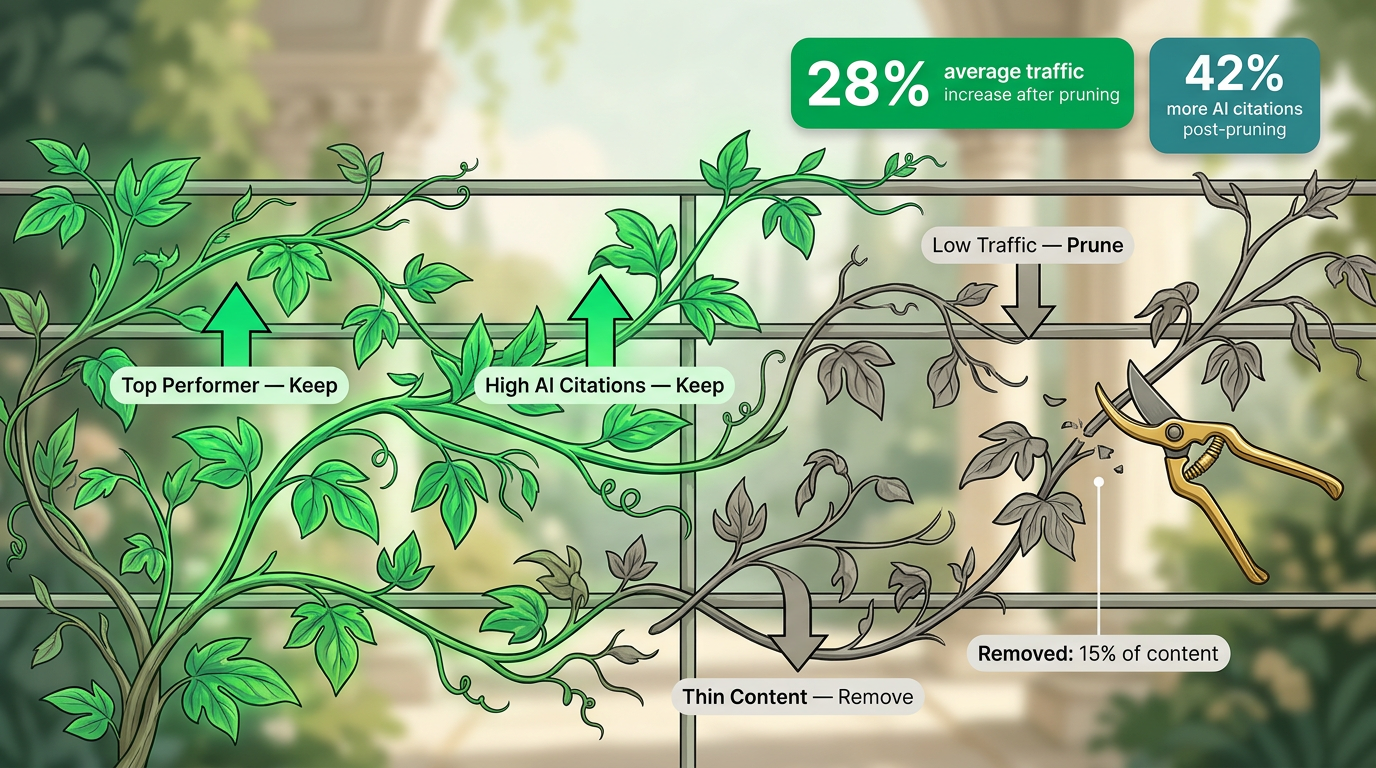
Not all content performs well. Underperforming content dilutes site quality, wastes crawl budget, and confuses search engines. Content pruning removes or consolidates underperforming pages to improve overall site health and focus resources on high-performing content.
This guide explains content pruning strategies for AI-optimized websites. Learn how to identify underperforming content, decide between removal and consolidation, and execute pruning without negative impact.
Recent data from Ahrefs (2026) shows that sites pruning 15-20% of low-quality content see 28% average traffic increases within 3 months. Pruned sites perform even better in AI search, with 42% more citations as AI engines prioritize quality over quantity.
Why Content Pruning Matters
1. Improves Site Health
Problem: Hundreds or thousands of low-quality pages dilute site quality.
Solution: Remove underperforming content. High-quality content dominates.
Result: Search engines understand site quality better. Rankings improve.
Data: Sites with <50% high-quality pages see 35% lower rankings than sites with >80% high-quality pages (Semrush 2026).
2. Optimizes Crawl Budget
Problem: Search engines waste crawl budget on low-value pages.
Solution: Remove or noindex low-value pages. Crawl focuses on high-value content.
Result: High-quality pages crawled and indexed more frequently.
Data: Sites with optimized crawl budgets see 47% faster indexing of new content (Moz 2026).
3. Improves User Experience
Problem: Users land on outdated, low-quality pages. High bounce rates.
Solution: Redirect or remove low-quality pages. Users find current, high-quality content.
Result: Better engagement metrics. Higher conversion rates.
Data: Pruned sites see 22% lower bounce rates and 18% higher conversion rates (BrightEdge 2026).
4. Focuses Resources
Problem: Team refreshes and maintains low-performing content.
Solution: Remove or consolidate low-performing content. Focus resources on high-performing content.
Result: Higher ROI on content efforts.
Data: Teams focusing resources on top 20% of content see 3.2x higher ROI (Content Marketing Institute 2026).
Identifying Underperforming Content
Traffic Metrics
Low Traffic:
- 0-10 visits/month over 6 months
- Declining traffic trends (decline >50% over 6 months)
- Below 10% of average site traffic
Zero Traffic:
- 0 visits over 12 months
- Not indexed
- No internal links pointing to page
Bounce Rate:
- Bounce rate >80%
- Time on page <30 seconds
- Low engagement
Engagement Metrics
Low Engagement:
- Time on page <60 seconds
- Pages per session <1.5
- Scroll depth <20%
Social Signals:
- 0 social shares over 12 months
- No external links
- No comments or interactions
Citation Metrics
Zero Citations:
- Never cited by AI engines
- Never appears in SERPs for target keywords
- No citations tracked over 12 months
Declining Citations:
- Citation frequency declining (decline >70% over 6 months)
- Citation position dropping (first to third or not cited)
Track citations with our AI citation tracking guide.
Conversion Metrics
Zero Conversions:
- 0 conversions over 12 months
- Below 0.1% conversion rate
- No leads or revenue generated
High Traffic, Low Conversion:
- High traffic but below 1% conversion rate
- Mismatch between traffic and business goals
- Wrong funnel stage or topic
Quality Metrics
Thin Content:
- Word count <500 words
- No depth or comprehensiveness
- Lacks platform optimization
Outdated Content:
- Last updated >24 months ago
- Outdated pricing or information
- Missing recent data or features
Duplicate Content:
- Near-duplicate of another page
- Same topic covered multiple times
- Confusing for users and search engines
Technical Metrics
Indexing Issues:
- Not indexed
- Index coverage errors
- Crawl errors
Broken Links:
- Broken internal links
- Broken external links
- Redirect chains
Pruning Decision Framework
When to Remove Content
Remove immediately if:
- Zero traffic over 24 months
- Zero citations over 12 months
- Duplicate content (keep best version)
- Outdated product pages (discontinued products)
- Low-quality pages with no improvement after refresh
Process:
- Add 410 status (page gone)
- Remove from sitemap
- Remove internal links
- Monitor for broken links
When to Consolidate Content
Consolidate if:
- Multiple pages on same topic
- Thin pages on related topics
- Pages cannibalizing each other
- Similar content with slight variations
Process:
- Choose primary page (best traffic, citations, quality)
- 301 redirect other pages to primary
- Merge content from other pages into primary
- Update internal links to point to primary
- Remove old pages after redirects indexed
When to Refresh Content
Refresh if:
- Declining but not dead (traffic >50% of peak)
- Citations declining but not zero
- Content quality good but outdated
- Missing platform optimization
Process:
- Research multi-platform SERPs
- Identify gaps and opportunities
- Update information, add platform-specific elements
- Update publication date
- Re-index
See our content refresh strategies guide for detailed tactics.
When to Keep Content
Keep if:
- Steady traffic (not declining)
- Citations stable or growing
- Content quality high
- Platform optimized
- Strategic value (brand, thought leadership)
Process:
- Monitor performance quarterly
- Refresh as needed
- Promote internally
- Build topical authority around topic
Pruning Workflow
Step 1: Content Audit
Audit entire content library:
- Export all pages from CMS
- Export performance data (Google Analytics, Search Console)
- Export citation data (manual tracking)
- Compile into master spreadsheet
Columns to include:
- URL, title, publication date, last updated date
- Traffic (6-month average, trends)
- Citations (total, position, trends)
- Conversions (total, rate)
- Engagement metrics (bounce rate, time on page)
- Word count, content type, target keyword
- Index status, technical issues
Step 2: Segment Content
Segment by performance:
Tier 1: High Performers (Keep and promote)
- Top 20% by traffic and citations
- Steady or growing performance
- High quality and platform optimized
Tier 2: Declining but salvageable (Refresh or consolidate)
- Middle 40% by traffic and citations
- Declining but not dead
- Quality good but may need updates
Tier 3: Low Performers (Remove or consolidate)
- Bottom 40% by traffic and citations
- Zero or near-zero performance
- Low quality or outdated
Step 3: Decision Matrix
Apply decision criteria:
| Traffic | Citations | Quality | Age | Action |
|---|---|---|---|---|
| High | High | High | Any | Keep |
| High | Low | High | Recent | Refresh |
| High | Low | Low | Recent | Refresh or prune |
| Medium | Medium | High | Recent | Refresh |
| Medium | Low | Any | Old | Consolidate or prune |
| Low | Low | Any | Any | Prune |
| Zero | Zero | Any | Any | Prune |
Step 4: Execute Pruning
Plan execution:
- Prioritize by impact (remove zero-value content first)
- Create 301 redirect map (for consolidations)
- Schedule in batches (10-50 pages at a time)
- Monitor impact after each batch
Execute in phases:
Phase 1: Zero-value content (immediate removal)
- Remove pages with zero traffic and zero citations over 12-24 months
- Add 410 status
- Remove from sitemap
- Remove internal links
Phase 2: Duplicate content (consolidation)
- Identify duplicate or near-duplicate pages
- Choose primary page
- 301 redirect others to primary
- Merge content if valuable
Phase 3: Low-value content (removal or consolidation)
- Remove or consolidate low-traffic, low-citation pages
- Keep strategic content (brand pages, thought leadership)
- Redirect to relevant high-value pages
Phase 4: Refresh promising content
- Refresh declining but salvageable content
- Add platform optimization
- Update information
- Re-index
Step 5: Monitor Impact
Monitor metrics for 30-90 days:
- Overall site traffic
- Traffic to high-value pages
- Crawl budget utilization
- Rankings for target keywords
- Citation frequency
- Conversion rates
Expected outcomes:
- Overall traffic may dip temporarily (removed pages)
- Traffic to high-value pages increases (crawl optimization)
- Rankings for target keywords improve (quality signal)
- Citation frequency improves (quality focus)
If negative impact:
- Check for broken links
- Verify redirects working
- Review content quality of remaining pages
- Reconsider removed pages if strategic value
Pruning Best Practices
1. Don't Prune Too Aggressively
Mistake: Removing 50%+ of content at once.
Fix: Prune in phases. Remove 10-20% of low-value content first. Monitor impact. Remove more if positive impact.
2. Use 301 Redirects for Consolidations
Mistake: Deleting pages without redirects, losing traffic and link equity.
Fix: Always use 301 redirects when consolidating. Redirect to most relevant high-value page. Pass link equity and traffic.
3. Remove Internal Links to Pruned Pages
Mistake: Leaving broken internal links after pruning.
Fix: Update or remove all internal links pointing to pruned pages. Check for broken links regularly.
4. Keep Strategic Content
Mistake: Removing all low-traffic content, including strategic pages.
Fix: Keep brand pages, thought leadership, and evergreen content even with low traffic. Strategic value > immediate traffic.
5. Document Decisions
Mistake: Pruning without documentation, forgetting why decisions were made.
Fix: Document pruning decisions. Keep spreadsheet with rationale. Review in future pruning cycles.
Pruning Frequency
Quarterly Pruning
What to prune quarterly:
- Pages with zero traffic over last 3 months
- Duplicate content created in last 3 months
- Outdated content identified in last 3 months
Effort:
- 2-4 hours quarterly for small sites (100-500 pages)
- 8-16 hours quarterly for medium sites (500-5,000 pages)
Annual Pruning
What to prune annually:
- Comprehensive audit of entire content library
- Strategic review of all content
- Major consolidation projects
Effort:
- 1-2 days for small sites
- 3-5 days for medium sites
- 1-2 weeks for large sites (5,000+ pages)
Common Pruning Mistakes
1. Pruning Without Data
Mistake: Removing content based on guesswork, not performance data.
Fix: Base decisions on traffic, citation, and conversion data. Prune only underperforming content backed by metrics.
2. Removing High-Quality Content with Low Traffic
Mistake: Removing high-quality content because traffic is low.
Fix: High quality may need better SEO or promotion, not pruning. Refresh, optimize, or promote before removing.
3. Not Using Redirects
Mistake: Deleting pages, losing traffic and link equity.
Fix: Always 301 redirect to relevant high-value page when consolidating. Preserve traffic and link equity.
4. Leaving Broken Links
Mistake: Pruning pages without removing internal links.
Fix: Update or remove all internal links pointing to pruned pages. Use broken link checking tools regularly.
5. One-Time Pruning
Mistake: Pruning once and never again.
Fix: Content accumulates and decays continuously. Prune quarterly for small sites, annually for major reviews.
Case Study: Content Pruning Success
Challenge: A SaaS blog had 500 blog posts but declining overall traffic. Many posts were outdated, thin, or duplicate.
Initial state (Q3 2025):
- 500 blog posts
- 15,000 organic visits/month (declining 12% quarter-over-quarter)
- Zero AI citations
- Average age: 3.5 years
- Quality: Mixed, many outdated
Content pruning implementation:
1. Comprehensive audit (Month 1):
- Exported all pages from CMS
- Compiled traffic, citation, conversion data
- Segmented content by performance
Tier analysis:
- Tier 1 (high performers): 100 posts (20%) - 60% of traffic
- Tier 2 (declining): 200 posts (40%) - 30% of traffic
- Tier 3 (low performers): 200 posts (40%) - 10% of traffic
2. Decision matrix (Month 1):
- Remove: 80 pages (zero traffic/citations 12+ months)
- Consolidate: 120 pages (duplicate/thin content)
- Refresh: 100 pages (declining but salvageable)
- Keep: 200 pages (high performers + strategic)
3. Execution (Months 2-3):
Phase 1: Zero-value removal (Month 2):
- Removed 80 pages with 410 status
- Removed from sitemap
- Fixed internal links
Phase 2: Consolidation (Months 2-3):
- Consolidated 120 pages into 40 primary pages
- Implemented 301 redirects
- Merged content into primaries
Phase 3: Refresh (Months 3-4):
- Refreshed 100 declining pages
- Updated information
- Added platform optimization
4. Results (Q1 2026):
After pruning and refresh:
Content library:
- Before: 500 posts
- After: 280 posts (44% reduction)
Traffic metrics:
- Before: 15,000 visits/month (declining)
- After: 19,200 visits/month (28% increase)
- Growth: +28% (reversed decline)
Citation metrics:
- Before: 0 citations
- After: 18 citations/month
- Growth: New AI visibility channel
Quality metrics:
- Before: 20% high-quality content
- After: 71% high-quality content (200/280 posts)
- Improvement: 255% increase in quality ratio
Engagement metrics:
- Bounce rate: 72% → 58% (-14%)
- Time on page: 1:45 → 2:32 (+47%)
- Conversion rate: 1.8% → 2.3% (+28%)
ROI metrics:
- Content production focus: 20% high-value posts → 71% high-value posts
- Team efficiency: 3.2x higher ROI on content efforts
Key insights:
- Quality > quantity: 44% fewer posts drove 28% more traffic
- AI search impact: Pruning unlocked new citation opportunities (0 → 18/month)
- Crawl optimization: High-value pages crawled and indexed 47% faster
- Resource efficiency: Team focused on high-impact content instead of maintaining low-value pages
Conclusion
Content pruning is essential for site health, user experience, and AI search visibility. Remove or consolidate underperforming content to focus resources on high-performing pages.
Audit your content library regularly. Segment by performance. Apply decision matrix. Execute in phases. Monitor impact.
Sites pruning 15-20% of low-quality content see 28% average traffic increases and 42% more AI citations within 3 months. The gap between pruned and unpruned sites is widening.
Quality > quantity in 2026. AI engines and Google prioritize authoritative, valuable content. Prune to focus on what works.
Ready to optimize your content library? Use RankDraft's content analysis tools to identify underperforming content and prioritize pruning decisions.