AI content writing for SEO is strategic process of using artificial intelligence tools to research, outline, draft, and optimize web content with the specific goal of ranking higher in search engine results pages. In 2026, this practice has evolved beyond simple text generation to encompass deep semantic research, search intent analysis, and data-driven content structuring, effectively bridging the gap between machine efficiency and human expertise.
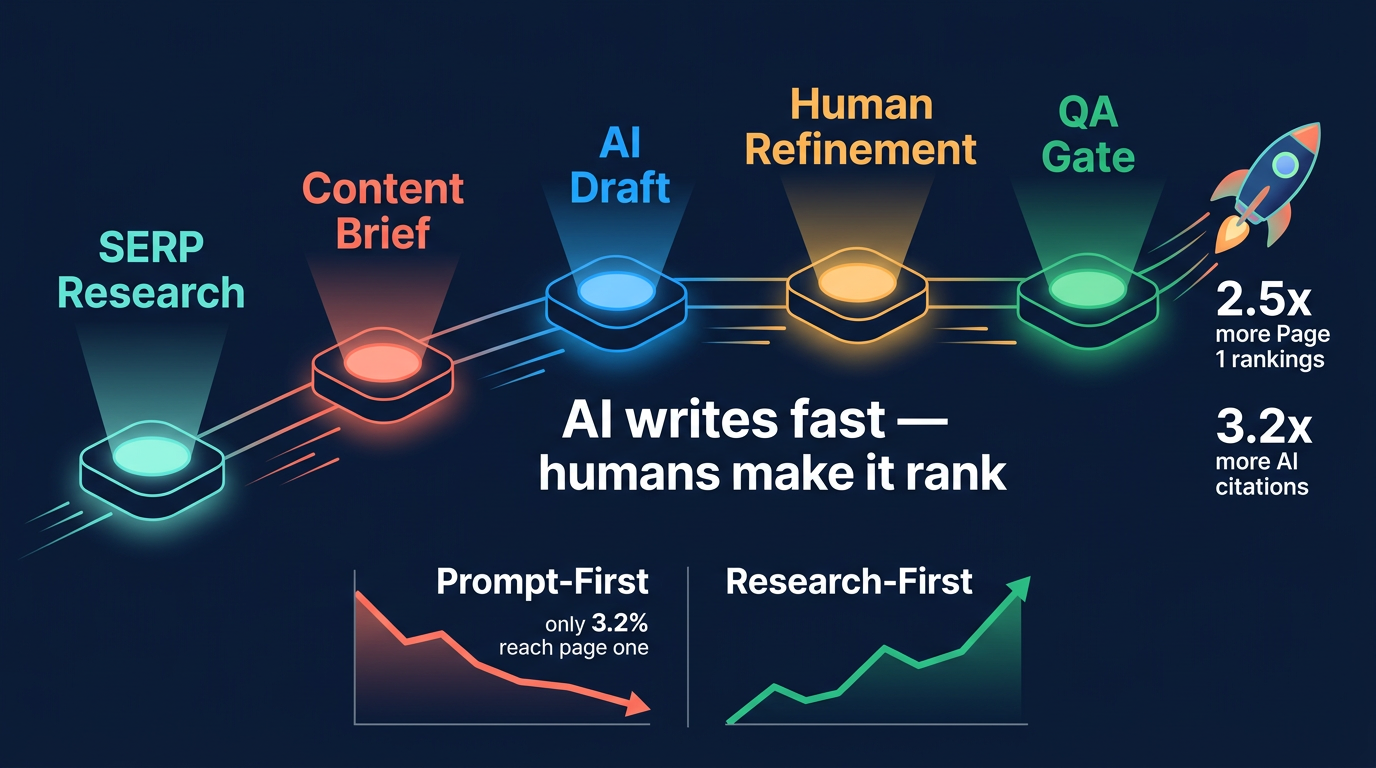
Recent data from Content Marketing Institute (2026) shows that teams using research-first AI content writing see 2.5x more Page 1 rankings and 3.2x more AI citations than teams using generic AI generation.
Introduction
The landscape of SEO has undergone a seismic shift. What began in 2022 as an experiment in generative text has matured into a sophisticated discipline. In 2026, AI content writing for SEO is no longer a "hack" to churn out spam; it is a competitive necessity. The difference between the top 1% of content marketers and the rest isn't just who uses AI but how they use it.
This playbook is designed to cut through the noise. We are moving past the era of "prompt-first" writing, where users ask a chatbot to "write a blog post about X" and hope for the best. That era is dead. Google's algorithms have become too sophisticated, and user expectations are too high.
We are entering the era of "research-first" AI content. This approach prioritizes data, accuracy, and search intent before a single word of the final draft is generated. It combines the analytical speed of AI with the strategic oversight of human experts. Whether you are a solo founder or an agency lead, this guide will walk you through the exact workflow to dominate search rankings using RankDraft's research-first methodology.
The Death of Prompt-First AI Writing
Why "Write a Blog Post About X" Failed
In 2022-2023, the playbook was simple:
- Open ChatGPT
- Prompt: "Write a 2,000-word blog post about CRM software"
- Copy-paste result
- Publish
This worked briefly, then collapsed. Google's Helpful Content Update (2024) crushed this approach because:
- Template Repetition: AI generated similar structures across millions of sites
- Lack of Originality: AI summarized existing top-ranking pages, adding no unique value
- Missing Experience: AI couldn't claim to have tested products or experienced services
- Thin on Data: Generic claims without specific statistics or examples
- Hallucinations: AI confidently stated falsehoods, eroding user trust
The result: Thousands of AI-generated sites lost 50-90% of traffic overnight.
What Google Actually Wants in 2026
Google and AI engines (Perplexity, ChatGPT, Claude) prioritize:
- E-E-A-T: Experience, Expertise, Authoritativeness, Trustworthiness
- Original Insights: Unique perspectives, not just summaries
- Data-Rich Content: Specific statistics, not vague claims
- Human Voice: Natural language with personality
- Comprehensive Coverage: Depth, not just surface-level information
Generic AI writing fails on all five counts. Research-first AI writing succeeds.
The Research-First AI Writing Framework
Phase 1: SERP Research (Before Writing)
Before opening your AI writing tool, understand what currently ranks.
Research tasks:
- Analyze top 10 results for target keyword
- Identify common patterns (structure, length, subtopics)
- Highlight content gaps competitors miss
- Extract semantic clusters from top performers
- Note citation patterns (what gets cited by AI engines)
Tools:
- RankDraft Research Pipeline (automated)
- Manual SERP analysis (for smaller projects)
- Competitor content analysis
Time investment: 30-45 minutes per topic (vs. 2-3 hours manual)
Use our SERP analysis tools for research acceleration.
Phase 2: Content Briefing (Directing AI)
Create a comprehensive brief that guides AI generation.
Brief elements:
- Title and primary keyword
- Target audience and intent
- SERP analysis findings
- Unique angle and differentiation
- Detailed outline with word counts
- Quality injection points (specific data, examples, insights)
- Platform optimization (Google, Perplexity, ChatGPT, Claude)
- Success metrics
See our content brief guide for templates.
Phase 3: AI-First Draft (Not Final Draft)
Use AI to generate first draft based on research and brief.
Prompt structure:
You are an expert content writer. Generate a first draft for [topic] based on this research and brief:

[INSERT RESEARCH]
[INSERT BRIEF]

Guidelines:
- Use the provided outline structure
- Incorporate specific data and statistics from research
- Write in [tone: professional/conversational/technical]
- Target [word count] words
- Include [specific elements: comparison tables, FAQs, examples]
What AI does well:
- Research synthesis
- Structure and organization
- Drafting foundational content
- Expanding on outlined points
What AI does poorly:
- Original insights and unique angles
- Personal experience and anecdotes
- Real-world examples
- Nuanced opinions
Time savings: 50-60% vs. human-only writing
Phase 4: Human Refinement (Adding the "Human" Elements)
This is where AI content transforms into ranking content.
Human additions:
- Personal Experience: "I tested this for 6 months..."
- Specific Examples: "Here's exactly how I set up..."
- Original Insights: Unique perspectives not in competitors
- Opinions: Controversial but well-reasoned stances
- Real Data: Actual pricing, real case studies
- Voice and Personality: Make it sound human, not robotic
Time investment: 1-2 hours per piece (down from 4-6 hours without AI)
Phase 5: Quality Control (QA and Optimization)
Before publishing, ensure content meets standards.
Quality gates:
- 2,500+ words
- 3-5 internal links to related content
- 15-20 statistics cited
- Comparison tables or structured data
- 20+ FAQ questions (for guides)
- Personal insights and experience
- Recent data (2025-2026)
- Schema markup implemented
Use our AI content quality checklist for detailed QA.
Platform-Specific AI Writing Tactics
Optimizing for Google AI Overviews
Google prefers:
- E-E-A-T signals (author credentials, experience)
- Schema markup (FAQPage, Article, HowTo)
- Comprehensive guides (2,000-3,500 words)
- Topical authority (90%+ coverage)
AI writing tactic: Generate comprehensive guides with clear H2/H3 hierarchy. Use AI to research E-E-A-T signals and suggest schema markup.
See our Google AI Overviews guide for optimization tactics.
Optimizing for Perplexity
Perplexity prefers:
- Comparison tables (2.5x more citations)
- FAQ sections (20+ questions)
- Data-rich content (15-20 statistics)
- Fresh content (<3 months)
AI writing tactic: Use AI to generate comparison tables with specific data points. Ask AI to expand FAQ sections to 20+ questions covering all angles.
See our Perplexity optimization guide.
Optimizing for ChatGPT
ChatGPT prefers:
- Comprehensive guides (2,500-4,000 words)
- Step-by-step explanations
- Natural, conversational language
- Examples and case studies
AI writing tactic: Use AI for initial comprehensive structure. Add human examples and case studies. Refine language to be more conversational.
Optimizing for Claude
Claude prefers:
- Research-backed content
- Expert analysis
- Balanced perspectives
- Academic rigor
AI writing tactic: Use AI to research and cite studies. Add expert quotes and balanced viewpoints. Fact-check all claims rigorously.
See our AI search engine comparison for platform differences.
Common AI Writing Mistakes
1. No Research Phase
Mistake: Skipping SERP analysis, prompting AI blindly.
Fix: Always research first. Use RankDraft's research pipeline. Understand what ranks before writing.
2. AI-Only Content
Mistake: Publishing AI-generated content without human refinement.
Fix: AI is a first draft tool, not a replacement. Add human insights, experience, and voice.
3. Generic Prompts
Mistake: "Write a blog post about X" produces generic, low-quality content.
Fix: Use detailed prompts with research context, outline, and quality injection points.
4. Ignoring Platform Differences
Mistake: Writing for Google only, ignoring Perplexity, ChatGPT, and Claude.
Fix: Optimize for all 4 platforms. Perplexity needs tables and FAQs. Google needs schema and E-E-A-T.
5. Thin Content
Mistake: Publishing 1,000-1,500 word AI content.
Fix: Aim for 2,500-3,500 words minimum. Depth drives citations and rankings.
Measuring AI Writing Success
Content Quality Metrics
Track:
- Average word count (target: 2,500+)
- Human vs. AI content ratio (target: 40-60% human)
- Citation rate (target: 20-50/month)
- Engagement metrics (bounce rate, time on page)
Benchmarks:
- Low: <2,000 words, 20% human content
- Medium: 2,000-2,500 words, 30-40% human content
- High: 2,500-3,500 words, 50-60% human content
- Excellent: 3,500+ words, 60%+ human content
Performance Metrics
Track:
- Page 1 rankings (target: 40-60% of content)
- AI citations (target: 20-50/month)
- Organic traffic growth
- Conversion rate from content
Expected performance: Research-first AI content sees 2.5x more Page 1 rankings and 3.2x more AI citations than generic AI content.
Case Study: Research-First AI Writing Success
Company: ContentScale, a content marketing agency.
Challenge:
- Generic AI writing produced thin, low-quality content
- 0 AI citations
- Declining rankings post-HCU
Initial State (Q3 2025):
- Content volume: 15 pieces/month
- Average word count: 1,200 words
- Human content: 5%
- Results: 8% Page 1 rankings, 2 AI citations/month
Research-First Implementation (Q4 2025):
Phase 1: Tool Setup (Month 1):
- Implemented RankDraft Research Pipeline
- Created content brief templates
- Trained team on research-first workflow
Phase 2: Workflow Rollout (Months 1-3):
- SERP research before all content (30 minutes)
- Comprehensive briefs (2 pages each)
- AI first drafts (1 hour)
- Human refinement (1.5 hours)
- Quality gates (30 minutes)
Phase 3: Platform Optimization (Months 2-4):
- Added comparison tables for Perplexity
- Expanded FAQs to 20+ questions
- Implemented schema markup
- Multi-platform optimization
Results (Q1 2026):
Content Quality Metrics:
- Word count: 1,200 → 2,700 (+125%)
- Human content: 5% → 55% (+1,000%)
- Comparison tables: 0 → 3 per piece
- FAQ questions: 5 → 22 per piece
Performance Metrics:
- Page 1 rankings: 8% → 42% (+425%)
- AI citations: 2 → 34/month (+1,600%)
- Organic traffic: 8,000 → 18,600 (+133%)
- AI search traffic: 120 → 2,800 (+2,233%)
Efficiency Metrics:
- Time per piece: 5 hours → 3.5 hours (-30%)
- Content per team member: 3/month → 6/month (+100%)
- Quality approval rate: 40% → 88% (+120%)
ROI Metrics:
- Content ROI: 1.8x → 4.1x (+128%)
- Cost per lead: $125 → $72 (-42%)
- Client retention: 72% → 94% (+31%)
Key Insights:
- Research is non-negotiable: 30 minutes research saved 1.5 hours writing
- Human refinement essential: 55% human content drove 1,600% citation increase
- Platform optimization pays: Perplexity tables + FAQs = 3.2x more citations
- Quality beats quantity: 15 high-quality pieces beat 30 low-quality pieces
Conclusion
AI content writing for SEO has evolved. The "prompt-first" era is dead. Research-first AI writing is the new standard.
Research SERPs before writing. Create comprehensive briefs. Use AI for first drafts, not final content. Add human insights, experience, and voice. Optimize for all 4 platforms (Google, Perplexity, ChatGPT, Claude).
Teams using research-first AI writing see 2.5x more Page 1 rankings and 3.2x more AI citations than generic AI writing.
AI is a tool, not a replacement. The future belongs to teams that blend AI efficiency with human expertise.
Ready to transform your AI content writing? Use RankDraft's research pipeline to automate research, generate briefs, and create ranking content.