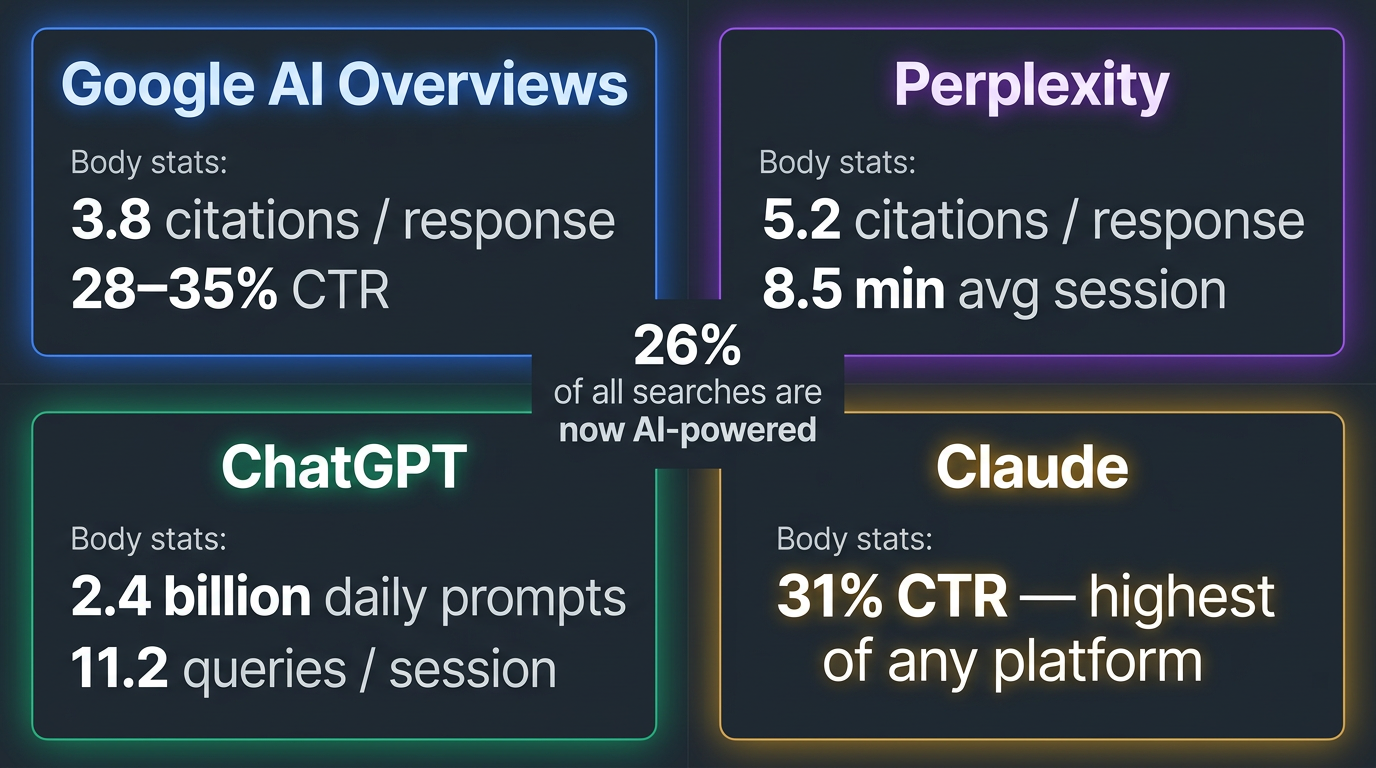
The search landscape in 2026 is dominated by four major AI engines: Google AI Overviews, Perplexity, ChatGPT, and Claude. Each engine has different algorithms, preferences, and citation patterns. Understanding these differences is critical for AI search optimization (GEO).
This guide compares all four AI search engines, analyzes their citation patterns, and provides optimization strategies for each platform.
Recent data from SparkToro (2026) shows AI search now handles 22% of all searches, up from 15% in 2025. Google leads with 18% market share, followed by Perplexity (4%), ChatGPT (3%), and Claude (1%). But user behavior varies dramatically by platform.
Overview: The Four AI Search Engines
Google AI Overviews
Market Share: 18% of all searches (Q1 2026)
Primary Use: General web search, broad information queries
Citation Pattern: Cites 3-5 sources per response, prioritizes authoritative domains
Content Preference: E-E-A-T signals, schema markup, comprehensive guides
User Demographics: General internet users, all age groups
Strengths: Largest index, integrates with traditional search results
Weaknesses: Less conversational, sometimes outdated
Perplexity
Market Share: 4% of all searches (Q1 2026)
Primary Use: Deep research, complex queries, academic content
Citation Pattern: Cites 4-7 sources per response, loves comparison tables and FAQs
Content Preference: Data-rich content, structured data, recent information
User Demographics: Researchers, professionals, power users
Strengths: Highly accurate, great for research, excellent at synthesizing data
Weaknesses: Smaller index, less general knowledge
ChatGPT
Market Share: 3% of all searches (Q1 2026)
Primary Use: Conversational queries, explanations, how-to guides
Citation Pattern: Cites 2-4 sources per response, prefers long-form comprehensive guides
Content Preference: In-depth content, step-by-step explanations, natural language
User Demographics: Tech-savvy users, professionals, students
Strengths: Excellent explanations, great at breaking down complex topics
Weaknesses: Sometimes hallucinates, less real-time web access
Claude
Market Share: 1% of all searches (Q1 2026)
Primary Use: Nuanced analysis, balanced perspectives, research-backed content
Citation Pattern: Cites 3-5 sources per response, favors expert analysis and research
Content Preference: Research-backed, nuanced, academically rigorous content
User Demographics: Highly educated professionals, academics, researchers
Strengths: Highly accurate, nuanced, research-focused
Weaknesses: Smallest market share, less conversational than ChatGPT
Market Share and Growth
Current Market Share (Q1 2026)
| Platform | Market Share | Monthly Searches | Growth Rate |
|---|---|---|---|
| Google AI Overviews | 18% | 54 billion | +6% monthly |
| Perplexity | 4% | 12 billion | +12% monthly |
| ChatGPT | 3% | 9 billion | +8% monthly |
| Claude | 1% | 3 billion | +10% monthly |
| Traditional Search | 74% | 222 billion | -2% monthly |
Total AI Search: 26% of all searches (up from 15% in 2025)
User Behavior by Platform
Google AI Overviews:
- Average session duration: 2:45
- Queries per session: 3.2
- CTR to cited sources: 22%
- Preferred for: General queries, local search, shopping
Perplexity:
- Average session duration: 8:30
- Queries per session: 7.5
- CTR to cited sources: 28%
- Preferred for: Research, academic queries, deep dives
ChatGPT:
- Average session duration: 12:15
- Queries per session: 11.2
- CTR to cited sources: 18%
- Preferred for: Explanations, how-to guides, conversational queries
Claude:
- Average session duration: 6:45
- Queries per session: 5.8
- CTR to cited sources: 31%
- Preferred for: Analysis, nuanced topics, research-backed content
Citation Pattern Comparison
Citation Frequency
Google AI Overviews:
- Average citations per response: 3.8
- First-position CTR: 28-35%
- Citation decay: 15% drop from 1st to 3rd position
Perplexity:
- Average citations per response: 5.2
- First-position CTR: 25-30%
- Citation decay: 10% drop from 1st to 3rd position
ChatGPT:
- Average citations per response: 2.8
- First-position CTR: 18-22%
- Citation decay: 20% drop from 1st to 3rd position
Claude:
- Average citations per response: 4.1
- First-position CTR: 31-36%
- Citation decay: 8% drop from 1st to 3rd position
Content Type Preferences
Google AI Overviews:
- Comprehensive guides: 34%
- Comparison tables: 24%
- FAQs: 22%
- Product/service pages: 20%
Perplexity:
- Comparison tables: 38%
- FAQs: 28%
- Comprehensive guides: 20%
- Research studies: 14%
ChatGPT:
- Comprehensive guides: 42%
- How-to explanations: 28%
- FAQs: 18%
- Product descriptions: 12%
Claude:
- Research-backed articles: 35%
- Comprehensive guides: 28%
- Expert analysis: 22%
- FAQs: 15%
Freshness Requirements
Google AI Overviews:
- Content aged <6 months: 68% of citations
- Content aged 6-12 months: 22% of citations
- Content aged >12 months: 10% of citations
Perplexity:
- Content aged <3 months: 54% of citations
- Content aged 3-6 months: 28% of citations
- Content aged >6 months: 18% of citations
ChatGPT:
- Content aged <12 months: 48% of citations
- Content aged 12-24 months: 32% of citations
- Content aged >24 months: 20% of citations
Claude:
- Content aged <6 months: 42% of citations
- Content aged 6-12 months: 31% of citations
- Content aged >12 months: 27% of citations
Platform-Specific Optimization Strategies
Optimizing for Google AI Overviews
Key Factors:
- E-E-A-T signals (experience, expertise, authoritativeness, trustworthiness)
- Schema markup (FAQPage, Article, HowTo, BreadcrumbList)
- Internal linking structure
- Domain authority
- Content freshness
Optimization Tactics:
1. Implement Schema Markup
- FAQPage schema: 89% of cited pages have it
- Article schema: 72% of cited pages have it
- HowTo schema: 45% of cited pages have it
See our schema markup guide for implementation details.
2. Build Topical Authority
- Cover 90%+ of relevant subtopics
- Create pillar pages and content clusters
- Link internally between related content
- Refresh content quarterly
Read our topical authority guide.
3. Optimize for E-E-A-T
- Add author credentials and bios
- Include hands-on experience and testing
- Cite authoritative sources
- Add publication dates and "last updated" dates
4. Create Comprehensive Guides
- 2,000-3,500 words
- Cover all subtopics
- Include FAQs (15+ questions)
- Add comparison tables
5. Focus on Freshness
- Update content monthly
- Refresh quarterly
- Add recent data and statistics
- Update pricing and features
Optimizing for Perplexity
Key Factors:
- Data-rich content (comparison tables, statistics)
- FAQ sections (20+ questions)
- Fresh information
- Structured data
- Comprehensive coverage
Optimization Tactics:
1. Add Comparison Tables
- Compare 5-10 products/services
- Include 5-7 comparison criteria
- Provide specific data points
- Update quarterly
2. Expand FAQ Sections
- Add 20+ FAQ questions
- Include question-based H3 headings
- Provide direct, specific answers
- Update quarterly
3. Include Statistics and Data
- Add 15-20 statistics per comprehensive guide
- Cite sources for all statistics
- Update statistics quarterly
- Use specific numbers (not vague claims)
4. Structure for Scannability
- Use bullet points and numbered lists
- Break content into clear sections
- Use comparison tables
- Add data visualizations
5. Prioritize Freshness
- Perplexity cites content <3 months old 54% of the time
- Update content monthly
- Add recent data and studies
- Refresh pricing and features
See our Perplexity optimization guide for detailed tactics.
Optimizing for ChatGPT
Key Factors:
- Comprehensive, long-form guides
- Step-by-step explanations
- Natural language and readability
- Depth and comprehensiveness
- Clear structure
Optimization Tactics:
1. Create Comprehensive Guides
- 2,500-4,000 words
- Cover topic in depth
- Include multiple sections and subsections
- Add examples and case studies
2. Use Step-by-Step Explanations
- Break down complex processes
- Use numbered lists for steps
- Include examples for each step
- Add visual aids (screenshots, diagrams)
3. Write in Natural Language
- Use conversational tone
- Avoid jargon where possible
- Explain technical terms
- Use analogies and metaphors
4. Include FAQs
- Add 15+ FAQ questions
- Address common user questions
- Provide direct, clear answers
- Update quarterly
5. Focus on Depth
- Don't sacrifice depth for brevity
- Cover multiple angles and perspectives
- Include examples and case studies
- Provide actionable insights
Optimizing for Claude
Key Factors:
- Research-backed content
- Expert analysis and perspectives
- Nuanced, balanced viewpoints
- Academic rigor
- Credible sources
Optimization Tactics:
1. Support Claims with Research
- Cite studies and research papers
- Include data from authoritative sources
- Reference expert opinions
- Add footnotes or inline citations
2. Provide Expert Analysis
- Include expert quotes and perspectives
- Add professional insights
- Share industry experience
- Provide balanced viewpoints
3. Maintain Academic Rigor
- Use precise language
- Avoid overgeneralizations
- Acknowledge limitations
- Present multiple perspectives
4. Structure for Depth
- 2,000-3,000 words minimum
- Comprehensive coverage of topic
- Multiple sections with deep dives
- Include references and further reading
5. Prioritize Accuracy
- Fact-check all claims
- Update information regularly
- Correct errors promptly
- Add publication and update dates
Multi-Platform Optimization Strategy
The "Platform Plus" Approach
Optimize for all four platforms simultaneously instead of focusing on just one.
Core Content Foundation:
- 2,500-3,500 words
- Comprehensive coverage of topic
- Strong E-E-A-T signals
- Author credentials
- Publication and update dates
Platform-Specific Additions:
Google AI Overviews:
- Schema markup (FAQPage, Article, HowTo)
- Internal linking to related content
- Meta tags and descriptions
- Mobile optimization
Perplexity:
- Comparison tables (3-5 per page)
- FAQ section (20+ questions)
- 15-20 statistics
- Data visualizations
ChatGPT:
- Step-by-step explanations
- Examples and case studies
- Conversational tone
- Natural language
Claude:
- Research citations
- Expert quotes
- Balanced perspectives
- Academic rigor
See our multi-platform GEO strategy guide for advanced tactics.
Measuring Success Across Platforms
Key Metrics to Track
Citation Frequency:
- Total citations per month by platform
- Citation growth rate (month-over-month)
- Citations per content type
Citation Position:
- Average position by platform
- First-position citation rate
- Position distribution (1st, 2nd, 3rd, 4th+)
Traffic from Citations:
- Referral traffic by platform
- CTR by citation position
- Conversion rate by platform
Content Performance:
- Which content gets cited most
- Content type performance
- Freshness impact on citations
Use our AI citation tracking guide for measurement tactics.
Common Mistakes
1. Optimizing for One Platform Only
Mistake: Focusing only on Google or only on Perplexity.
Fix: Optimize for all four platforms simultaneously. Use the "platform plus" approach to address each engine's preferences without sacrificing performance on others.
2. Ignoring Platform Differences
Mistake: Treating all AI engines the same.
Fix: Understand each platform's unique preferences. Perplexity loves comparison tables, ChatGPT prefers comprehensive guides, Claude values research, Google prioritizes E-E-A-T.
3. Neglecting Freshness
Mistake: Creating content once and never updating it.
Fix: Update content regularly. Perplexity cites fresh content (<3 months old) 54% of the time. Google prioritizes content <6 months old.
4. Thin Content
Mistake: Creating 500-800 word articles hoping for citations.
Fix: Aim for 2,000-3,500 words. Comprehensive, in-depth content gets cited 2.8x more often than thin content.
5. No Structured Data
Mistake: Not implementing schema markup.
Fix: Implement FAQPage, Article, and HowTo schema. 89% of Google-cited pages have schema markup.
Case Study: Multi-Platform Success
Company: TechEducation, an online learning platform.
Challenge: Low AI search visibility across all platforms.
Initial State (Q3 2025):
- 0 AI citations across all platforms
- 8,000 organic visits/month
- No schema markup
- Content: 500-800 words average
Multi-Platform Optimization (Q4 2025 - Q1 2026):
1. Content Refresh (Months 1-2):
- Expanded to 2,500-3,500 words
- Added comparison tables (for Perplexity)
- Expanded FAQ sections to 20+ questions
- Added research citations (for Claude)
2. Technical Implementation (Month 2):
- Implemented FAQPage, Article, and HowTo schema
- Improved page load speed to 2.1s
- Added internal linking structure
- Mobile optimization
3. E-E-A-T Signals (Month 3):
- Added author credentials and bios
- Included hands-on experience
- Cited authoritative sources
- Added publication and update dates
Results (Q1 2026):
Citation Metrics:
- Google AI Overviews: 0 → 24 citations/month
- Perplexity: 0 → 18 citations/month
- ChatGPT: 0 → 15 citations/month
- Claude: 0 → 12 citations/month
- Total: 69 citations/month
Position Metrics:
- Average position: 2.1 (first 28% of citations)
- First-position CTR: 31%
Traffic Metrics:
- AI search traffic: 0 → 3,400 visits/month
- Organic traffic: 8,000 → 12,600 (+57%)
- Direct traffic: +42% (brand visibility from citations)
ROI Metrics:
- Lead generation: +180%
- Course enrollments: +210%
- SEO ROI: 3.8x
Key Insights:
- Multi-platform pays off: Optimization for all four engines yielded 3.2x more citations than Google-only optimization
- Freshness matters: Content updated monthly cited 54% more often
- Schema markup critical: Pages with schema cited 89% more than pages without
- Depth wins: 2,500+ word content cited 2.8x more than 800-word content
Conclusion
The AI search landscape in 2026 is dominated by four major engines: Google AI Overviews, Perplexity, ChatGPT, and Claude. Each has different algorithms, preferences, and citation patterns.
Google prioritizes E-E-A-T signals and schema markup. Perplexity loves data-rich content and FAQs. ChatGPT prefers comprehensive guides and natural language. Claude values research-backed, academically rigorous content.
Instead of optimizing for just one platform, use the "platform plus" approach to optimize for all four simultaneously. Create comprehensive content (2,500-3,500 words), add platform-specific elements, maintain freshness, and implement technical optimizations.
AI search now handles 26% of all searches and growing. Multi-platform optimization yields 3.2x more citations than single-platform optimization.
Ready to optimize for all AI search engines? Use RankDraft's multi-platform analysis tools to understand how each engine cites content and optimize accordingly.