B2B SaaS SEO is different. Longer sales cycles. Multiple decision-makers. Technical products. Research-heavy buyers. Traditional SEO tactics that work for e-commerce or local business don't translate to SaaS.
Here's the problem most B2B SaaS companies face: they treat SEO like a checkbox exercise. Publish a few blog posts, sprinkle in some keywords, wait for traffic. Then wonder why their organic pipeline stays flat while competitors like HubSpot pull in 16+ million organic visits per month.
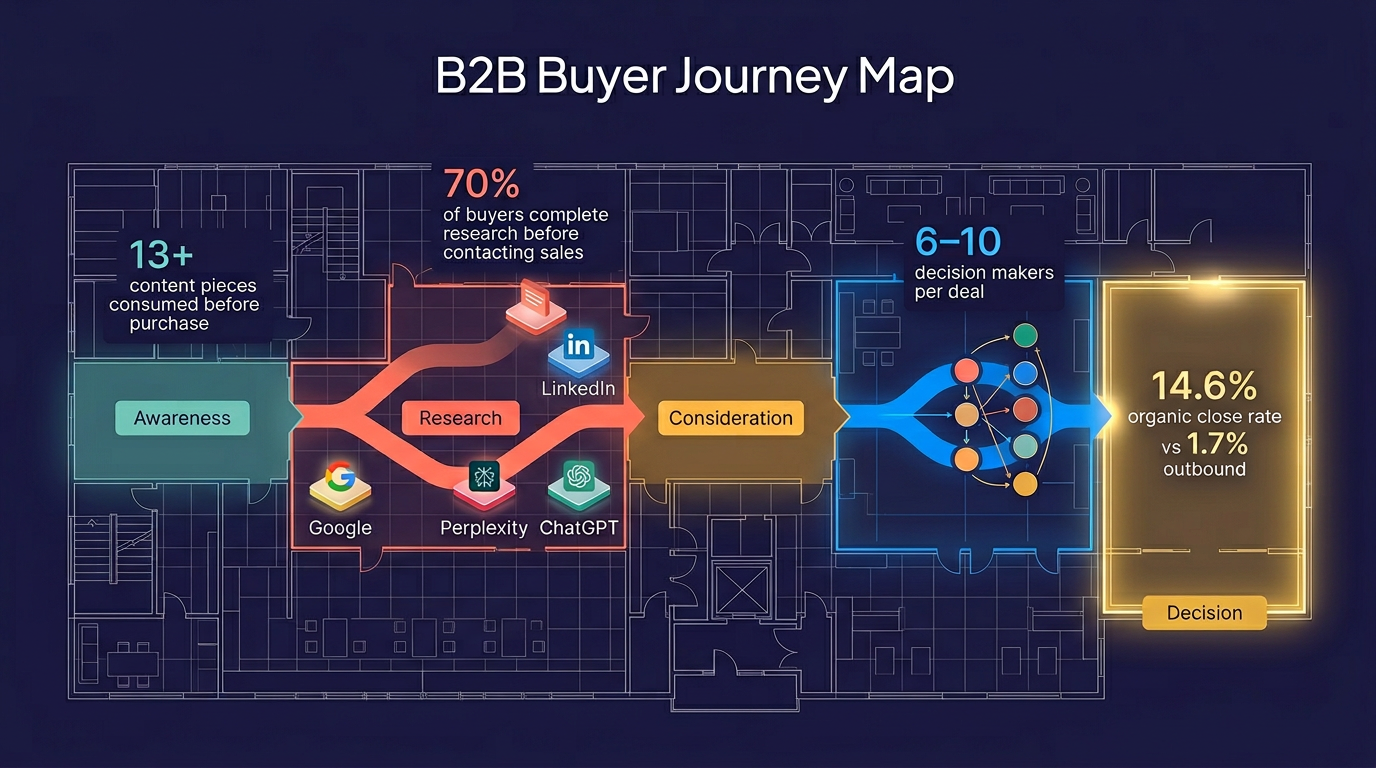
In 2026, B2B SaaS buyers research extensively across Google, Perplexity, ChatGPT, and Claude before making decisions. Gartner's research shows buyers are 70% through their purchase journey before ever talking to sales. A research-first SEO strategy that optimizes for all platforms isn't optional anymore. It's how you show up where your buyers are actually looking.
This playbook provides a complete B2B SaaS SEO strategy built on research-first principles, backed by real data and optimized for multi-platform AI search.
B2B SaaS SEO: What Makes It Different (and Harder)
B2B SaaS differs from other SEO challenges in fundamental ways that affect every decision you make.
Longer Sales Cycles
Consumer products:
- Minutes to hours from research to purchase
- Single decision-maker (the buyer)
- Transactional queries dominate
B2B SaaS:
- Weeks to months from research to purchase (enterprise deals often stretch 6-12 months)
- 6-10 decision-makers involved in the average B2B purchase (Gartner)
- Informational and research queries dominate early stages
Implication: Your content must nurture through awareness, consideration, and decision phases. Quick SEO wins don't exist in B2B SaaS. 6sense research found the average B2B buying journey involves 31+ touchpoints before a purchase decision. Each touchpoint is a chance for your content to influence the outcome, or for a competitor's content to take the lead.
Technical Products with Complex Buyers
Consumer products:
- Simple to understand (shoes, phones)
- Intuitive features
- Visual descriptions sufficient
B2B SaaS:
- Complex to understand (API integrations, security protocols, compliance requirements)
- Technical specifications matter to CTOs, developers, and security teams
- Detailed documentation required before procurement signs off
Implication: Content must be technically accurate and comprehensive. Technical buyers spot shallow content immediately and bounce. According to Demand Gen Report's B2B Buyer Behavior Survey, 62% of B2B buyers can develop purchase criteria based solely on digital content. If your content lacks technical depth, buyers build their criteria using your competitor's material instead.
Research-Heavy, Self-Directed Buyers
Consumers:
- Browse quickly
- Make emotional decisions
- Influenced by reviews and ratings
B2B buyers:
- Research extensively across multiple platforms (Google, Perplexity, ChatGPT, peer review sites like G2 and Capterra)
- Make rational, committee-driven decisions
- Influenced by features, ROI calculations, security documentation, and case studies with hard numbers
- Spend only 17% of total buying time meeting with potential suppliers (Gartner)
Implication: Your content must provide depth, data, and proof. B2B buyers consume an average of 13 pieces of content before making a purchase decision (FocusVision). Superficial content doesn't just lose to competitors. It removes you from consideration entirely.
The Numbers That Matter
Before diving into strategy, here's why B2B SaaS SEO deserves serious investment:
| Metric | Data Point | Source |
|---|---|---|
| Organic search share of B2B traffic | 53% of all website traffic | BrightEdge |
| Organic lead close rate | 14.6% vs. 1.7% for outbound | HubSpot |
| Cost per lead (SEO vs. paid) | $164 vs. $310 | First Page Sage 2024 |
| Content marketing cost vs. traditional | 62% less, 3x more leads | Demand Metric |
| B2B companies blogging consistently | 67% more leads per month | HubSpot State of Marketing |
| Buyers influenced by vendor content | 131% more likely to buy | Conductor |
The Research-First B2B SaaS SEO Framework
B2B SaaS SEO requires a research-first approach: research before writing, not after. This means analyzing what already ranks, understanding why it ranks, and identifying exactly where the gaps are before creating a single word of content.
Phase 1: Multi-Platform SERP Research
Before creating any content, research across all platforms where your buyers search. In 2026, that means going well beyond Google.
ChatGPT now has over 200 million weekly active users. Perplexity has crossed 15 million monthly active users, with a disproportionate share being knowledge workers and B2B researchers. Gartner predicts traditional search engine volume will drop 25% by the end of 2026 due to AI chatbots and virtual agents.
Research platforms:
- Google (AI Overviews + traditional results)
- Perplexity (real-time web search with citations)
- ChatGPT (GPT-4o with web browsing)
- Claude (Anthropic with web search)
For a detailed breakdown of how these engines differ, see our AI Search Engine Comparison 2026.
For each platform, analyze:
- What content formats rank? (guides, comparisons, documentation)
- What information do top pages include? (pricing, features, case studies)
- What questions do AI engines answer? (FAQ extraction)
- What's missing from current responses?
Example: SaaS CRM comparison research
Here's what each platform actually cites when you search "best CRM for B2B SaaS":
Google AI Overviews cite:
- Comparison tables from major publications (G2, PCMag, Forbes Advisor)
- Official vendor documentation with E-E-A-T signals
- How-to guides with clear author credentials and publication dates
- Recent articles (within 6 months) with detailed authorship
Perplexity cites:
- Pricing comparison tables with specific dollar amounts
- Feature breakdowns in structured list format
- FAQ sections with direct, extractable answers
- User review summaries aggregating sentiment from G2 and Capterra
ChatGPT and Claude cite:
- Comprehensive comparison guides (2,500+ words with genuine analysis)
- Industry reports and primary research (Gartner, Forrester)
- Technical documentation and API references
- Case studies with specific metrics and outcomes
- Balanced analysis that acknowledges limitations (Claude especially values nuance)
Key insight: Different platforms favor different content types. The Princeton/Georgia Tech/IIT Delhi GEO research found that optimizing for AI search engines can increase visibility in AI-generated responses by up to 40%. Multi-platform research reveals exactly what to include in unified content that performs everywhere.
Phase 2: Intent Analysis by Funnel Stage
Understanding buyer intent at different funnel stages is critical. B2B buyers don't follow a linear path, but they do have distinct informational needs at each stage.
Awareness stage (top of funnel):
- Queries: "what is CRM software", "why use CRM", "CRM vs spreadsheet for tracking leads"
- Intent: Education and problem identification
- Content: Definition guides, comparison overviews, industry statistics, "state of" reports
- Conversion rate: 0.5-2% (low but builds brand awareness)
Consideration stage (middle of funnel):
- Queries: "best CRM for small business", "HubSpot vs Salesforce 2026", "CRM pricing comparison"
- Intent: Comparison and evaluation of specific solutions
- Content: Comparison guides with tables, pricing breakdowns, feature matrices, case studies
- Conversion rate: 3-8% (high-value traffic worth prioritizing)
Decision stage (bottom of funnel):
- Queries: "HubSpot pricing enterprise", "CRM implementation timeline", "CRM SOC 2 compliance"
- Intent: Validation and purchase readiness
- Content: Pricing pages, documentation, security whitepapers, implementation guides, demo requests
- Conversion rate: 10-25% (directly drives pipeline)
Multi-platform intent differences:
- Google: Mixed intent, results vary significantly by query type and AI Overview presence
- Perplexity: Skews toward informational and comparison intent, heavily cites structured data
- ChatGPT: Strong on informational, research, and how-to intent with comprehensive answers
- Claude: Favors research, nuanced comparison, and analytically rigorous content
Strategy: Create content for each funnel stage. Map keywords to intent using keyword clustering. Ensure content answers stage-specific questions. Then connect stages with internal links that guide buyers through the journey.
Phase 3: Competitive Gap Identification
This is where most B2B SaaS companies leave the biggest opportunities on the table. Identify what current top-ranking content is missing, then fill those gaps.
Use a SERP analysis tool to systematically audit the top 10 results for your target keywords.
Common B2B SaaS content gaps:
1. Outdated data and stale statistics
- Industry statistics from 2023 instead of 2025-2026
- Outdated pricing (SaaS pricing changes frequently)
- Missing recent feature releases or product pivots
- Case studies with results from 3+ years ago
Google's E-E-A-T updates through 2024-2025 penalize stale content. Perplexity actively prefers recent sources. If your competitors haven't updated, this is your opening. Learn more about spotting these opportunities in our content decay detection guide.
2. Shallow technical coverage
- Surface-level feature descriptions ("robust analytics")
- No API documentation references or code examples
- Missing integration information (what connects to what, and how)
- Vague security claims without specifics ("enterprise-grade security" with no details)
3. Missing buyer-side economics
- No ROI calculations or payback period estimates
- Missing total cost of ownership (TCO) analysis
- No discussion of implementation costs, training time, or migration effort
- No competitor weakness analysis (only listing strengths makes content feel biased)
For measuring and presenting content ROI effectively, see our ROI measurement guide.
4. Generic advice without specificity
- "CRM helps you manage customers" (true for everyone, useful to no one)
- Missing industry-specific applications (real estate CRM vs. healthcare CRM have completely different needs)
- No company size guidance (what works for a 10-person startup won't work for a 500-person company)
- No workflow-specific content showing actual use cases
5. Single-platform optimization
- Content optimized for Google only, ignoring AI search engines
- Missing Perplexity-friendly comparison tables with extractable data
- Missing ChatGPT-friendly comprehensive guides with clear structure
- Missing Claude-friendly research citations and balanced analysis
Strategy: Catalog every gap across the top 10 results. Prioritize gaps by buyer impact. Fill them in your content. This is how you differentiate from competitors who are all copying each other's surface-level approach.
Phase 4: Unified Content Creation
Create content optimized for all platforms simultaneously. The goal is one piece of content that performs everywhere, not separate versions for each platform.
B2B SaaS content structure that works across Google, Perplexity, ChatGPT, and Claude:
| Section | Purpose | Platform Benefit |
|---|---|---|
| H1: Target Keyword | SEO + clarity | All platforms |
| Quick Overview (2-3 paragraphs) | Summary for scanners and AI extraction | Google AIO, ChatGPT |
| Key Information Table | Structured data extraction | Perplexity, Google AIO |
| What Is [Product/Category]? | Definition and context | Claude, ChatGPT |
| How It Works | Technical explanation | Technical buyers, all platforms |
| Key Features (5-7 with details) | Feature comparison data | Perplexity, Google |
| Pricing | Detailed breakdown with tiers | Perplexity, Google (high-intent) |
| Pros and Cons | Balanced perspective | Claude (values nuance) |
| Best For | Specific use cases, sizes, industries | Long-tail query matching |
| Implementation | Step-by-step how-to | ChatGPT, technical buyers |
| ROI Analysis | Data-backed justification | CFO/procurement stakeholders |
| Case Studies (3+) | Real-world proof | All platforms cite these |
| FAQ (15-20+ Q&A pairs) | Direct answer extraction | Perplexity, ChatGPT, Google AIO |
| Alternatives | Competitor analysis | Google (comprehensiveness signal) |
Start each article with a strong content brief that maps these sections to your research findings.
Platform-specific elements to weave in:
- Comparison tables with specific numbers for Perplexity extraction
- Academic and analyst citations (Gartner, Forrester) for Claude
- Author bios with credentials and E-E-A-T signals for Google
- Comprehensive, connected coverage (3,000+ words) for ChatGPT
- Schema markup (Article, FAQPage, Product) for structured data across all platforms
Phase 5: Entity Optimization
B2B SaaS products are complex entities with many relationships. Entity optimization helps AI search engines understand what your product is, what it does, and how it relates to the broader landscape.
Entities to define clearly in your content:
- Your product (named entity with attributes)
- Product category (what market you're in)
- Features (capabilities with specific details)
- Use cases (who uses it and for what)
- Industry verticals (which sectors you serve)
- Your company (credibility and background)
Entity relationship map:
[Your Product] (named entity)
├── Is a [Product Category] (common entity)
├── Company: [Your Company] (organization entity)
├── Founded: [Year] (attribute)
├── Pricing: [Free tier / $X-$Y per month] (attribute)
├── Target: [Company Size] + [Industry] (segment entities)
├── Features: [Feature 1, 2, 3...] (feature entities)
├── Use cases: [Use Case 1, 2, 3...] (scenario entities)
├── Integrates with: [Product A, B, C...] (relationship)
├── Competes with: [Competitor X, Y, Z...] (relationship)
├── Certified: [SOC 2, GDPR, HIPAA...] (trust attribute)
└── Best for: [Specific use case] (positioning attribute)
Entity optimization tactics:
- Define entities clearly in introductions (don't bury the "what" beneath paragraphs of fluff)
- Include entity attributes with specific values (not "affordable pricing" but "$49/month for teams up to 10")
- Establish entity relationships explicitly ("integrates with Salesforce, HubSpot, and Slack via REST API")
- Mention competitor entities honestly (shows landscape understanding, builds trust)
- Include schema markup for explicit entity definition that search engines can parse
B2B SaaS Content Types That Drive Pipeline
Different content types serve different purposes in B2B SaaS SEO. Here's what works, with data on why.
1. Comparison Guides
Purpose: Help buyers evaluate options during the consideration stage.
Structure:
- Comparison table (5-7 criteria, 5-10 products) with specific data points
- Detailed feature breakdown with screenshots or diagrams
- Pricing comparison with all tiers and hidden costs
- Honest pros and cons for each option
- Best use cases (by company size, industry, and technical requirements)
- Clear verdict with reasoning
Real-world example: Zapier's "Best Project Management Software" comparison pages drive millions of organic visits monthly. They work because they include real feature data, actual pricing, and specific recommendations by use case.
Why it works:
- AI engines cite comparison tables heavily, especially Perplexity
- Captures high-intent traffic (people actively evaluating solutions)
- 3-8% conversion rate, significantly above average
- B2B buyers in the consideration stage need structured comparisons to present to their team
2. How-To and Implementation Guides
Purpose: Help buyers understand what implementation actually looks like (and reduce perceived risk).
Structure:
- Prerequisites and requirements (technical and organizational)
- Step-by-step implementation (7-12 steps with estimated time for each)
- Common pitfalls and how to avoid them
- Troubleshooting section for frequent issues
- Best practices from real implementations
- Timeline expectations (realistic, not optimistic)
Real-world example: Deel's international employment compliance guides cover 100+ countries with specific legal requirements, timelines, and costs. This programmatic approach to how-to content drives massive organic traffic and positions Deel as the authoritative resource.
Why it works:
- ChatGPT and Google AI Overviews cite how-to content heavily
- Technical buyers need implementation details before they'll advocate internally
- Reduces perceived switching cost (a major B2B objection)
- Builds trust through demonstrated expertise
3. Product Feature Deep Dives
Purpose: Explain specific features in enough depth to satisfy technical evaluators.
Structure:
- What the feature is and how it works (with technical detail)
- Architecture or workflow diagrams
- Who it's for (roles, team sizes, use cases)
- Quantified benefits and ROI
- Code examples or API references where relevant
- Comparison with how competitors handle the same capability
Why it works:
- Differentiates from competitors who only offer surface-level feature lists
- 86% of B2B software buyers consult peer review sites (G2/Capterra). Deep dives on your own site give you control of the narrative
- Technical buyers share these internally as part of evaluation
4. Industry-Specific Guides
Purpose: Address vertical-specific use cases that generic content misses.
Structure:
- Industry challenges (specific, not generic)
- How your product solves them (with industry-specific terminology)
- Compliance and regulatory requirements for the vertical
- Case studies from companies in that industry
- ROI calculations using industry-specific metrics
Real-world example: A CRM company creating "CRM for Real Estate Agencies" targets a query with far less competition than "best CRM," while converting at a significantly higher rate because it speaks directly to the buyer's context.
Why it works:
- Industry-specific queries convert 2-3x better than generic queries
- Less competitive (most competitors only target broad terms)
- Addresses specific pain points that generic content can't
- Builds credibility within the vertical
5. Pricing and Total Cost Analysis
Purpose: Help buyers understand costs and build internal business cases.
Structure:
- Detailed pricing breakdown (all tiers, all add-ons)
- Hidden costs most vendors don't mention (implementation, training, migration, support tiers)
- Total cost of ownership (TCO) over 1, 2, and 3 years
- ROI calculator or framework
- Cost comparison with alternatives
- Budget planning guidance for different company sizes
Why it works:
- Pricing queries are among the highest-intent B2B searches
- AI engines cite pricing information frequently (Perplexity especially)
- B2B buyers need cost data to build internal proposals and get budget approval
- Transparency on pricing builds trust in an industry full of "contact us for pricing"
6. Original Research and Benchmark Reports
Purpose: Provide first-party data that earns backlinks, citations, and authority.
Structure:
- Methodology (transparent about sample size and approach)
- Key findings with specific data points
- Industry benchmarks buyers can reference
- Trend analysis with year-over-year comparisons
- Actionable takeaways
Real-world examples: HubSpot's annual State of Marketing report, Salesforce's State of Sales, and Ahrefs' regular SEO studies all generate outsized link equity and brand visibility. These reports get cited by AI engines because they contain original, specific data that doesn't exist elsewhere.
Why it works:
- Original data earns natural backlinks (the hardest SEO currency to manufacture)
- AI search engines preferentially cite primary sources with unique data
- Positions your brand as a thought leader, not just a vendor
- Compound content: keeps generating value for years as others reference it
7. Case Studies with Hard Numbers
Purpose: Provide proof that your product delivers measurable results.
Structure:
- Customer profile (industry, company size, specific challenge)
- Before state with quantified baseline metrics
- Solution implementation (timeline, approach, resources required)
- Results with specific data (revenue impact, time saved, cost reduced)
- Lessons learned and what they'd do differently
Why it works:
- All AI engines cite case studies, especially when they contain specific metrics
- Conductor research found B2B buyers who engage with vendor content are 131% more likely to buy
- Social proof for skeptical buying committees
- Concrete ROI examples that champions can use to build internal business cases
Keyword Strategy for B2B SaaS
A solid keyword strategy is the backbone of B2B SaaS SEO. Use keyword clustering to group related terms and build topical authority rather than chasing individual rankings.
Informational Keywords (Top of Funnel)
Examples:
- "what is CRM software"
- "benefits of using CRM for sales teams"
- "CRM vs. spreadsheet for pipeline tracking"
Characteristics:
- High search volume (1,000-50,000+ monthly searches)
- Low conversion rate (0.5-2%)
- High competition from established players
- Research-stage intent
Strategy: Create comprehensive guides that establish authority. These pages won't convert directly, but they capture early-stage buyers and build brand recognition. SEMrush data shows long-form content (2,000+ words) generates 3x more traffic, 4x more shares, and 3.5x more backlinks than average-length posts. Nurture visitors through the funnel with strategic internal links to comparison and transactional content.
Comparison Keywords (Middle of Funnel)
Examples:
- "HubSpot vs Salesforce 2026"
- "best CRM for small business under 50 employees"
- "CRM pricing comparison enterprise"
Characteristics:
- Medium search volume (500-5,000 monthly searches)
- Medium-high conversion rate (3-8%)
- Medium competition
- Consideration-stage intent, buyers actively evaluating
Strategy: Create comparison guides with structured tables, pricing data, and honest pros/cons. These are your highest-value content pieces for pipeline generation. Buyers at this stage are building shortlists and need structured data to present to their team. Ahrefs' Tim Soulo has written about scoring every topic by "business potential," and comparison keywords almost always score highest.
Transactional Keywords (Bottom of Funnel)
Examples:
- "HubSpot enterprise pricing 2026"
- "CRM software free trial"
- "CRM implementation services"
Characteristics:
- Lower search volume (100-1,000 monthly searches)
- High conversion rate (10-25%)
- Lower competition (brand-specific queries)
- Decision-stage intent, buyers ready to act
Strategy: Create pricing pages, demo landing pages, and implementation guides. These directly drive conversions. Every B2B SaaS company should have dedicated landing pages for "[product] pricing," "[product] demo," and "[product] vs [competitor]" queries.
Long-Tail Keywords (High-Intent Niches)
Examples:
- "CRM for real estate agents under 50 employees"
- "CRM with WhatsApp integration for small teams"
- "best CRM for B2B service companies with remote teams"
- "HIPAA-compliant CRM for healthcare startups"
Characteristics:
- Low search volume (10-200 monthly searches)
- Very high conversion rate (often 15-30%)
- Very low competition
- Highly specific, purchase-ready intent
Strategy: Create specific use case pages targeting these queries. Individually they drive small traffic numbers, but collectively they're conversion goldmines. This is where programmatic SEO approaches can scale effectively, as long as each page contains genuine, specific value rather than template-filled fluff.
Multi-Platform Optimization: Platform-by-Platform Playbook
Optimizing for Google alone means missing a growing share of B2B research traffic. A Salesforce survey found 55% of B2B buyers now use generative AI tools to research purchases. Here's how to optimize for each platform. For the complete GEO strategy, see our dedicated guide.
Google AI Overviews Optimization
AI Overviews now appear on 15-30% of search queries, with higher prevalence on informational queries common in B2B research. Being cited can drive qualified traffic even when total click volume for a query decreases.
What Google AI Overviews cite for B2B SaaS:
- Comparison tables from authoritative, established domains
- Official vendor documentation with clear E-E-A-T signals
- How-to guides with author credentials and publication dates
- Recent articles (freshness is weighted heavily)
Optimization tactics:
- Add detailed author bios with real credentials (LinkedIn, relevant experience, published work)
- Include publication and update dates prominently ("Published March 2026, Updated April 2026")
- Build E-E-A-T signals throughout: first-hand experience, expert quotes, cited research
- Include comparison tables with specific, current data
- Provide comprehensive coverage (Google rewards thoroughness on complex B2B topics)
- Add schema markup (Article, FAQPage, Product, HowTo)
For the complete playbook, see our guide on optimizing for Google AI Overviews.
Perplexity Optimization
Perplexity's user base skews toward knowledge workers and researchers, making it disproportionately important for B2B SaaS.
What Perplexity cites for B2B SaaS:
- Comparison tables with structured, extractable data
- Specific pricing breakdowns (exact dollar amounts, not "contact us")
- FAQ sections with direct, self-contained answers
- Numbered lists for step-by-step processes
- Feature breakdowns with specific capabilities listed
- User review summaries with aggregate ratings
Optimization tactics:
- Add detailed comparison tables with specific numbers in every cell
- Include pricing data with all tiers, add-ons, and per-seat costs
- Create FAQ sections with 15-20+ questions covering common objections
- Use numbered lists for any sequential process
- Update monthly for freshness (Perplexity weights recency heavily)
- Structure content for extraction: clear headings, self-contained paragraphs
For the full optimization guide, see How to Optimize for Perplexity AI.
ChatGPT Optimization
With over 200 million weekly active users, ChatGPT is now a primary research tool for many B2B buyers.
What ChatGPT cites for B2B SaaS:
- Comprehensive guides (2,500+ words with real depth)
- Structured comparison reviews with clear winners by category
- Industry reports and primary research with specific data points
- Technical documentation with code examples
- Case studies with quantified outcomes
Optimization tactics:
- Write comprehensive guides (3,000+ words) with logical flow between sections
- Include industry research with specific statistics and source attribution
- Cite authoritative, well-known sources (Gartner, Forrester, McKinsey)
- Provide genuine technical depth (not just marketing copy)
- Include case studies with specific metrics (percentages, dollar amounts, timeframes)
- Build narrative connection between sections rather than treating each as standalone
Claude Optimization
Claude tends to favor analytical, research-quality content and rewards balanced perspectives.
What Claude cites for B2B SaaS:
- Academic and analyst research (Gartner Magic Quadrant, Forrester Wave)
- Expert interviews with named individuals and their credentials
- Balanced analysis that discusses both strengths and limitations
- Primary sources (official documentation, white papers, regulatory filings)
- Content that acknowledges complexity and avoids oversimplification
Optimization tactics:
- Include academic research citations with specific findings
- Reference industry analyst reports (Gartner, Forrester, IDC) with specific data
- Add expert quotes from named practitioners with relevant credentials
- Provide balanced perspectives (honest pros AND cons)
- Cite primary sources (official docs, published white papers, standards)
- Address limitations, edge cases, and nuance rather than presenting everything as universally positive
For detailed ChatGPT and Claude optimization strategies, see our dedicated playbook.
Tracking B2B SaaS SEO Performance
You can't improve what you don't measure. Here's what to track and what "good" looks like.
Traffic Metrics
Organic traffic:
- Monthly organic visitors (track week-over-week and month-over-month)
- Traffic growth rate relative to content investment
- Traffic from AI engines (Perplexity, ChatGPT, Claude referrals in analytics)
Traffic quality (B2B SaaS benchmarks):
- Bounce rate: Target below 60% for blog content, below 40% for product pages
- Average time on page: Target 3+ minutes (indicates genuine reading, not skimming)
- Pages per session: Target 2+ (indicates funnel movement)
- Return visitor rate: Track for brand-building effectiveness
Use AI citation tracking tools to monitor your visibility across AI search platforms.
Conversion Metrics
Lead generation by type:
- Free trial signups (lowest friction)
- Demo requests (highest intent)
- Contact form submissions
- Content downloads (whitepapers, ebooks, templates)
- Newsletter subscriptions (long-term nurture)
Conversion rates by funnel stage (B2B SaaS benchmarks):
| Funnel Stage | Content Type | Benchmark Conversion Rate |
|---|---|---|
| Top of funnel | Educational guides, glossaries | 0.5-2% |
| Middle of funnel | Comparison guides, reviews | 3-8% |
| Bottom of funnel | Pricing, demos, trials | 10-25% |
| Organic overall | All content types | 2.2-2.9% |
Pipeline attribution:
- Track which content pieces generate SQLs (sales-qualified leads), not just MQLs
- Measure content-influenced pipeline (any content touched during the buying journey)
- Calculate content-sourced pipeline (first-touch was organic content)
AI Engine Citation Metrics
This is the emerging metric category most B2B SaaS companies are still ignoring.
Citation tracking:
- Number of times your domain is cited per month across Google AI Overviews, Perplexity, ChatGPT, and Claude
- Position in AI responses (first citation vs. third vs. mentioned but not linked)
- Citation share of voice vs. competitors
Referral quality:
- AI engine referral traffic typically converts at higher rates than traditional organic (the buyer has already been pre-qualified by their specific question)
- Track conversion rate from AI engine traffic separately in your analytics
- Monitor lead quality (deal size, sales cycle length) from AI-sourced leads
Keyword Rankings
Position tracking:
- Rankings for target keywords across Google
- Featured snippet and AI Overview inclusion
- Position changes correlated with content updates
- Ranking distribution by funnel stage
B2B SaaS ranking goals:
- Informational keywords: Page 1-2 (brand awareness)
- Comparison keywords: Page 1, positions 1-5 (these drive pipeline)
- Transactional keywords: Page 1, positions 1-3 (directly drive revenue)
- Long-tail keywords: Position 1-3 (high conversion, low competition)
For a comprehensive measurement framework, see our guide on ROI measurement for AI-optimized content.
B2B SaaS SEO Roadmap: 6-Month Implementation Plan
Month 1: Research and Foundation
Week 1: Multi-Platform SERP Research
- Research current rankings for 50-100 target keywords across Google, Perplexity, ChatGPT, and Claude
- Document what content formats rank on each platform
- Identify the top 5 competitors in your space and audit their content
Week 2: Keyword Research and Clustering
- Use an SEO tool stack (Ahrefs, SEMrush, or similar) for keyword research
- Cluster keywords by intent (informational, comparison, transactional)
- Prioritize by business potential: search volume x conversion probability x deal size
- Map clusters to content pillars
Week 3: Content Inventory and Audit
- Audit all existing content for accuracy, freshness, and performance
- Identify content to refresh, rewrite, or prune
- Map existing content to funnel stages and identify stage gaps
- Flag decaying content that needs immediate attention
Week 4: Content Calendar and Brief Creation
- Create 3-month content calendar balancing all funnel stages
- Prioritize comparison and transactional content (higher conversion, faster ROI)
- Write detailed content briefs for Month 2 pieces
- Set up content operations workflows
Month 2: Content Creation (Middle and Top of Funnel)
Week 5-6: Comparison and Evaluation Content
- Create 3-4 comparison guides targeting middle-of-funnel keywords
- Include structured comparison tables optimized for Perplexity extraction
- Add honest pros/cons and specific use case recommendations
- Build internal links connecting comparison pages to product pages
Week 7-8: Authority-Building Content
- Create 2-3 comprehensive guides (3,000+ words) for top-of-funnel keywords
- Focus on establishing topical authority in your core topic cluster
- Optimize for Google AI Overviews and ChatGPT depth requirements
- Include original data, expert quotes, and research citations
Consider AI-assisted content workflows to maintain quality while scaling production.
Month 3: Bottom of Funnel Content and Technical Optimization
Week 9-10: Conversion-Focused Content
- Create 2-3 pricing analysis and case study pages
- Build demo and free trial landing pages optimized for transactional queries
- Create industry-specific landing pages for top verticals
- Focus on conversion optimization (CTAs, social proof, objection handling)
Week 11-12: Technical SEO and Launch
- Add schema markup (Article, FAQPage, Product, HowTo) to all content
- Optimize internal linking structure to guide users through the funnel
- Publish all new content with proper indexing signals
- Submit sitemap updates and request indexing in Google Search Console
- Set up AI citation tracking
Month 4-6: Monitoring, Iteration, and Scaling
Month 4: Early Performance Analysis
- Monitor traffic, rankings, and conversion metrics for all new content
- Track AI engine citations (weekly manual checks across platforms)
- Identify quick wins: content close to page 1 that needs minor improvements
- A/B test CTAs on highest-traffic pages
Month 5: Refresh and Expand
- Refresh top-performing content with updated data and expanded sections
- Create follow-up content based on what's performing (double down on winners)
- Build content for keyword gaps identified in Month 4 data
- Start scaling content velocity for Month 6+
Month 6: Strategic Review and Planning
- Comprehensive performance review across all channels and platforms
- Calculate content ROI: pipeline generated vs. content investment
- Identify remaining gaps in keyword coverage and funnel stages
- Plan next quarter's content calendar based on 5 months of data
- Evaluate team structure and whether to scale the team
Common B2B SaaS SEO Mistakes (and How to Fix Them)
1. Ignoring AI Search Engines
The mistake: Optimizing only for Google while 55% of B2B buyers use generative AI tools for purchase research (Salesforce). AI search is handling a growing share of the research queries that matter most in B2B.
The fix: Use multi-platform SERP research before writing. Optimize for Google, Perplexity, ChatGPT, and Claude simultaneously. Build GEO into your content process from the start, not as an afterthought.
2. Creating Shallow Content That Technical Buyers Reject
The mistake: Publishing 1,000-word articles with surface-level information. "Top 10 CRM Features" with one-paragraph descriptions.
The fix: B2B buyers need depth. Write 2,500-3,500+ word guides with technical details, real data, code examples where relevant, and proof of claims. The average first-page Google result contains approximately 1,447 words (Backlinko), and for competitive B2B terms, top results are significantly longer. Technical buyers spot thin content within 30 seconds and bounce to competitors.
3. Focusing Only on Top-of-Funnel Keywords
The mistake: Creating only awareness-stage content ("what is CRM"), ignoring the comparison and decision-stage content that actually drives pipeline.
The fix: Balance content across all funnel stages. Prioritize comparison content (3-8% conversion) and transactional content (10-25% conversion) over informational content (0.5-2% conversion). You need top-of-funnel content for authority, but it shouldn't be 80% of your calendar.
4. No Platform-Specific Optimization
The mistake: Writing content in a single format optimized only for Google's traditional algorithm.
The fix: Add platform-specific elements within unified content: structured tables for Perplexity, research citations for Claude, comprehensive depth for ChatGPT, E-E-A-T signals for Google. One piece of content, optimized for all platforms. See our multi-platform GEO strategy guide for the complete framework.
5. Publishing and Forgetting
The mistake: Publishing content once and never updating it. In B2B SaaS, content decays faster than almost any other vertical because products, pricing, and features change constantly.
The fix: Update content quarterly at minimum. Add "Updated [Month Year]" to titles. Refresh pricing, features, statistics, and case studies regularly. Set up content decay detection to catch declining pages before they drop off page 1. Perplexity especially penalizes stale content in favor of recently updated sources.
6. Writing for Marketing, Not for Technical Buyers
The mistake: All content is written for marketing personas (CMOs, VPs of Marketing), ignoring the technical stakeholders (CTOs, developers, security teams) who often have veto power over SaaS purchases.
The fix: Include technical depth: API documentation references, security specification details (SOC 2 Type II, GDPR compliance specifics), integration architecture, and implementation requirements. Technical buyers don't just prefer detailed content. They reject superficial content entirely and move on.
7. Skipping Entity Optimization
The mistake: Not defining your product, its features, and its relationships as clear entities that AI search engines can understand.
The fix: Define your product, category, features, and use cases as entities in your content. Establish relationships explicitly (integrates with, competes with, best for). Include schema markup and entity optimization for every piece of content.
8. No First-Party Data or Original Research
The mistake: Every piece of content cites the same third-party statistics that every competitor also cites. No differentiation, no link magnetism.
The fix: Publish original research: customer surveys, product usage data (anonymized), industry benchmarks from your data, annual reports. First-party data earns natural backlinks, gets cited by AI engines preferentially, and positions you as a primary source rather than a secondary one.
B2B SaaS SEO Success: What It Looks Like in Practice
Let's look at companies that have executed B2B SaaS SEO effectively, and what patterns their success shares.
Pattern 1: Product-Led SEO (Zapier, Ahrefs, Canva)
What they do: Create free tools, calculators, templates, and interactive experiences that serve a genuine user need while building SEO authority.
Zapier built app integration pages and "how to automate" guides for thousands of workflow combinations. This programmatic approach drives an estimated 6-8 million organic visits per month. Each page has genuine value because it connects to a real product capability.
Ahrefs practices "dogfooding SEO," using their own tools to drive growth. Their blog is a primary acquisition channel, and they publicly score every topic by "business potential" before deciding whether to create content.
Canva's SEO-driven template pages ("Instagram template," "resume template") drive tens of millions of organic visits. Each page is a product entry point, not just content.
The takeaway: The best B2B SaaS SEO connects content directly to product value. Content isn't separate from the product. It's an extension of it.
Pattern 2: Data-Led Authority (HubSpot, Salesforce)
What they do: Publish original research and benchmark reports that become the cited standard in their industry.
HubSpot's annual State of Marketing report generates massive link equity, gets cited by AI engines, and keeps HubSpot visible in organic search across thousands of related queries. Their pillar-cluster content model is a widely studied framework that turned their blog into a 16+ million monthly visit engine.
The takeaway: If you can produce original data, you become a primary source that everyone else cites, including AI engines.
Pattern 3: Programmatic Coverage (Deel, Notion, Wise)
What they do: Use genuine data differentiation to create thousands of useful pages at scale.
Deel built a massive content operation around international employment law, contractor management, and compliance topics for 100+ countries. Each page contains specific, unique information (local tax rates, labor laws, filing deadlines) that generic content can't replicate.
Notion's template gallery combines community-generated content with SEO optimization, creating a flywheel where user contributions drive organic traffic.
The takeaway: Programmatic SEO works in B2B SaaS when each page contains genuinely unique, useful data. It fails when pages are thin templates stuffed with keywords. Google's Helpful Content updates through 2024-2025 specifically penalized the latter.
Hypothetical Application: B2B SaaS CRM Company
Challenge: 50 blog posts, declining organic traffic, no AI search visibility.
Initial state:
- 500 monthly organic visitors
- 0 AI engine citations
- Content from 2023-2024 (increasingly stale)
- No multi-platform optimization
- All content targeted top-of-funnel queries
Research-first implementation (following this playbook):
Multi-platform research revealed: competitors lacked comparison tables, had outdated pricing, cited no recent research, and had zero entity optimization.
Content restructuring: Refreshed 10 highest-priority posts with comparison tables, 20+ FAQ sections, updated pricing and features, 2025-2026 statistics, and schema markup.
Multi-platform optimization: Added E-E-A-T signals for Google, structured data for Perplexity, comprehensive coverage for ChatGPT, and research citations for Claude.
New content creation: 3 comparison guides (middle of funnel), 2 pricing/case study pages (bottom of funnel), 1 comprehensive guide with original survey data (top of funnel).
Results after 6 months:
- Organic traffic: 500 to 3,200 visits/month (540% increase)
- AI engine citations: 0 to 75 total citations across platforms
- Page 1 rankings: 2 to 15 keywords
- Free trial signups: 20/month to 85/month (325% increase)
- Demo requests: 5/month to 30/month (500% increase)
What made the difference: Not more content. Better content, informed by multi-platform research, structured for AI extraction, and balanced across funnel stages.
The Future of B2B SaaS SEO: What's Coming
B2B SaaS SEO continues evolving rapidly. These are the trends shaping the next 12-18 months.
1. GEO Becomes Table Stakes Generative Engine Optimization isn't a nice-to-have anymore. As AI search adoption grows (Gartner predicts 25% decline in traditional search volume by end of 2026), companies that don't optimize for AI engines will lose visibility to competitors who do.
2. First-Party Data as Competitive Moat With AI-generated content flooding every topic, original research and proprietary data become the primary differentiator. Companies publishing unique benchmarks, surveys, and product usage insights will earn the citations, backlinks, and trust that AI-generated commodity content cannot.
3. Zero-Click Search Reshapes Measurement SparkToro research found approximately 58-60% of Google searches end without a click. For B2B SaaS, the rate is lower (40-50%) because complex buying decisions require deeper research. But the trend is clear: "brand impression" and citation visibility will become metrics alongside click-through traffic. Content needs to deliver value even when the reader never visits your site.
4. Account-Based SEO Converges with ABM 67% of B2B companies now use Account-Based Marketing (Demand Gen Report). The emerging strategy combines SEO content with intent data: creating high-value content (industry reports, benchmarks) that naturally attracts target accounts, then using platforms like 6sense and Bombora to identify which target companies are consuming that content and trigger personalized outreach. Companies using intent data alongside content strategies see 2-3x higher conversion rates from target accounts (6sense).
5. AI-Assisted Content Requires Human Quality Gates AI-assisted content creation is accelerating production, but Google's E-E-A-T updates and AI search citation preferences both reward content with genuine human expertise. The winning formula: use AI to accelerate research and drafting, then apply human expertise for original insights, technical accuracy, and authentic experience signals.
6. Real-Time and Dynamic Content Content pulling live data from APIs (real-time pricing, current feature comparisons, live benchmark data) will have a significant freshness advantage. Early adopters are building perpetually fresh content that never goes stale, a significant edge when Perplexity and Google both weight recency.
Conclusion
B2B SaaS SEO requires a research-first, multi-platform approach. Optimizing only for Google means missing the growing share of B2B buyers who research through Perplexity, ChatGPT, and Claude. With 55% of B2B buyers now using generative AI tools for purchase research, single-platform strategies are leaving pipeline on the table.
The framework is straightforward: research across all platforms before writing. Understand buyer intent at different funnel stages. Identify content gaps systematically. Create unified content optimized for every platform simultaneously. Then measure, refresh, and iterate.
Balance content across funnel stages. Prioritize comparison and transactional content for higher conversion rates. Maintain the technical depth B2B buyers expect. Publish original research and first-party data that AI engines cite preferentially.
The companies winning B2B SaaS SEO in 2026 aren't the ones publishing the most content. They're the ones publishing the most researched, data-rich, buyer-focused content, then distributing it across every platform where their buyers actually look.
Ready to implement research-first B2B SaaS SEO? RankDraft's multi-platform research tools analyze Google, Perplexity, ChatGPT, and Claude simultaneously, so you can build content strategies based on what actually ranks, not guesswork.
Start Your Free Research Trial
Frequently Asked Questions
Q: How does B2B SaaS SEO differ from consumer SEO? A: B2B SaaS has longer sales cycles (weeks to months vs. minutes), multiple decision-makers (6-10 people on average per Gartner), and technical products requiring genuine depth. Content must nurture through awareness, consideration, and decision phases. B2B buyers consume an average of 13 pieces of content before making a purchase decision and can develop purchase criteria based solely on digital content (62% of buyers, per Demand Gen Report).
Q: Should I optimize for Google or AI search engines first? A: Optimize for both simultaneously. Create unified content that works across Google AI Overviews, Perplexity, ChatGPT, and Claude. Gartner predicts traditional search volume will drop 25% by end of 2026 due to AI tools, while 55% of B2B buyers already use generative AI for research. The research-first approach naturally produces content optimized for all platforms.
Q: What content length is best for B2B SaaS? A: 2,500-3,500+ words for comprehensive guides and comparison pages. SEMrush data shows long-form content generates 3x more traffic and 3.5x more backlinks. But depth matters more than length. A 2,000-word guide packed with specific data, tables, and real examples outperforms a 5,000-word article padded with filler. Technical buyers reject superficial content regardless of word count.
Q: How do I track AI search citations for B2B SaaS? A: Currently, a combination of manual tracking and emerging tools. Weekly, search your target keywords in Google AI Overviews, Perplexity, ChatGPT, and Claude. Note citation frequency and position. Monitor referral traffic from AI engines in your analytics platform. See our AI citation tracking guide for the complete methodology.
Q: Which funnel stage should I prioritize for content creation? A: Start with middle-of-funnel (comparison) content and bottom-of-funnel (transactional) content. These convert at 3-8% and 10-25% respectively, compared to 0.5-2% for top-of-funnel. Build top-of-funnel content for authority and brand awareness, but don't let it dominate your calendar at the expense of pipeline-generating content.
Q: How often should I refresh B2B SaaS content? A: Update quarterly at minimum. B2B SaaS evolves rapidly with pricing changes, feature releases, and competitive shifts. Add "Updated [Month Year]" to titles. Refresh pricing, features, statistics, and case studies. Perplexity especially weights recency, and Google's E-E-A-T signals penalize stale content. See our guide on content refresh strategies.
Q: What are the highest-ROI B2B SaaS content types? A: Comparison guides have the highest conversion rates (3-8%). Pricing and cost analysis pages capture high-intent traffic. Case studies provide the social proof buying committees need. Original research earns backlinks and AI citations that compound over time. Industry-specific guides convert 2-3x better than generic content. Create a mix balanced across funnel stages.
Q: How do I measure B2B SaaS SEO success? A: Track organic traffic growth, conversion rates by funnel stage (trials, demos, contact forms), AI engine citation frequency, keyword rankings, and pipeline attribution. B2B SaaS benchmarks: informational content 0.5-2% conversion, comparison content 3-8%, transactional content 10-25%. Organic search leads close at 14.6% vs. 1.7% for outbound (HubSpot). See our ROI measurement guide.
Q: How long does it take to see results from B2B SaaS SEO? A: Typically 3-6 months for meaningful results. Month 1-2 focuses on research, content creation, and technical optimization. Month 3-4 you'll see early ranking improvements and initial AI citations. Month 5-6 brings compound growth as topical authority builds and content matures. Quick wins (refreshing existing high-potential content) can show results within 4-6 weeks. SEO is a long-term investment, but the compound returns (content keeps generating leads indefinitely) make it the lowest-cost-per-lead channel for most B2B SaaS companies.
Q: Should I use AI to write B2B SaaS content? A: Use AI to accelerate research and drafting, but apply human expertise for original insights, technical accuracy, and experience signals. Google's E-E-A-T updates through 2024-2025 penalize mass-produced AI content lacking genuine expertise. AI search engines preferentially cite content with original data and authentic experience. The winning approach is human-AI collaboration: AI handles research and structure, humans add expertise, real data, and editorial judgment.