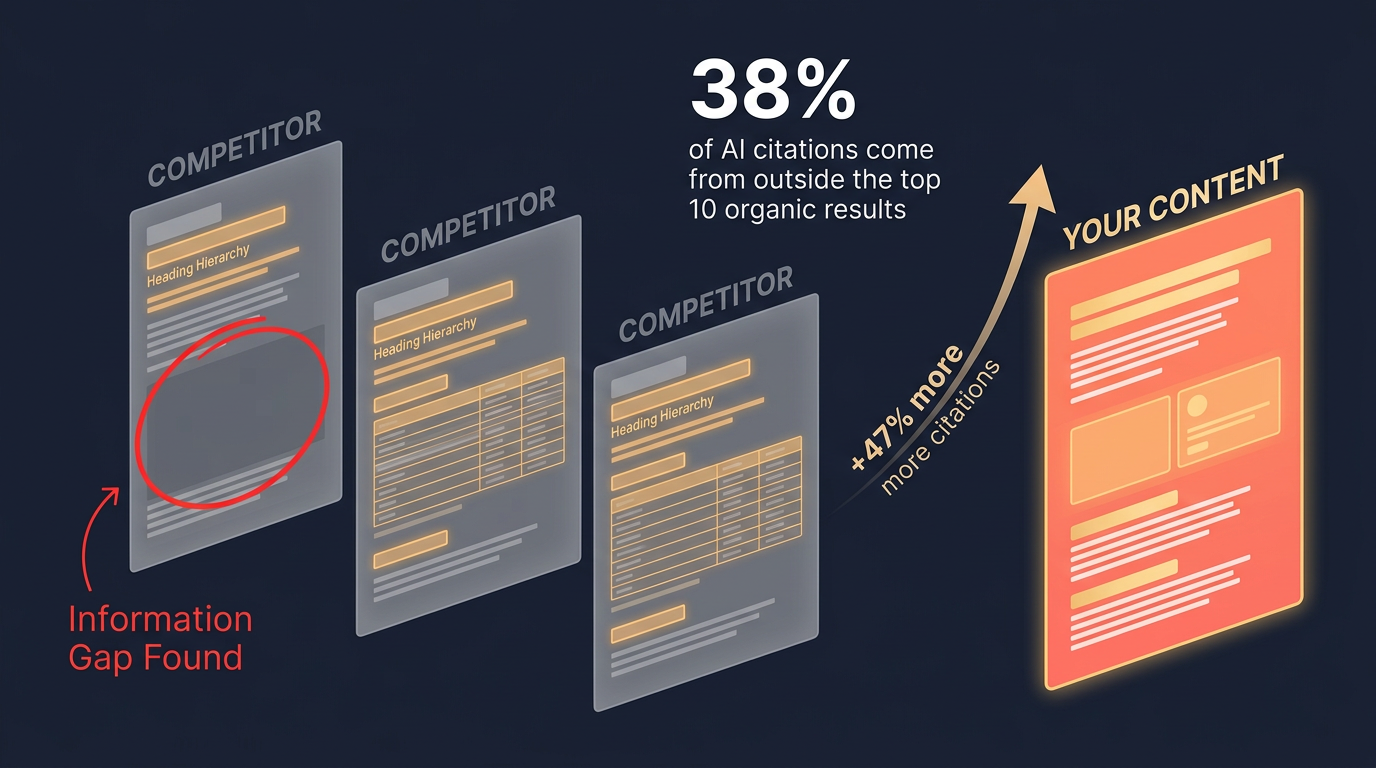
Competitor content analysis is the process of evaluating top-performing pages on search engine results pages (SERPs) to reverse-engineer their success, find their weaknesses, and create content that outperforms them on measurable dimensions. In 2026, this process extends beyond Google's organic results. You also need to analyze which competitors get cited by AI search engines like Perplexity, ChatGPT, and Google AI Overviews.
Ahrefs' 2026 study of 863,000 keywords found that only 38% of pages cited in Google AI Overviews also rank in the top 10 organic results, down from 76% seven months earlier. Rankings and AI citations are now separate outcomes. Winning one does not guarantee the other.
This guide breaks down the framework for deconstructing SERPs, exploiting content gaps, analyzing entity coverage, and building content that dominates both traditional search and AI engines using RankDraft.
Why competitor analysis is a requirement, not an option
Most content creators publish in a vacuum. They write what seems like a good idea, hit publish, and wonder why the page sits on page five. The reality: Google already has a preference for specific content types, formats, and depth levels for every query. Competitor analysis replaces guesswork with data.
Search Engine Land's 2026 data shows that teams using dedicated SERP analysis tools see 47% more Page 1 rankings and 2.8x more AI citations than teams relying on manual research. Content Marketing Institute found that research-first workflows produce 2.5x more Page 1 rankings than generic AI-generated content.
By analyzing the top 5-10 results, you can determine average word count, depth of topic coverage, user intent, and specific subtopics competitors miss. But in 2026, you need to go further: identify which competitors get cited in AI Overviews, extract their entity coverage, and measure their information gain.
The great decoupling: rankings vs. citations
Before diving into the framework, you need to understand the biggest shift in competitive analysis since 2025.
BrightEdge's analysis shows that as few as 17% of AI Overview citations come from pages ranking in the top 10 organic results (methodology-dependent). A page ranking #7 with cleaner structure, better tables, and clearer entity definitions can get cited in AI Overviews over the #1 result.
This means competitor analysis in 2026 has three separate targets:
- Organic ranking competitors (who occupies positions 1-10)
- AI citation competitors (who gets cited in AI Overviews, Perplexity, ChatGPT)
- SERP feature competitors (who holds featured snippets, PAA spots, video carousels)
For each target keyword, a page that ranks #1 organically might not appear in AI Overviews at all, while a page at #8 with a clear comparison table gets cited. You need to analyze both sets of competitors separately. For a deeper comparison of how each AI engine selects sources, see AI search engine comparison 2026.
Deconstructing the SERP: reverse engineering success
The first step is to strip down the top results across both organic rankings and AI citations.
Identify your true competitors
Forget business competitors. In SEO, your competitors are anyone occupying pixel space for your target keyword. That includes affiliate sites, directories like G2 and Capterra, Reddit threads (Reddit accounts for 46.7% of Perplexity's top citations according to LLMClicks.ai data), YouTube videos, and AI-generated results themselves.
Use RankDraft's SERP research tool to pull the top URLs for your target query. Then check AI Overviews and Perplexity for the same query to see which pages get cited there. The overlap between these two lists is often surprisingly small.
Analyze content type and format
Look at the top results. Are they listicles, how-to guides, comparison pages, or product pages? If the top 5 results are listicles, writing a dense academic essay will fail regardless of quality. Align your format with searcher intent.
Pay special attention to structural elements. Semrush data shows content with comparison tables gets cited 2.5x more often by Perplexity than content without tables. Pages with 15+ FAQ questions see 62% higher AI citation rates than pages with 5 or fewer. Format is no longer just about matching intent; it determines whether AI engines can extract and cite your content.
For a detailed breakdown of how SERP analysis tools compare on these features, see our tool comparison guide.
Dissect structure and hierarchy
Open the top three results. Map their H2 and H3 tags. Are they breaking the topic down in a consistent pattern? If you target "best CRM software" and all top results have sections for pricing, integrations, and ease of use, those are required subtopics.
But go further: run entity extraction on these pages using Google's NLP API or InLinks. This reveals concepts (entities) that competitors cover beyond what is visible in their headings. A competitor might not have a heading about "data migration" but could discuss it extensively in their body text. Entity extraction catches what heading analysis misses.
Evaluate content depth and information gain
Is the content thin and generic, or deep and actionable? Google's Information Gain patent (filed 2018, granted June 2024) scores documents on how much additional information they provide beyond what users have already seen on other pages.
Ahrefs data shows pages above 20,000 characters average about 10 AI citations each versus 2.4 for pages under 500 characters. The optimal range for comprehensive guides is 2,500-3,500 words. But length without unique information is worthless. Look for:
- Original data or research competitors lack
- First-person experience or testing that competitors cannot replicate
- Updated 2025-2026 statistics when competitors cite 2022-2023 data
- Novel frameworks not found in existing results
- Contrarian viewpoints absent from the current SERP
Semrush found that content with unique insights or original research gets cited 47% more often than generic content. If every top result says the same thing with slightly different words, the information gain opportunity is massive.
Identifying content gaps across three dimensions
Once you understand what the top pages do well, you need to find what they miss. In 2026, content gaps exist across three dimensions: keywords, entities, and AI citations.
Keyword gap analysis
Use RankDraft to compare your target keyword against the keywords the top competitors rank for. You might find that competitors rank for "benefits of X" but not "side effects of X" or "X alternatives." Including those missing sections gives you an immediate edge.
Semrush's content gap tool and Ahrefs' competing domains feature both automate this at scale. For 1,000+ target keywords, manual analysis is impossible. Programmatic approaches (covered in our programmatic SEO guide) can cluster gaps into themes tied to business goals.
Entity gap analysis
This is where 2026 competitor analysis diverges from older methods. Search engines now use knowledge graphs, not just keyword indexes. AI models generate answers by pulling verified entities and their relationships.
Run entity extraction on top-performing competitor pages using InLinks, Google NLP API, or WordLift. Compare the entity set each competitor covers. You will find that the top-ranking page might cover 40 entities while the page at #5 covers 25. The gap between them reveals exactly which concepts you need to include.
For example, if you target "email marketing automation" and the top result covers entities like "drip campaigns," "behavioral triggers," "A/B testing," "deliverability," and "GDPR compliance" but the #3 result misses "deliverability" and "GDPR compliance," those missing entities are weaknesses you can exploit. Our entity optimization guide covers this process in detail.
AI citation gap analysis
Check which queries in your category trigger AI Overviews but do not cite your pages. Tools like Otterly.ai track citations across six platforms: ChatGPT, Perplexity, Google AI Overviews, Gemini, Copilot, and Google AI Mode. Ahrefs' Brand Radar also tracks AI citation patterns by domain.
For each citation gap, examine which competitor pages get cited instead. What do those pages have that yours lack? Common differences include:
- Cleaner structural hierarchy (clear H2/H3 nesting)
- Comparison tables and structured data
- FAQ sections with direct question-and-answer format
- Schema markup (89% of AI-cited pages have schema according to Semrush data)
- Fresher publication dates (Perplexity cites content less than 3 months old 54% of the time)
If your content ranks well organically but is not getting cited in AI Overviews, the problem is usually structure and clarity, not authority. See how to optimize for AI Overviews for specific formatting techniques.
Freshness gaps
In fast-moving niches, information becomes obsolete fast. Ahrefs' 2026 freshness study shows that 50% of Perplexity's citations are from content published or updated within the past year. Google AI Overviews cite content updated within 6 months 47% more often than older content.
If the top result was last updated in 2024 and mentions practices that have changed, you have a clear gap. Create freshness by updating data, screenshots, and statistics. Websites that systematically update content every 90-120 days maintain an average position 4.2 spots higher than competitors who leave content untouched. For a systematic approach, see our content refresh strategies guide.
Building topical authority to outrank single-page competitors
Targeting a single keyword is not enough. Google and AI engines favor sites that cover a topic comprehensively across a cluster of related content. Sites covering 80%+ of relevant subtopics see 2.5x more AI Overview citations according to Ahrefs' 2026 data.
What semantic clusters look like in practice
Semantic clusters are groups of content pieces that cover a broad topic and its related subtopics. Instead of writing one post on "content marketing," you might write a pillar page and supporting articles on email marketing, social media strategy, and SEO content, all interlinked.
When you analyze competitors, look at their internal linking. Do they have a supporting web of content around their ranking page? If they have one strong article but no supporting cluster, you can beat them by building a content ecosystem. RankDraft helps identify these semantic relationships, allowing you to map out a content strategy that signals topical authority to search engines.
Entity salience across your cluster
Use related terms and synonyms naturally. If your top competitor only uses the exact match keyword "cheap laptops," you improve semantic relevance by also using "affordable notebooks," "budget computers," and "low-cost devices." This helps search engines understand the broader context of your page.
But entity salience goes beyond synonyms. Measure how relevant each entity is to your content's main topic. Factors include frequency, position (entities mentioned early have higher salience), semantic distance from the main topic, and entity type. Named entities with clear attributes (pricing, features, target audience) score higher than vague category references.
Pruning weak content in your cluster
Not all content helps your topical authority. Ahrefs' 2026 data shows that sites pruning 15-20% of low-quality content see 28% average traffic increases within 3 months, and 42% more AI citations. Thin pages that cover the same subtopic as a stronger page actually dilute your authority. Audit your cluster and prune or consolidate weak pages before adding new ones.
Modern tools for competitor content analysis
The tool landscape has changed significantly. Here is what the 2026 stack looks like for competitive analysis:
| Tool | Best for | Price range |
|---|---|---|
| Ahrefs | Link analysis, organic keyword gaps, Brand Radar for AI citation tracking | $129-999/mo |
| Semrush | Content gap analysis, AI Overview tracking module, 10M-keyword studies | $130-500/mo |
| InLinks | Entity extraction from competitor pages, knowledge graph building | $39-399/mo |
| Frase.io | SERP analysis of top 20 results per keyword, entity mapping | $15-115/mo |
| Otterly.ai | AI citation tracking across 6 platforms (ChatGPT, Perplexity, Google, Gemini, Copilot) | Free-$99/mo |
| WordLift | Knowledge graph building, Wikidata/DBpedia entity connection | $59-199/mo |
| RankDraft | Research-first briefs, SERP deconstruction, content scoring, gap discovery | Free-$199/mo |
For AI-specific citation tracking, Otterly.ai and Ahrefs' Brand Radar are the current leaders. For entity gap analysis, InLinks and WordLift provide the deepest insights. For a complete breakdown, see our SEO tool stack guide.
The 7-step RankDraft framework for execution
Here is the step-by-step framework. Each step maps to a specific tool or feature in RankDraft.
Step 1: SERP extraction
Input your target keyword into RankDraft. Select the top 10 competitors from the SERP. Let RankDraft extract their headings, word counts, entity coverage, and content structure. This gives you a baseline content score to beat, plus a map of what the SERP currently rewards.
Step 2: AI citation audit
Check the same keyword on Perplexity and Google AI Overviews (if available for your query). Note which pages get cited. Cross-reference with the organic top 10. If different pages get cited in AI results versus organic, you have two separate competitor sets to analyze.
Step 3: Intent and format verification
Review the extracted data. Ensure your intended format matches SERP leaders. If RankDraft shows that 80% of top results are guides averaging 2,400 words, plan your article at 2,800-3,200 words. If comparison tables appear in 4 of the top 5 results, your content needs tables too.
Step 4: Gap discovery across all three dimensions
Run content gap analysis in RankDraft. The tool highlights which subtopics are covered by most competitors and which are underrepresented. Layer in entity gap analysis (which entities do competitors cover that you miss?) and AI citation gap analysis (what structural elements do cited pages have that non-cited pages lack?).
Add the missing subtopics, entities, and structural elements to your outline. This is where most of your competitive advantage comes from. For guidance on turning this analysis into a structured brief, see how to write a content brief.
Step 5: Information gain injection
Before writing, identify 3-5 unique value additions that no current competitor offers. These could be:
- Original data you have collected or can collect
- Screenshots or test results from hands-on experience
- Updated 2026 statistics replacing outdated competitor data
- A novel framework or methodology
- Expert quotes or interviews
Human-refined AI content with 50-60% human contribution drove 1,600% citation increases versus AI-only content in one case study tracked by BrightEdge. The human contribution should focus on information gain: things only you can add. For balancing AI and human effort, see our AI content writing playbook.
Step 6: Drafting and optimization
Write (or generate) content following your enriched outline. Use RankDraft to grade your content against the top pages in real time. Pay attention to:
- Entity coverage compared to top competitors
- Structural elements (tables, FAQs, lists) that AI engines need for citation
- Schema markup: implement Article, FAQ, HowTo, Breadcrumb, and Review schema where relevant. Sites with all 5 major schema types see 3.1x higher citation rates (Semrush)
- Keyword density in the 1-2% range (content at 1-2% gets 43% more AI citations than over-optimized content at 3%+)
- Readability and clear heading hierarchy
Step 7: Cluster integration
After publishing, connect the new page to your existing content cluster. Add internal links from related pages and link out to supporting content. This step is not optional. A standalone page with no internal link support competes at a disadvantage against competitors with deep topical clusters. Our content operations framework covers how to systematize this process.
Real-world examples
Example A: the "thin content" upgrade
A RankDraft user analyzed the keyword "keto meal plan." The top result was a generic list of foods with no structure. The comments section had 47 requests for a shopping list and weekly schedule. The user created a guide that included a food list organized by macronutrient profile, a 7-day schedule with calorie counts, and a downloadable shopping list grouped by grocery store aisle. The page also included a comparison table of keto vs. paleo vs. Whole30 macros that none of the top 5 results covered. It reached position #3 within 90 days and got cited in Google AI Overviews within 120 days.
Example B: the "topical authority" play
In the B2B SaaS space, a competitor ranked for "CRM software" with a single 1,500-word page. Using semantic cluster analysis, a startup built a CRM hub: one pillar page plus 22 supporting articles covering integrations (8 articles), migration guides (4 articles), industry-specific use cases (6 articles), and comparison pages (4 articles). Each supporting article linked back to the pillar and to 2-3 related supporting pages. The collective topical authority pushed the pillar page from position #18 to #4 in five months, even though the startup's domain rating was 28 versus the competitor's 65.
Example C: the "AI citation" gap exploit
A fintech content team tracked their AI citation presence using Otterly.ai and found they were cited for "payment processing" queries but never for "payment gateway comparison" queries, even though they ranked #6 organically for the latter. Analysis showed the cited competitors had structured comparison tables with pricing columns, integration counts, and feature checklists. The fintech team restructured their existing page to add three comparison tables and FAQ schema. Within 6 weeks they appeared in AI Overviews for that query without changing their organic ranking position.
Mistakes that kill your competitive advantage
Chasing word count instead of information gain
Do not write 3,000 words of filler to beat a competitor's word count. Ahrefs' data shows the highest AI citation rate (38%) comes from posts around 2,200 words, not from the longest content. If your 1,800-word article covers more entities, includes original data, and answers more questions than a competitor's 4,000-word article, it will outperform. Quality and specificity matter more than length.
Ignoring AI search entirely
If your competitor analysis only looks at Google organic results, you are missing half the picture. AI Overviews appear in approximately 48% of searches (2026 data), and Gartner projects 25% of organic search traffic will shift to AI chatbots and voice assistants by end of 2026. Analyze competitors across Google, Perplexity, and ChatGPT, not just traditional SERPs.
Copying instead of improving
If you rewrite a competitor's article paragraph by paragraph, you create near-duplicate content with zero information gain. Google's information gain scoring rewards content that adds new knowledge to the conversation. Use competitors as a map of required subtopics, then add unique value through original data, updated statistics, hands-on testing, or novel frameworks.
Skipping technical foundations
Even the best content analysis will not help if your site takes 4+ seconds to load or lacks proper schema markup. Sites with strong E-E-A-T signals see 67% more AI Overview citations (Semrush). Author pages with clear expertise signals, proper structured data, and fast page speeds are table stakes. Fix these before investing in competitive content.
Analyzing once and forgetting
Competitor analysis is not a one-time activity. Content decays within 12 months for 60% of pages (Ahrefs). New competitors enter the SERP. AI citation patterns shift as engines update their models. Set up automated monitoring: AI agents can crawl competitor sites weekly, scanning new pages and keyword changes. Build a 90-day refresh cycle to re-analyze your competitive position for top keywords.
Framework checklist
- Identify target keyword and top 10 SERP competitors (organic + AI citations)
- Check AI Overviews and Perplexity for the same keyword to find citation competitors
- Determine content format (guide vs. list vs. comparison) based on SERP patterns
- Extract H2/H3 structures and entity coverage from top performers
- Run keyword gap analysis to find missing subtopics
- Run entity gap analysis to find missing concepts and relationships
- Identify AI citation gaps (what structural elements do cited pages have?)
- Identify 3-5 information gain opportunities (original data, testing, updated stats)
- Create outline that exceeds competitor breadth and depth
- Draft content with comparison tables, FAQ sections, and clear hierarchy
- Implement schema markup (Article, FAQ, HowTo, Breadcrumb as relevant)
- Add internal links to supporting cluster content
- Grade content against top pages using RankDraft before publishing
- Schedule 90-day competitive re-analysis
Competitor analysis template
Use this template for each target keyword:
- Target keyword: ____________________
- Organic top 3 competitors (URLs): ____________________
- AI citation competitors (URLs from AI Overviews/Perplexity): ____________________
- Average word count of top 3: ____________________
- Dominant content format: ____________________
- Primary subtopics covered by competitors:
- Entity coverage (top entities from extraction): ____________________
- Identified keyword gaps:
- Identified entity gaps:
- AI citation structural gaps (tables, FAQs, schema missing from your page):
- Information gain opportunities (what unique value can you add?):
- Target internal links for clustering: ____________________
- Refresh date (90 days from publish): ____________________
Next steps
The difference between pages that rank and pages that don't comes down to how well you understand the competition before you write. Competitor analysis in 2026 covers three layers: organic rankings, AI citations, and SERP features. Skip any layer and you leave ranking potential on the table.
Start with your highest-priority keyword. Run it through RankDraft's SERP research tool, extract the competitive landscape, identify gaps across all three dimensions, and build content that fills those gaps with original value. Then connect it to your content cluster and schedule the 90-day re-analysis.