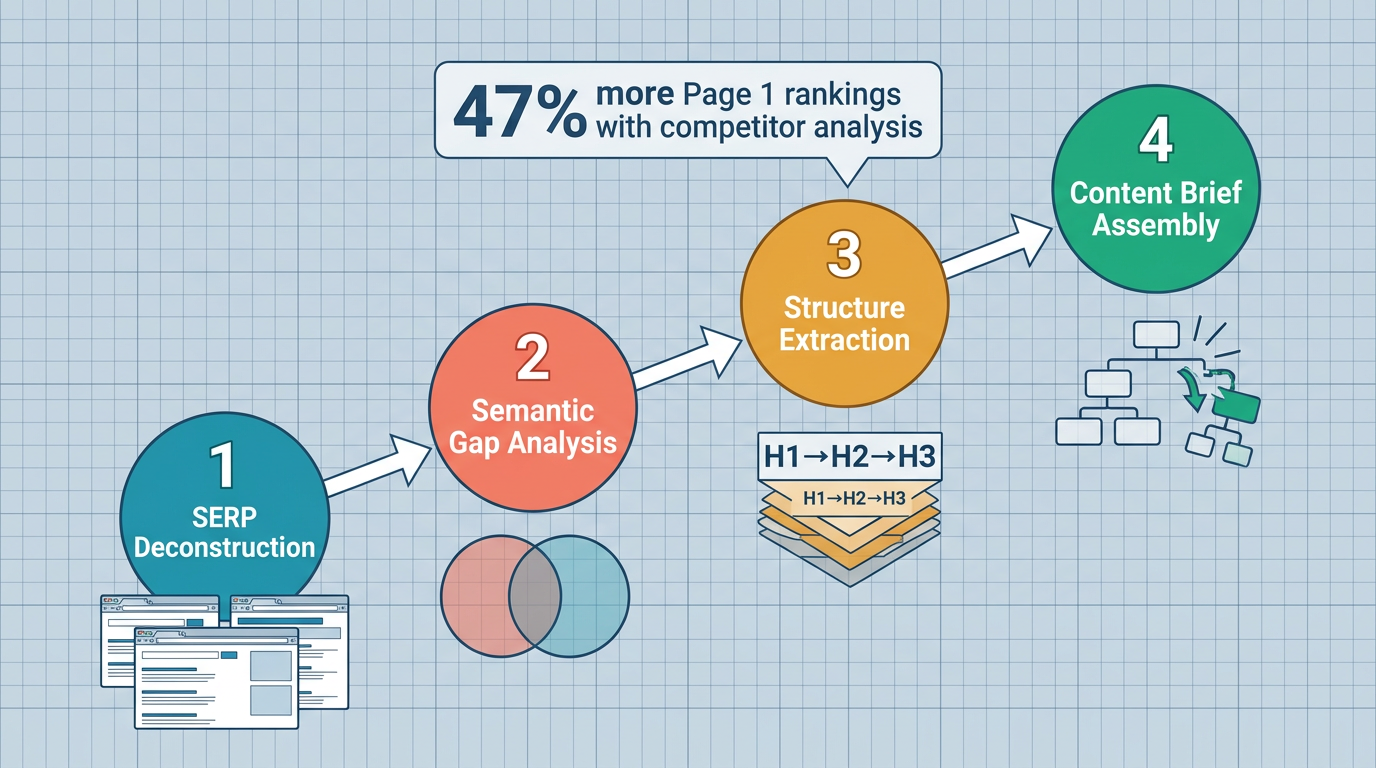
Every page ranking on page one paid a tax you can avoid. The top 10 results for your target keyword have already tested headlines, formats, depths, and angles against Google's ranking system. Your job is to study what worked, find what they missed, and build something better before you write a single paragraph.
Most content teams skip this step. They pick a keyword, draft an outline from gut instinct, and wonder why the piece stalls at position 14. Competitor content analysis fixes that. It gives you a data-backed blueprint: which subtopics to cover, which format to use, which gaps to exploit, and which sections to skip because every competitor already nailed them.
This tutorial walks through the full process, tool by tool, with a worked example you can follow along with.
What Competitor Content Analysis Actually Involves
Competitor content analysis is the practice of deconstructing the top-ranking pages for a target keyword to understand why they rank. You extract their structure, semantic coverage, trust signals, and user experience choices, then use that data to plan a piece that is objectively more complete.
This is different from keyword research (finding what to target) and different from content auditing (evaluating your existing pages). It sits between those two steps: you already have a keyword, and now you need to figure out what the SERP demands before you build an outline. If you want a broader view of how research-first content fits into a content workflow, start there.
Why You Should Analyze Before Writing
Writing before analyzing the SERP is guesswork with a word processor. Here is what the analysis gives you.
Intent alignment
Google categorizes queries by intent: informational, commercial investigation, transactional, navigational. If the top 10 results for "best project management tools" are comparison listicles and you publish a "What is project management?" explainer, you will not rank. The SERP tells you what format Google expects. Respect it.
Structural efficiency
The top results have already tested which H2s and subtopics earn engagement. You do not need to reinvent the structure. You need to identify the mandatory sections (covered by all competitors) and the missing ones (your opportunity).
Competitive differentiation
Content gaps are the reason new pages can outrank established ones. A competitor published their guide in 2023 and never updated it. Another one skips a subtopic that appears in 40% of People Also Ask questions. A third uses no original data. These are your openings. For a deeper look at turning gaps into ranking wins, see our guide on how to outrank every competitor.
The 2026 Tool Stack for Competitor Analysis
Before walking through the process, here is the tool stack. You do not need all of these, but you need at least one from each category. For a full breakdown of which tools are worth paying for, see our 2026 SEO tool stack guide.
SERP data and keyword intelligence
| Tool | What it does | Cost |
|---|---|---|
| Ahrefs | Keyword difficulty, SERP overview, content gap reports, traffic estimates | From $129/mo |
| Semrush | Keyword magic tool, SERP features tracking, content template builder | From $139/mo |
| SE Ranking | Affordable SERP analysis with competitor comparison views | From $52/mo |
Content and semantic analysis
| Tool | What it does | Cost |
|---|---|---|
| RankDraft | Automated competitor scanning, semantic cluster extraction, outline generation | Free tier available |
| Clearscope | NLP-based content grading against top competitors | From $170/mo |
| Surfer SEO | Content editor with real-time SERP comparison | From $99/mo |
| Frase | SERP research + AI brief generation in one workflow | From $15/mo |
AI-assisted research
| Tool | What it does | Free? |
|---|---|---|
| Perplexity AI | Source-cited answers for quick competitive intelligence | Free tier |
| ChatGPT (Browse) | Summarize competitor pages, extract patterns from pasted content | Plus plan |
| Claude | Analyze pasted competitor content for structure, tone, and gaps | Free tier |
For a comparison of how these AI search tools differ in sourcing behavior, see our 2026 AI search engine comparison.
Step-by-Step Tutorial: Full Competitor Analysis Workflow
We will use a real example keyword throughout: "content brief template" (1,900 monthly searches, KD 34 in Ahrefs).
Step 1: Pull the SERP and classify intent
Open Ahrefs Keywords Explorer (or Semrush Keyword Overview) and search your target keyword. Look at the SERP overview.
What to record:
- SERP features present: Featured Snippet? People Also Ask? Video carousel? Image pack?
- Dominant format: Are results listicles, how-to guides, templates, or product pages?
- Domain authority range: All DR 80+ sites, or a mix including DR 30-50 sites?
- Freshness signals: When were the top results last updated?
Worked example for "content brief template":
- SERP features: Featured Snippet (paragraph), PAA box (6 questions), "Things to know" panel
- Format: 7 of 10 results are how-to guides with downloadable templates. 2 are tool landing pages. 1 is a listicle of templates.
- Domain range: DR 45 to DR 88. Three results are from sites under DR 55, which signals opportunity for mid-authority sites.
- Freshness: 4 results updated in 2025 or 2026. 3 results are from 2023 with no update.
Intent classification: Informational with commercial undertones. Users want to learn how to write a brief AND want a ready-made template to download.
This tells you: your piece needs both a tutorial section and a downloadable template. A pure template page or a pure explainer will miss half the intent.
For more on this step, our SERP analysis tool comparison covers which tools give the best SERP feature data.
Step 2: Select 5 competitors for deep analysis
From the SERP results, pick 5 pages to analyze in depth. Selection criteria:
- Relevance: Must match the same intent as your planned piece. Exclude dictionary definitions, YouTube videos, and tool signup pages unless you are building one of those.
- Recency: Prefer results updated within the last 12 months.
- Diversity: Include at least one high-DR and one mid-DR competitor. This shows you what works at different authority levels.
Worked example selections:
| # | Title | DR | Last updated | Word count |
|---|---|---|---|---|
| 1 | "How to Write a Content Brief (+ Template)" | 78 | Jan 2026 | 3,200 |
| 2 | "Content Brief Template: 12 Fields You Need" | 62 | Mar 2026 | 2,100 |
| 3 | "The Complete Guide to Content Briefs" | 85 | Sep 2025 | 4,500 |
| 4 | "Free Content Brief Template for SEO Writers" | 48 | Nov 2025 | 1,800 |
| 5 | "Content Briefs That Get Results: Framework" | 55 | Feb 2026 | 2,700 |
Open all five in separate tabs.
Step 3: Extract the structural blueprint
For each competitor, document their H2 and H3 structure. You can do this manually (inspect the page) or paste the URL into RankDraft's competitor scanner, which extracts headers automatically.
Build a comparison table:
| Section topic | Comp 1 | Comp 2 | Comp 3 | Comp 4 | Comp 5 |
|---|---|---|---|---|---|
| What is a content brief | Y | N | Y | N | Y |
| Why content briefs matter | Y | Y | Y | N | Y |
| Key components/fields | Y | Y | Y | Y | Y |
| How to write step-by-step | Y | N | Y | N | Y |
| Template download | Y | Y | N | Y | N |
| Examples of filled briefs | N | N | Y | N | N |
| Common mistakes | Y | N | N | N | Y |
| Tools for creating briefs | N | Y | N | N | N |
What this reveals:
- Mandatory sections (4+ competitors cover it): "Key components/fields" and "Why content briefs matter" appear across almost every result. You must include these.
- Opportunity sections (1-2 competitors cover it): "Examples of filled briefs" appears in only one result, and "Tools for creating briefs" in only one. These are differentiation opportunities.
- Missing entirely: None of the five competitors include a section on how to adapt briefs for AI-assisted writing workflows. That is a 2026-specific gap. (For context on this angle, see our post on human-AI collaboration workflows.)
Step 4: Run semantic and keyword analysis
This is where NLP tools earn their cost. Use RankDraft, Clearscope, or Surfer to scan your selected competitors and extract:
Semantic clusters (groups of related terms):
For "content brief template," the tool might return clusters like:
- Core terms: content brief, brief template, content brief template, SEO brief
- Component cluster: target keyword, word count, audience persona, tone of voice, internal links, outline structure, meta description
- Process cluster: content strategy, content calendar, editorial workflow, content production
- Quality cluster: search intent, SERP analysis, competitor research, topic authority
Keyword frequency data:
| Term | Appears in X of 5 competitors | Average frequency |
|---|---|---|
| content brief | 5/5 | 18 times |
| target audience | 4/5 | 6 times |
| search intent | 4/5 | 5 times |
| word count | 5/5 | 4 times |
| SEO writer | 3/5 | 3 times |
| content strategy | 4/5 | 7 times |
This data feeds directly into your outline. If "search intent" appears in 4 of 5 competitors, your piece must address it. If "editorial workflow" appears in only 1, you can include it as a differentiator. For more on building keyword clusters into a content strategy, we have a full guide.
Step 5: Audit for content gaps and quality weaknesses
Now read each competitor page with a critical eye. You are looking for five specific types of gaps.
1. Depth gaps: Sections that exist but are surface-level.
Example: Competitor 3 has a "How to define target audience" section that says "Think about who your reader is and what they need." That is 12 words on a subtopic that deserves 200. You can expand it with specific questions to answer: job title, experience level, stage in the buying journey, existing knowledge.
2. Freshness gaps: Outdated information or examples.
Example: Competitor 1 recommends "use Google's Keyword Planner for volume data." In 2026, AI search optimization has changed how volume data should be interpreted. A section that accounts for AI Overviews eating click-through rates is a meaningful update.
3. Format gaps: Missing visual or structural elements.
Example: None of the competitors include a filled-out example brief. They all describe the fields but never show a completed one. A before/after example of a bad brief versus a good brief would be a strong differentiator.
4. Trust gaps: Missing citations, data, or expertise signals.
Example: Competitor 2 claims "briefs improve content quality by 60%" with no source. You can either find the original study and cite it properly, or run your own analysis. Specific data with sources beats unsourced claims every time. See our notes on E-E-A-T and the human-first SEO approach.
5. AI search gaps: Content not structured for AI engines.
In 2026, your content needs to be cited by Perplexity, ChatGPT, and Google's AI Overviews. Competitors who wrote their pieces before mid-2025 rarely optimize for this. Structuring your content with clear definitions, attributable statements, and entity-rich paragraphs gives you an edge. Our GEO guide covers the specifics.
Step 6: Extract People Also Ask and related questions
Pull every question from the PAA box for your keyword. Then cross-reference with:
- Ahrefs "Questions" report for the keyword
- AlsoAsked.com for question trees
- The FAQ sections of competitor pages
Worked example PAA questions for "content brief template":
- What should be included in a content brief?
- How long should a content brief be?
- What is the difference between a content brief and a creative brief?
- How do you write a content brief for a freelance writer?
- Do content briefs improve SEO performance?
- What tools can create content briefs automatically?
Cross-reference with competitors:
| Question | Answered by competitors? | Quality of answer |
|---|---|---|
| What should be included? | 5/5 | Good (covered in "components" sections) |
| How long should a brief be? | 1/5 | Weak (one sentence: "1-2 pages") |
| Difference from creative brief? | 0/5 | Not addressed at all |
| Brief for freelance writers? | 2/5 | Moderate |
| Do briefs improve SEO? | 1/5 | Weak (no data) |
| Auto-generate briefs? | 1/5 | Weak (just mentions one tool) |
Questions 2, 3, 5, and 6 are under-served. They become H2 or H3 candidates in your outline, or FAQ section entries that can win the PAA featured position.
Step 7: Analyze trust signals and link profiles
Check what external sources competitors cite and what internal linking patterns they use.
External citations to note:
- Studies or reports cited (potential sources for your piece)
- Industry experts quoted
- Statistics with sources versus unsourced claims
Internal linking patterns:
- How many internal links do top competitors include?
- Where do they link (related blog posts, product pages, pillar content)?
This informs your own linking strategy. If competitors average 8-12 internal links per post, you should match or exceed that. For your RankDraft content, you would link to related guides like how to write a content brief, content operations framework, and content velocity strategies.
Step 8: Synthesize findings into a content plan
Compile everything into a single document with three sections:
Mandatory coverage (all or most competitors cover, and you must too):
- Definition of a content brief
- Key components/fields (keyword, audience, intent, structure)
- Why briefs improve content output
- Downloadable template
Differentiation opportunities (gaps you will fill):
- Filled-out example of a real brief (before/after)
- How to adapt briefs for AI-assisted writing
- Data on brief impact on content performance
- Brief templates for different content types (blog, landing page, comparison)
Unique value (what only you can provide):
- RankDraft's automated brief generation workflow
- Proprietary data on how research-backed briefs affect ranking speed
- A brief checklist tied to your AI content quality standards
Turning Your Analysis into an Outline
The analysis is done. Now structure it. Do not copy the #1 result's outline. Google can detect structural similarity, and a "me too" layout does not differentiate you.
Group semantic clusters into logical sections
Take the clusters from Step 4 and group them into themes:
- Foundation cluster (what + why): definition, importance, impact on content quality
- Component cluster (the fields): target keyword, audience, intent, structure, word count, tone
- Process cluster (how to): step-by-step creation, tools, templates
- Advanced cluster (differentiation): AI-assisted briefs, brief templates by content type, measuring brief effectiveness
Set the hierarchy
- H1: Your primary keyword with a hook. "How to Write a Content Brief That Actually Gets Used (+ Free Template)"
- H2s: Map to the major clusters above. Each H2 should target a semantic group.
- H3s: Answer specific PAA questions or cover individual subtopics within each cluster.
Insert your unique angle
Every outline needs one section that no competitor has. This is what earns backlinks and social shares. For the "content brief template" example, this might be:
- A real, filled-out brief for a published article that ranked, with annotations explaining each decision
- A comparison of briefs created manually versus briefs generated by AI tools like RankDraft, with quality scores for each
For guidance on building unique value into every piece, see our post on topical authority scaling.
Practical Example: Full Outline Built from Analysis
Here is the outline we would build for "content brief template" based on the analysis above:
H1: How to Write a Content Brief That Actually Gets Used (+ Free Template)

Intro (120 words)
- Problem: Most content briefs are ignored because they're too vague or too rigid
- Promise: A framework that SEO writers actually follow, with a free template

H2: What Is a Content Brief?
- Definition (target Featured Snippet)
- How it differs from a creative brief (PAA gap)
- Who creates briefs and who uses them

H2: Why Content Briefs Directly Impact Rankings
- Data: [cite specific study on brief usage and content performance]
- Alignment between brief quality and first-draft accuracy
- Time saved in revision cycles

H2: The 9 Fields Every Content Brief Needs
H3: Target keyword and secondary keywords
H3: Search intent classification
H3: Target audience profile
H3: Competitor analysis summary (link back to this guide)
H3: Recommended structure and word count
H3: Internal and external linking targets
H3: Tone and brand voice guidelines
H3: Visual and media requirements
H3: SEO metadata (title tag, meta description)

H2: How to Write a Content Brief Step by Step
H3: Step 1 - Run competitor analysis (reference this tutorial)
H3: Step 2 - Define the reader and their stage
H3: Step 3 - Build the structural outline
H3: Step 4 - Add specific instructions for each section
H3: Step 5 - Include the research sources

H2: Filled Example: A Real Brief for a Published Article
- Before: a weak brief with vague instructions
- After: a detailed brief that led to a page-one ranking
- Annotations on what made the difference

H2: Content Brief Templates by Type
H3: Blog post brief template
H3: Landing page brief template
H3: Comparison/listicle brief template

H2: Adapting Briefs for AI-Assisted Writing Workflows
- What to include when the first draft comes from AI
- Quality gates and review checkpoints
- Link to human-AI collaboration workflows guide

H2: Tools That Generate Content Briefs Automatically
- RankDraft, Frase, Clearscope, Surfer comparison
- When automated briefs work and when they don't

H2: FAQ
- How long should a content brief be?
- Do freelance writers need different briefs?
- How often should you update a brief template?

Conclusion + CTA
This outline covers every mandatory topic, fills four content gaps competitors missed, and includes two unique value sections (the filled example and the AI workflow adaptation).
Common Mistakes That Waste Your Analysis
Copying the top result's structure verbatim
If your outline looks identical to the #1 page, you have not analyzed the SERP. You have plagiarized it. The point of analysis is synthesis: combine the best elements from multiple competitors into something new.
Ignoring format mismatch
If 8 of 10 results are listicles, do not publish a narrative essay. Match the dominant format first. You can innovate within it (better visuals, interactive elements, downloadable resources), but do not fight the format Google has chosen to reward.
Analyzing only the top 3
Position 1-3 results often rank partly on domain authority. Positions 4-10 can reveal more about what on-page factors Google values, because those pages compensate for lower authority with better content. Always analyze deeper.
Skipping the "quality read"
Tools give you data. Reading the actual competitor pages gives you insight. If you only look at word counts and keyword frequencies without reading the content, you will miss tone, depth, and clarity issues that tools cannot quantify.
Targeting keywords beyond your authority
If your site is DR 20 and the top 10 is all DR 70+, on-page optimization alone will not get you there. Use your analysis to find a more specific long-tail variation where mid-authority sites already rank. The AI content writing playbook covers how to pick winnable keywords at different authority levels.
Scaling Competitor Analysis Across Your Content Calendar
Running this process for every article is time-intensive. Here is how to scale it.
Batch your analysis
Group 5-10 keywords in the same topical cluster and analyze them together. The competitor landscape overlaps heavily within clusters, so one analysis session covers multiple future articles. This pairs well with a content operations framework that systematizes research across your team.
Build reusable templates
Create a standard competitor analysis template in your project management tool. Include every field from this tutorial (intent, format, semantic clusters, gaps, PAA questions, trust signals). Fill it in for each piece, and your writers receive a data-backed brief instead of a vague topic.
Automate the repeatable parts
RankDraft automates SERP scanning, semantic extraction, and gap identification. Use automated tools for data collection and reserve your time for the quality read and strategic synthesis that requires human judgment. For teams publishing at volume, this is the difference between 2 hours per analysis and 20 minutes. Read more on content velocity without quality loss.
Re-analyze when refreshing content
Content decays. When a page drops in rankings after 6-12 months, re-run the competitor analysis before rewriting. The SERP may have shifted: new competitors, new intent signals, new SERP features. Our content decay detection guide covers when and how to catch these drops, and our content refresh strategies guide covers the update process.
Checklist: Competitor Content Analysis
Run through this before you start drafting.
Intent and SERP
- Identified the primary search intent (informational, commercial, transactional)
- Recorded SERP features (Featured Snippet, PAA, video, images)
- Documented the dominant content format in the top 10
- Noted the domain authority range of ranking pages
- Checked freshness dates on all top 10 results
Competitor selection
- Selected 5 competitors across a range of domain authorities
- Excluded irrelevant result types (videos, dictionaries, tool pages)
- Opened all 5 in separate tabs for manual review
Structural analysis
- Extracted H2/H3 structure from all 5 competitors
- Built a comparison table of section coverage
- Identified mandatory sections (covered by 4+ competitors)
- Identified opportunity sections (covered by 0-2 competitors)
Semantic analysis
- Ran NLP analysis (RankDraft, Clearscope, or Surfer)
- Documented primary semantic clusters
- Recorded keyword frequency data for top terms
- Identified terms used by competitors that I might miss
Gap analysis
- Found at least 2 depth gaps (thin competitor sections)
- Found at least 1 freshness gap (outdated data or examples)
- Found at least 1 format gap (missing visuals, templates, or tools)
- Identified trust signal opportunities (unsourced claims to cite properly)
- Checked for AI search optimization gaps
Questions and PAA
- Extracted all People Also Ask questions
- Cross-referenced with competitor FAQ coverage
- Identified under-served questions for H2/H3 or FAQ placement
Outline
- Grouped findings into mandatory, opportunity, and unique sections
- Structured H1/H2/H3 hierarchy from semantic clusters
- Included at least one unique value section no competitor has
- Planned internal links to related content
Conclusion
Competitor content analysis is the step that separates content that ranks from content that sits on page three. The process is straightforward: pull the SERP, pick your competitors, extract structure, run semantic analysis, find gaps, and build an outline from the data. The tools in 2026 make the data collection fast. Your advantage comes from the quality of your gap analysis and the strategic decisions you make about what to include that others left out.
Start your next piece with a competitor analysis. If you use RankDraft, the SERP scanning, semantic extraction, and outline generation happen in one workflow, and you can focus your time on the strategic gaps that require human judgment.