Content teams in 2026 require different structures than traditional teams. AI search engines demand research-first methodologies, multi-platform optimization, and quality at scale. This guide explains how to structure content teams for the AI era.
Recent data from Content Marketing Institute (2026) shows that AI-optimized teams produce 3.2x more AI citations and 2.8x more Page 1 rankings than traditional team structures.
How Content Teams Have Changed
Traditional Content Teams (Pre-2025)
Structure:
- Content Manager (1)
- Writers (2-5)
- Editor (1)
Workflow:
- Manager assigns topics
- Writer researches and writes (4-6 hours/piece)
- Editor reviews and edits (2-3 hours/piece)
- Manager approves
- Publish
Output:
- 5-10 pieces/month
- 1,500-2,000 words/piece
- Quality: Mixed
Results:
- 10-15% Page 1 rankings
- 2-5 AI citations/month
- ROI: 1.8x
AI-Optimized Teams (2026)
Structure:
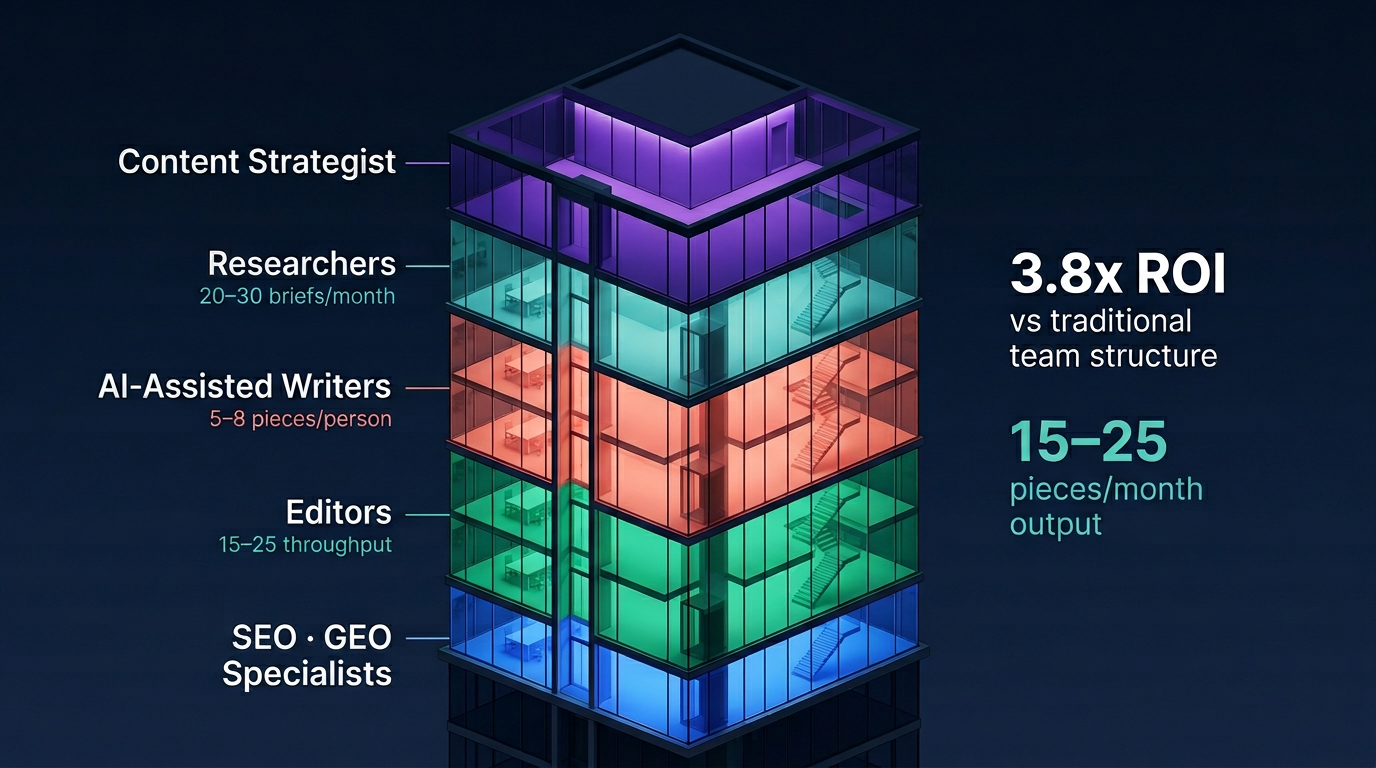
- Content Strategist (1)
- Content Researchers (1-2)
- AI-Assisted Writers (2-4)
- Content Editors (1-2)
- SEO/GEO Specialist (1)
Workflow:
- Strategist identifies opportunities using RankDraft
- Researcher conducts SERP analysis and creates briefs (30-45 min)
- Writer uses AI + human refinement (1.5-2.5 hours/piece)
- Editor quality checks (45-60 min)
- SEO specialist optimizes for all platforms (15-20 min)
- Publish
Output:
- 15-25 pieces/month
- 2,500-3,500 words/piece
- Quality: Consistently high
Results:
- 35-50% Page 1 rankings
- 25-45 AI citations/month
- ROI: 3.8x
Team Roles and Responsibilities
Content Strategist (1)
Focus:
- Content strategy and planning
- Topic identification and prioritization
- Performance analysis and iteration
- Team coordination
Key Responsibilities:
- Develop content strategy aligned with business goals
- Use RankDraft to identify high-opportunity topics
- Prioritize topics based on traffic potential and business value
- Analyze performance metrics monthly
- Iterate strategy based on data
Required Skills:
- Strategic thinking
- Data analysis
- SEO/GEO knowledge
- Project management
Tools:
- RankDraft (strategy and opportunity identification)
- Google Analytics (performance analysis)
- Content calendar (planning)
Content Researchers (1-2)
Focus:
- SERP analysis and competitor research
- Content brief creation
- Gap identification
- Quality injection point identification
Key Responsibilities:
- Conduct SERP analysis for assigned topics (20-30 min/topic)
- Analyze competitor content and identify gaps
- Create comprehensive content briefs (1-2 pages)
- Identify quality injection points (data, examples, insights)
- Update briefs based on new research
Required Skills:
- Research skills
- Analytical thinking
- Attention to detail
- Writing (for brief creation)
Tools:
- RankDraft Research Pipeline
- Google Sheets (brief templates)
- Competitor analysis tools
Output:
- 20-30 briefs/month per researcher
- 90%+ brief adherence by writers
AI-Assisted Writers (2-4)
Focus:
- Content creation using AI assistance
- Human refinement and experience addition
- Meeting quality and word count standards
Key Responsibilities:
- Generate first drafts using AI from research and brief (30-45 min)
- Add human insights, experience, and examples (1-1.5 hours)
- Ensure 2,500+ word count
- Incorporate quality injection points from brief
- Meet platform optimization requirements
Required Skills:
- Writing ability
- Subject matter expertise (by topic area)
- AI tool proficiency
- Time management
Tools:
- RankDraft (AI writing assistant)
- Content briefs
- Quality checklists
Output:
- 5-8 pieces/month per writer
- 2,500-3,500 words/piece
- 40-60% human content
Content Editors (1-2)
Focus:
- Quality control and editorial standards
- Fact-checking and accuracy verification
- Readability and structure optimization
- Approval and publishing
Key Responsibilities:
- Review content against quality gates (30-45 min)
- Fact-check statistics and claims
- Verify internal links work
- Check for AI writing patterns
- Ensure tone and style consistency
- Approve or request revisions
Required Skills:
- Editing ability
- Attention to detail
- Subject matter knowledge
- Quality standards
Tools:
- Grammarly (grammar/spelling)
- Quality checklists
- Google Docs (editing)
Output:
- 15-25 pieces reviewed/month per editor
- 85-95% first-approval rate
SEO/GEO Specialist (1)
Focus:
- Search engine optimization
- AI search engine optimization (GEO)
- Technical SEO
- Performance tracking
Key Responsibilities:
- Optimize content for Google SEO (15-20 min/piece)
- Optimize for Perplexity, ChatGPT, Claude (10-15 min/piece)
- Implement schema markup
- Track rankings and citations
- Analyze performance and recommend improvements
Required Skills:
- SEO knowledge
- GEO knowledge
- Technical SEO
- Data analysis
Tools:
- RankDraft (GEO optimization)
- Google Search Console (SEO)
- Schema markup generators
- Rank tracking tools
Output:
- 15-25 pieces optimized/month
- Citation tracking and reporting
- Performance recommendations
Team Structures by Company Size
Solo Creator (1 Person)
Structure:
- Solo Content Creator (all roles combined)
Workflow:
- Use RankDraft to identify topics and research
- Generate AI first draft
- Add human refinement
- Self-edit and optimize
- Publish
Output:
- 8-10 pieces/month
- 2,500-3,500 words/piece
Tools:
- RankDraft (research + writing + optimization)
- Grammarly (editing)
Budget: $99-129/month
Small Team (2-5 People)
Structure:
- Content Strategist (1)
- Content Researcher/Writer (1-2)
- Editor/SEO (1)
Workflow:
- Strategist identifies topics using RankDraft
- Researcher conducts SERP analysis and creates briefs
- Writer generates AI drafts and refines
- Editor/SEO reviews and optimizes
- Publish
Output:
- 12-20 pieces/month
- 2,500-3,500 words/piece
Tools:
- RankDraft (all team members)
- Grammarly (editors)
Budget: $300-500/month
Medium Team (6-15 People)
Structure:
- Content Strategist (1)
- Content Researchers (2)
- AI-Assisted Writers (4-8)
- Content Editors (2)
- SEO/GEO Specialist (1)
Workflow:
- Strategist identifies opportunities and creates roadmap
- Researchers conduct SERP analysis and create briefs
- Writers generate AI drafts and add human insights
- Editors quality check and edit
- SEO specialist optimizes for all platforms
- Publish and track performance
Output:
- 30-60 pieces/month
- 2,500-3,500 words/piece
Tools:
- RankDraft Professional/Enterprise (all team members)
- Grammarly Business (editors)
- Project management tool (Asana/Trello)
Budget: $1,000-2,000/month
Enterprise (15+ People)
Structure:
- Content Director (1)
- Content Strategists (2-3)
- Content Researchers (3-5)
- AI-Assisted Writers (10-20)
- Senior Editors (2-3)
- Associate Editors (3-5)
- SEO/GEO Specialists (2-3)
- Content Operations Manager (1)
Workflow:
- Director sets overall strategy
- Strategists develop content roadmaps
- Researchers conduct SERP analysis and create briefs
- Writers generate AI drafts and add human insights
- Senior editors review and approve
- Associate editors quality check
- SEO specialists optimize for all platforms
- Operations manager coordinates workflow
- Publish and track performance
Output:
- 100-200 pieces/month
- 2,500-3,500 words/piece
Tools:
- RankDraft Enterprise (all team members)
- Grammarly Enterprise (editors)
- Enterprise CMS (Contentful, Storyblok)
- Project management (Workfront, Monday)
- Analytics platform (Adobe Analytics)
Budget: $5,000-15,000/month
Key Workflows and Processes
Topic Identification Workflow
Input: Business goals, keyword research, competitor analysis
Process:
- Use RankDraft to identify high-opportunity topics
- Score topics by traffic potential and business value
- Prioritize topics into monthly roadmap
- Assign to researchers
Output: Monthly content calendar with 15-25 topics
Owner: Content Strategist
Research and Briefing Workflow
Input: Assigned topics
Process:
- Conduct SERP analysis using RankDraft (20-30 min)
- Analyze top 10 competitors
- Identify gaps and unique angles
- Create comprehensive brief (2 pages)
- Assign to writer
Output: Detailed content brief
Owner: Content Researcher
Time: 30-45 minutes per topic
Writing Workflow
Input: Content brief
Process:
- Generate AI first draft from brief (30-45 min)
- Add human insights and experience (1-1.5 hours)
- Incorporate quality injection points
- Ensure 2,500+ word count
- Submit for review
Output: Draft content
Owner: AI-Assisted Writer
Time: 1.5-2.5 hours per piece
Editing Workflow
Input: Draft content
Process:
- Review against quality gates (30-45 min)
- Fact-check statistics and claims
- Verify internal links work
- Check for AI writing patterns
- Ensure tone consistency
- Approve or request revisions
Output: Approved content
Owner: Content Editor
Time: 45-60 minutes per piece
SEO/GEO Optimization Workflow
Input: Approved content
Process:
- Optimize for Google SEO (15-20 min)
- Optimize for Perplexity (comparison tables, FAQs)
- Optimize for ChatGPT (comprehensive structure)
- Optimize for Claude (research citations)
- Implement schema markup
- Publish
Output: Optimized, published content
Owner: SEO/GEO Specialist
Time: 30-40 minutes per piece
Common Team Structure Mistakes
1. Missing Research Role
Mistake: No dedicated researcher. Writers do their own research.
Fix: Assign 1-2 researchers for every 4-6 writers. Research saves writing time and improves quality.
2. No AI Training
Mistake: Team doesn't know how to use AI tools effectively.
Fix: Train all team members on AI-assisted workflows. Document best practices.
3. Ignoring GEO
Mistake: Team focuses only on Google, ignoring AI search engines.
Fix: Add SEO/GEO specialist role. Train team on multi-platform optimization.
4. Too Many Managers
Mistake: Multiple approval layers slow down production.
Fix: Flatten hierarchy. One editor approval + one SEO optimization.
5. No Quality Standards
Mistake: No documented quality gates or checklists.
Fix: Document quality gates. Use checklists. Train team on standards.
Case Study: Team Structure Transformation
Company: ContentHub, a B2B SaaS marketing team (8 people).
Challenge:
- Traditional team structure producing low-quality content
- Zero AI citations
- Slow production (8 pieces/month)
Initial Structure (Q3 2025):
- Content Manager (1)
- Writers (4)
- Editor (1)
- Designer (1)
- Analyst (1)
Results:
- 8 pieces/month
- 1,800 words/piece
- 12% Page 1 rankings
- 2 AI citations/month
- ROI: 1.6x
Team Restructuring (Q4 2025):
Phase 1: Role Redesign (Month 1):
- Content Strategist: Promoted from Manager
- Content Researchers: Hired 2 (from writers)
- AI-Assisted Writers: Kept 2 best writers
- Content Editors: Kept 1, promoted from Editor
- SEO/GEO Specialist: Hired 1 (new role)
- Removed: Designer (outsourced), Analyst (not needed)
Phase 2: Training (Months 1-2):
- Trained team on Rank workflows
- Trained researchers on SERP analysis
- Trained writers on AI-assisted writing
- Trained SEO specialist on multi-platform optimization
Phase 3: Workflow Optimization (Months 2-3):
- Implemented quality gates
- Created brief templates
- Established weekly sprints
- Added performance tracking
Optimized Structure (Q1 2026):
- Content Strategist (1)
- Content Researchers (2)
- AI-Assisted Writers (2)
- Content Editors (1)
- SEO/GEO Specialist (1)
- Designer (outsourced as needed)
Results (Q1 2026):
Production Metrics:
- Pieces/month: 8 → 22 (+175%)
- Word count: 1,800 → 2,900 (+61%)
- Time per piece: 7 hours → 3.5 hours (-50%)
Quality Metrics:
- Page 1 rankings: 12% → 38% (+217%)
- AI citations: 2 → 36/month (+1,700%)
- First-approval rate: 40% → 88% (+120%)
Efficiency Metrics:
- Cost per piece: $350 → $180 (-49%)
- Team satisfaction: 3.2/5 → 4.6/5
ROI Metrics:
- Content ROI: 1.6x → 4.2x (+163%)
- Lead generation: +215%
- SEO budget: $5,600 → $3,960 (-29%)
Key Insights:
- Research role critical: 2 researchers enabled 22 pieces/month (vs. 8)
- AI assistance essential: 50% time reduction while improving quality
- SEO/GEO specialist pays: 1,700% citation increase
- Flattened hierarchy: Faster production, better quality
Conclusion
Content teams in 2026 require different structures than traditional teams. AI search engines demand research-first methodologies, multi-platform optimization, and quality at scale.
Build teams with:
- Content Strategist (strategy and planning)
- Content Researchers (SERP analysis and briefs)
- AI-Assisted Writers (AI + human refinement)
- Content Editors (quality control)
- SEO/GEO Specialist (multi-platform optimization)
AI-optimized teams produce 3.2x more AI citations and 2.8x more Page 1 rankings than traditional structures.
Structure for size. Train on AI workflows. Implement quality gates. Track performance.
Ready to transform your content team? Use RankDraft's team collaboration features to coordinate research, writing, and optimization across your team.