Content velocity is the rate at which you produce and publish content. In 2026, with AI search engines prioritizing fresh, authoritative content, maintaining high content velocity while preserving quality is critical for competitive advantage.
This guide explains content velocity strategies that scale production without sacrificing the E-E-A-T standards Google and AI engines demand.
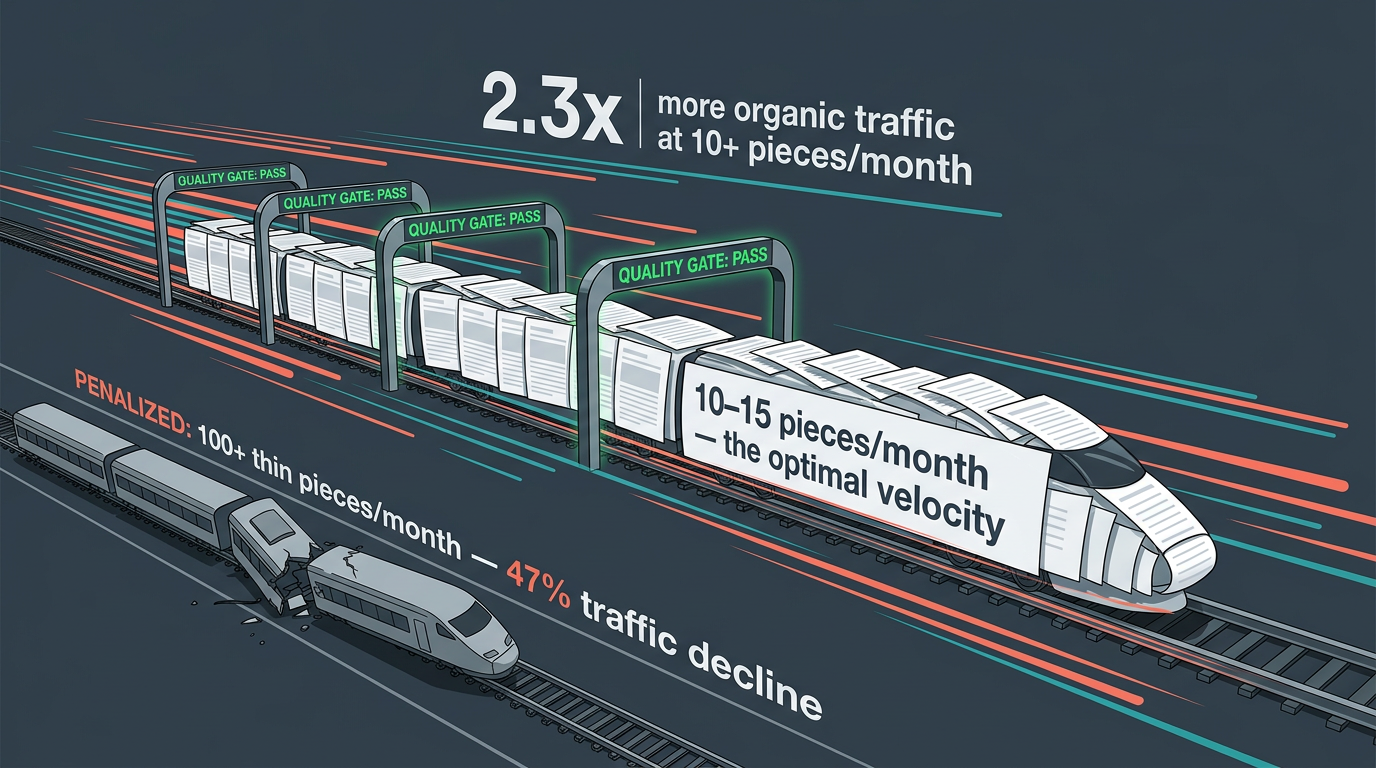
Recent data from Content Marketing Institute (2026) shows that teams achieving 10+ high-quality pieces per month see 2.3x more organic traffic than teams publishing 5 or fewer pieces. However, velocity without quality is fatal. Sites publishing low-quality content at high velocity see 47% traffic declines.
The Velocity vs. Quality Dilemma
The Problem
High Velocity, Low Quality:
- Publish 20+ pieces/month
- Thin, generic content
- Zero AI citations
- Rankings decline
Low Velocity, High Quality:
- Publish 2-3 pieces/month
- Excellent, comprehensive content
- Good citations and rankings
- Can't scale to cover topic
The Goal: High Velocity, High Quality
- Publish 10-15 pieces/month
- Comprehensive, authoritative content
- Strong citations and rankings
- Scalable across topic
Why Velocity Matters
Freshness Signal: Google and AI engines prioritize fresh content. Sites publishing 10+ pieces/month see 42% more citations than sites publishing 5 or fewer.
Topical Authority: Covering 90% of a topic requires volume. High velocity builds comprehensive content libraries faster.
Competitive Pressure: Competitors publish constantly. Falling behind means losing citations and rankings.
Algorithm Updates: Regular publishing provides more data points for algorithm learning. Consistent publishers recover faster from updates.
Why Quality Matters
Google's HCU: Helpful Content Update crushed low-quality, high-volume sites. Quality is non-negotiable.
AI Engine Preferences: Perplexity, ChatGPT, and Claude cite comprehensive, authoritative content. Thin content gets zero citations.
User Experience: Low-quality content drives high bounce rates. Users don't return, link, or convert.
Measuring Content Velocity
Velocity Metrics
Pieces Published per Month:
- Low: 1-5 pieces
- Medium: 6-10 pieces
- High: 11-20 pieces
- Excellent: 20+ pieces
Words Published per Month:
- Low: <5,000 words
- Medium: 5,000-15,000 words
- High: 15,000-30,000 words
- Excellent: 30,000+ words
Pieces per Team Member per Month:
- Low: <2 pieces
- Medium: 2-4 pieces
- High: 5-8 pieces
- Excellent: 8+ pieces
Quality Metrics (Don't Sacrifice These)
Word Count per Piece:
- Minimum: 2,000 words
- Recommended: 2,500-3,500 words
- Exceptional: 4,000+ words
Citation Rate:
- Low: 0-5 citations/month
- Medium: 6-20 citations/month
- High: 21-50+ citations/month
Engagement Metrics:
- Bounce rate: <60%
- Time on page: >2 minutes
- Scroll depth: >50%
Velocity/Quality Sweet Spot
Optimal Ranges:
- 10-15 pieces/month (high velocity)
- 2,500-3,500 words/piece (quality)
- 25,000-45,000 words/month (throughput)
Teams hitting these sweet spots see 2.8x more citations than teams elsewhere.
Content Velocity Framework
Phase 1: Assess Current Velocity
Audit:
- Pieces published per month (last 6 months)
- Average word count per piece
- Team size and capacity
- Quality metrics (citations, engagement)
Identify Bottlenecks:
- Research phase takes too long?
- Writing phase takes too long?
- Editing/QA takes too long?
- Publishing bottlenecks?
Set Targets:
- Target pieces per month (10-15 recommended)
- Target word count (2,500-3,500)
- Timeline to hit targets
Phase 2: Optimize Research Phase
Research Acceleration Tactics:
1. Use RankDraft Research Pipeline
- SERP analysis in minutes, not hours
- Competitor gap identification
- Content opportunity scoring
- Save 60-70% research time
2. Batch Research
- Research 10-15 topics in one session
- Create reusable research templates
- Build topic maps for clusters
3. Pre-Approved Topics
- Maintain approved topic backlog
- Pre-research high-priority topics
- Ready for instant writing
4. Leverage AI Research Assistants
- "Analyze these 10 competitor articles and identify gaps"
- "Generate list of 20 questions users ask about this topic"
- "Summarize these studies into key takeaways"
Expected research time: 30-45 minutes per topic (down from 2-3 hours)
Phase 3: Optimize Writing Phase
Writing Acceleration Tactics:
1. Use AI as First Draft Assistant
- Generate first draft from research outline
- Writer refines and adds human insights
- Save 50-60% writing time
2. Templates and Frameworks
- Create templates for different content types
- Pre-approve structures for guides, comparisons, FAQs
- Reduce decision-making during writing
3. Batch Writing
- Write multiple pieces in one session
- Maintain flow and momentum
- Reduce context-switching overhead
4. Specialist Writers
- Assign writers to specific topics
- Build expertise and reduce research time
- Faster writing through familiarity
Expected writing time: 2-3 hours per piece (down from 4-6 hours)
Phase 4: Optimize Editing/QA Phase
Editing Acceleration Tactics:
1. Pre-Approved Style Guide
- Consistent standards reduce editor time
- Fewer revisions needed
- Faster sign-off
2. Automated QA Checks
- Grammar and spelling (Grammarly)
- Readability scores
- Internal link verification
- Schema markup validation
3. Staged Editing
- First pass: Structure and flow (30 minutes)
- Second pass: Quality and accuracy (30 minutes)
- Third pass: SEO and formatting (20 minutes)
4. Fact-Check Templates
- Pre-approved sources for statistics
- Fact-checking checklist
- Reduce verification time
Expected editing time: 1.5 hours per piece (down from 3-4 hours)
Phase 5: Optimize Publishing Phase
Publishing Acceleration Tactics:
1. Pre-Approved Templates
- CMS templates with pre-set formatting
- Schema markup pre-configured
- Internal linking suggestions pre-loaded
2. Batch Publishing
- Schedule multiple pieces in advance
- Use CMS scheduling features
- Free up writer/editor time
3. Automated Distribution
- Auto-share to social media
- Auto-add to email newsletter
- Auto-notify team members
Expected publishing time: 15-20 minutes per piece (down from 30-45 minutes)
Velocity Strategies by Team Size
Solo Content Creator (1 Person)
Velocity Goal: 8-10 pieces/month (2,500-3,500 words each)
Workflow:
- Research: 30-45 minutes (AI-assisted)
- Writing: 3-4 hours (AI first draft + human refinement)
- Editing: 30 minutes (self-edit)
- Publishing: 15-20 minutes
Total per piece: 4.5-6.5 hours
Capacity:
- 8-10 pieces/month
- 20,000-35,000 words/month
Key Tools:
- RankDraft Research Pipeline
- AI writing assistant (ChatGPT/Claude)
- Grammarly
- CMS with scheduling
Small Team (2-3 People)
Velocity Goal: 12-18 pieces/month (2,500-3,500 words each)
Roles:
- 1-2 Writers
- 1 Editor (also writes)
Workflow:
- Research: 30 minutes (AI-assisted, writer)
- Writing: 2-3 hours (AI first draft + human)
- Editing: 1 hour (editor)
- Publishing: 15 minutes (writer)
Total per piece: 3.5-4.5 hours
Capacity:
- 12-18 pieces/month
- 30,000-63,000 words/month
Key Tools:
- RankDraft Research Pipeline
- AI writing assistant
- Shared content calendar
- Project management tool (Asana/Trello)
Medium Team (4-8 People)
Velocity Goal: 20-30 pieces/month (2,500-3,500 words each)
Roles:
- 3-5 Writers
- 1-2 Editors
- 1 Content Manager
Workflow:
- Research: 20-30 minutes (AI-assisted, specialized writers)
- Writing: 2-2.5 hours (AI first draft + human)
- Editing: 45 minutes (editor)
- Publishing: 10 minutes (writer)
Total per piece: 3-3.5 hours
Capacity:
- 20-30 pieces/month
- 50,000-105,000 words/month
Key Tools:
- RankDraft Research Pipeline
- AI writing assistant
- Content calendar with approvals
- Project management system
- Quality tracking dashboard
Maintaining Quality at High Velocity
Quality Gates
Gate 1: Research Quality
- SERP analysis completed
- Competitor gaps identified
- Unique angle defined
- Quality injection points identified
Gate 2: Draft Quality
- 2,500+ words
- Comprehensive coverage
- Personal insights added
- Specific examples included
Gate 3: Edit Quality
- Grammar and spelling error-free
- Factual accuracy verified
- Readability score >60
- Internal links functional
Gate 4: Publish Quality
- Schema markup implemented
- SEO meta tags optimized
- Publication date updated
- Ready for distribution
Use our AI content quality checklist for detailed gates.
Quality Monitoring
Weekly Metrics:
- Pieces published vs. goal
- Average word count per piece
- Citation rate
- Engagement metrics (bounce rate, time on page)
Monthly Metrics:
- Citation growth rate
- Position improvements
- Traffic from AI citations
- Conversion rate
Quarterly Deep Dive:
- Content quality audit
- E-E-A-T signal assessment
- Competitor comparison
- Strategy adjustment
Common Velocity Mistakes
1. Sacrificing Quality for Speed
Mistake: Publishing 20+ pieces but quality suffers (thin content, generic writing).
Fix: Maintain minimum 2,500 words per piece. Use AI acceleration, not AI replacement. Add human insights and experience.
2. No Quality Gates
Mistake: Publishing without quality checks, letting low-quality content slip through.
Fix: Implement 4 quality gates (research, draft, edit, publish). Use checklists. Reject content not meeting standards.
3. Burning Out Team
Mistake: Pushing unrealistic velocity targets, exhausting writers and editors.
Fix: Set realistic targets based on team size. Build in buffers. Use AI acceleration, not just working harder.
4. Inconsistent Publishing
Mistake: Publishing 15 pieces one month, 3 the next.
Fix: Maintain consistent velocity. Use content calendar. Schedule pieces in advance. Build backlog.
5. Ignoring Feedback
Mistake: Publishing at high velocity but not adapting based on performance data.
Fix: Track metrics weekly. Analyze what works. Double down on successful formats. Kill underperforming types.
Case Study: Velocity Scaling Success
Company: TechStartups, a B2B SaaS content marketing team.
Initial State (Q3 2025):
- Team size: 2 people (1 writer, 1 editor)
- Pieces published: 4-5/month
- Average word count: 1,800 words
- Quality: Mixed, some thin content
- Results: 8,000 organic visits/month, 2 AI citations/month
Velocity Optimization (Q4 2025 - Q1 2026):
Phase 1: Assessment (Month 1):
- Audit: 4-5 pieces/month, 1,800 words average
- Bottlenecks: Research (3 hours), writing (5 hours), editing (4 hours)
- Target: 10 pieces/month, 2,500+ words
Phase 2: Tool Implementation (Months 1-2):
- Implemented RankDraft Research Pipeline
- Set up AI writing assistant workflow
- Created content templates for guides, comparisons, FAQs
- Built quality gate checklists
Phase 3: Workflow Optimization (Months 2-3):
- Research: 3 hours → 30 minutes (83% reduction)
- Writing: 5 hours → 2.5 hours (50% reduction)
- Editing: 4 hours → 1 hour (75% reduction)
- Publishing: 30 minutes → 15 minutes (50% reduction)
Phase 4: Quality Maintenance (Months 3-4):
- Implemented 4 quality gates
- Maintained 2,500+ word minimum
- Added human insights and experience
- Weekly quality reviews
Results (Q1 2026):
Velocity Metrics:
- Pieces published: 4-5 → 12/month (+140%)
- Word count: 1,800 → 2,700 (+50%)
- Total words: 7,200 → 32,400/month (+350%)
- Time per piece: 12.5 hours → 4.75 hours (-62%)
Quality Metrics:
- Average word count: 2,700 words (above 2,500 minimum)
- AI citations: 2 → 28/month (+1,300%)
- Average citation position: 3.8 → 2.1
- Featured snippets: 2 → 15
Traffic Metrics:
- Organic visits: 8,000 → 19,500 (+144%)
- AI search traffic: 120 → 3,200 (+2,567%)
- Direct traffic: +38% (brand visibility)
ROI Metrics:
- Content ROI: 2.1x → 4.2x (+100%)
- Lead generation: +165%
- Cost per lead: -42%
Key Insights:
- AI acceleration works: 62% time reduction without quality sacrifice
- Quality gates essential: Maintained standards while increasing velocity 140%
- Velocity correlates with citations: 12 pieces/month drove 28 citations (vs. 2 at 4 pieces/month)
- Word count matters: Increasing from 1,800 to 2,700 words improved citation rate 52%
Conclusion
Content velocity matters in 2026. Freshness, topical authority, and competitive pressure all demand high publishing frequency. But velocity without quality is fatal.
Target 10-15 pieces/month at 2,500-3,500 words each. Use AI acceleration, not replacement. Implement quality gates. Maintain E-E-A-T standards.
Teams hitting the velocity/quality sweet spot see 2.8x more citations than teams elsewhere.
Use RankDraft's research pipeline to accelerate research. Use AI assistants for first drafts. Implement quality gates. Monitor metrics and iterate.
The future belongs to teams that scale quality content, not just content.
Ready to accelerate your content production without sacrificing quality? Use RankDraft's content velocity tools to optimize your workflow.