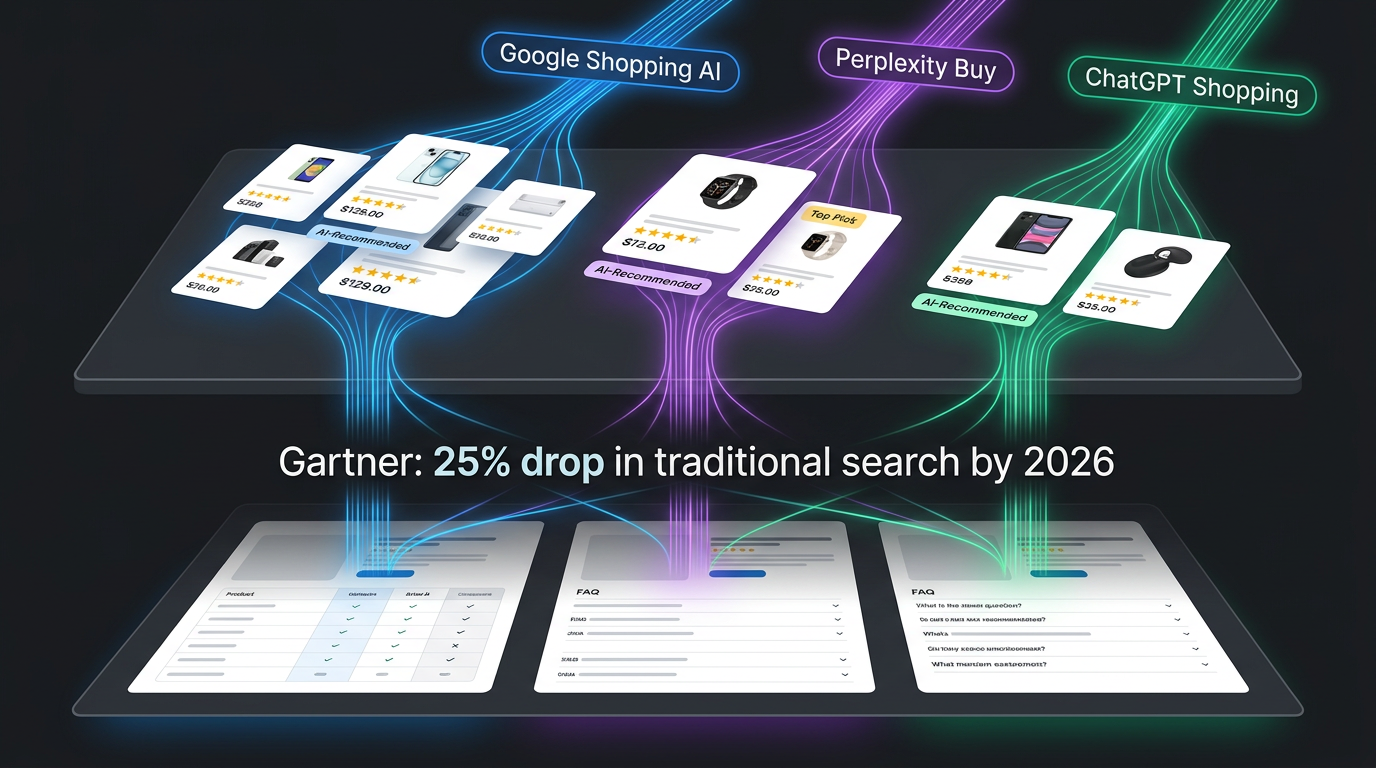
Gartner predicted in late 2024 that traditional search engine volume would drop 25% by 2026 as AI-powered alternatives absorb product research queries. That prediction is playing out. Google AI Overviews now reach over 1 billion users. Perplexity processes hundreds of millions of monthly queries. ChatGPT surpassed 300 million weekly active users and launched dedicated shopping features. The shopping journey no longer starts with a search box. It starts with a question.
For eCommerce brands, this shift changes everything. When a shopper asks Perplexity "best espresso machine under $500" or tells ChatGPT "I need a moisturizer for sensitive skin that won't break me out," the AI engine compares products, extracts pricing, reads reviews, and delivers a synthesized recommendation. Your product either makes the shortlist or it doesn't exist.
This guide covers the complete eCommerce content strategy for 2026: how to structure product pages, category content, and merchant feeds so AI engines cite and recommend your products across every platform.
For background on how AI search engines select sources, see our guide to Generative Engine Optimization.
How AI Search Changed the Shopping Journey
The Old Funnel vs. the New One
Traditional shopping journey (pre-2024):
- Search Google for "best espresso machine"
- Click through 5-8 results
- Open product pages in tabs
- Manually compare features and prices
- Read review sites separately
- Return to make purchase
AI-driven shopping journey (2026):
- Ask AI engine "best espresso machine under $500 for a beginner"
- AI engine searches the web, extracts data from product pages, reviews, and comparison guides
- AI engine synthesizes a ranked recommendation with pros, cons, and pricing
- Shopper clicks through to 1-2 recommended products
- Makes purchase (sometimes directly inside the AI platform)
The critical difference: AI engines act as a filter layer. Instead of visiting 5-8 sites, shoppers visit 1-2. SparkToro and Datos research consistently shows that over 60% of Google searches end without a click. AI Overviews push that number higher for product research queries. If your product doesn't appear in the AI-synthesized answer, most shoppers will never see your product page.
What Each AI Platform Does Differently for Shopping
Each AI search engine handles product queries with different strengths. Optimizing for all of them requires understanding what each one extracts and cites.
Google AI Overviews synthesize answers from top-ranking pages and display product carousels with images, prices, and ratings pulled from Google Merchant Center and structured data. For a query like "best noise-cancelling headphones 2026," Google AI Overviews typically cite 3-5 sources: a comparison guide, a product review site, and 1-2 retailer pages with strong schema markup.
For a deep dive on Google's citation patterns, see our Google AI Overviews optimization guide.
Perplexity launched its Shopping features in late 2024, including "Buy with Pro" that lets users purchase products directly within the app. Perplexity searches the web in real-time, extracts comparison tables and specification lists, and cites pages with structured, extractable data. For product queries, Perplexity often pulls pricing directly from product pages and displays side-by-side comparisons.
Our Perplexity optimization guide covers citation patterns in detail.
ChatGPT added shopping-like product recommendations in early 2025, integrating product cards with images, prices, and direct purchase links into search results. ChatGPT favors comprehensive, editorial-quality content: detailed reviews, buying guides with expert analysis, and pages that explain why a product fits a specific use case.
Claude prioritizes research-backed content, expert analysis, and balanced perspectives. For product queries, Claude cites pages that acknowledge trade-offs, reference testing data, and provide technical depth rather than promotional copy.
For a full comparison of all platforms, see our AI search engine comparison.
eCommerce Content Architecture
Winning in AI search requires three content layers working together: optimized product pages, supporting editorial content, and merchant feed integrations. Each layer feeds different AI engines differently.
Layer 1: Product Pages That AI Engines Can Extract From
Your product page is the atomic unit of eCommerce SEO. AI engines scrape it directly. Every element needs to be structured for extraction.
Product name and title tag: Don't just use the product name. Include the category, primary use case, and a differentiating detail.
| Weak Title | Strong Title |
|---|---|
| Breville Barista Express | Breville Barista Express BES870XL: Semi-Automatic Espresso Machine with Built-in Grinder |
| CeraVe Moisturizer | CeraVe Moisturizing Cream: Fragrance-Free Face and Body Moisturizer for Dry Skin (16 oz) |
| Sony WH-1000XM5 | Sony WH-1000XM5: Wireless Noise-Cancelling Over-Ear Headphones with 30-Hour Battery |
Product description (300-500 words minimum): AI engines need substance to extract. A 50-word description gives them nothing to work with. Structure your description in extractable blocks:
- Opening paragraph (50-75 words): What the product is, who it's for, and why it stands out
- Key features (100-150 words): 5-7 bullet points with specific details, not marketing fluff. "Extracts espresso at 15 bars of pressure with a 54mm portafilter" beats "Makes amazing coffee"
- Use cases (75-100 words): Specific scenarios where this product excels. "Ideal for home baristas who want cafe-quality espresso without a separate grinder"
- Technical specifications: Structured list with exact measurements, materials, compatibility
- What's in the box: Complete list of included items
Comparison to alternatives: This is the single most important element for AI citations. AI engines answer comparison queries constantly ("Breville vs. DeLonghi," "CeraVe vs. Cetaphil"). If your product page includes a fair comparison to 3-5 competitors, you become the source AI engines cite.
Build a comparison table directly on the product page:
| Feature | Breville Barista Express | DeLonghi Magnifica | Gaggia Classic Pro |
|---|---|---|---|
| Price | $699 | $549 | $449 |
| Grinder | Built-in burr | Built-in burr | None (separate purchase) |
| Pressure | 15 bar | 15 bar | 15 bar |
| Milk Frother | Manual steam wand | Automatic | Manual steam wand |
| Best For | Home baristas who want control | Convenience-first buyers | Purists on a budget |
FAQ section (10-20 questions): AI engines cite FAQ content at a high rate. Each question-answer pair is a discrete, extractable unit. Write questions in the exact phrasing shoppers use:
- "Is the Breville Barista Express worth it?"
- "Can I use pre-ground coffee with the Breville Barista Express?"
- "How long does the Breville Barista Express last?"
- "Breville Barista Express vs. Breville Barista Pro: what's the difference?"
Answer each in 2-4 sentences with specific facts, not vague reassurances.
Customer reviews displayed on-page: AI engines extract review sentiment. Display reviews prominently with:
- Aggregate rating and total review count
- Filterable by rating (5-star, 4-star, etc.)
- "Most helpful" reviews surfaced first
- Both positive and critical reviews visible (balanced pages get cited more)
Layer 2: Supporting Editorial Content
Product pages capture bottom-of-funnel queries. Editorial content captures the research phase, where AI engines do most of their citation work.
Category buying guides ("Best X for Y"): These are the highest-value pages for AI search citations. When someone asks "best espresso machine for beginners," AI engines look for comprehensive guides that compare multiple products.
Structure:
- H1: "Best [Category] for [Use Case] in 2026"
- 2,000-3,000 words
- Comparison table of 5-10 products near the top
- Individual product sections (200-300 words each) with pros, cons, and a verdict
- "Best for" designations: best overall, best budget, best premium, best for [specific use case]
- FAQ section with 15-20 questions
Product vs. product comparisons: Create dedicated pages for the comparisons shoppers actually search for. Check search volume for "[Product A] vs [Product B]" queries in your category. These pages convert at 3-8% because the shopper is close to a buying decision.
Structure each comparison page with:
- Side-by-side specification table
- Category-by-category breakdown (design, performance, value, durability)
- A clear verdict with reasoning
- "Choose [Product A] if... Choose [Product B] if..." section
How-to and use case guides: "How to choose a home espresso machine," "Best skincare routine for acne-prone skin," "How to set up a home office under $500." These guides establish topical authority and give AI engines editorial content to cite alongside product recommendations.
Problem-solution content: Target the questions people ask before they know what product they need. "Why does my coffee taste bitter?" leads to grinder recommendations. "How to fix dry skin in winter" leads to moisturizer recommendations. This content captures shoppers at the earliest research stage.
For more on building a content network that establishes authority, see our topical authority scaling guide.
Layer 3: Merchant Feeds and Structured Data
Merchant feeds are the direct pipeline between your product catalog and AI shopping features.
Google Merchant Center: Google AI Overviews pull product data (images, prices, availability, ratings) from Merchant Center feeds. If you're not submitting a feed, your products won't appear in the visual product carousels within AI Overviews.
Requirements:
- Product title, description, image URL, price, availability
- GTIN/UPC for product matching
- Product category (Google taxonomy)
- Shipping and return information
- Sale price and promotion details
Perplexity Merchant Program: Perplexity's "Buy with Pro" lets shoppers purchase directly within the platform. Participating merchants submit product feeds that Perplexity uses for in-app product cards. If you sell direct-to-consumer, this is a channel worth prioritizing.
Schema markup (required for all product pages):
Implement Product, Review, FAQPage, and BreadcrumbList schema. AI engines extract structured data before they parse page content.
{
  "@context": "https://schema.org",
  "@type": "Product",
  "name": "Breville Barista Express BES870XL",
  "image": [
    "https://example.com/images/breville-front.jpg",
    "https://example.com/images/breville-side.jpg"
  ],
  "description": "Semi-automatic espresso machine with built-in conical burr grinder. 15 bars of pressure, 54mm portafilter, manual steam wand.",
  "brand": {
    "@type": "Brand",
    "name": "Breville"
  },
  "sku": "BES870XL",
  "gtin13": "0021614055507",
  "offers": {
    "@type": "Offer",
    "url": "https://example.com/breville-barista-express",
    "price": "699.95",
    "priceCurrency": "USD",
    "availability": "https://schema.org/InStock",
    "priceValidUntil": "2026-12-31",
    "shippingDetails": {
      "@type": "OfferShippingDetails",
      "shippingRate": {
        "@type": "MonetaryAmount",
        "value": "0",
        "currency": "USD"
      },
      "deliveryTime": {
        "@type": "ShippingDeliveryTime",
        "handlingTime": {
          "@type": "QuantitativeValue",
          "minValue": 0,
          "maxValue": 1,
          "unitCode": "DAY"
        },
        "transitTime": {
          "@type": "QuantitativeValue",
          "minValue": 3,
          "maxValue": 5,
          "unitCode": "DAY"
        }
      }
    },
    "hasMerchantReturnPolicy": {
      "@type": "MerchantReturnPolicy",
      "returnPolicyCategory": "https://schema.org/MerchantReturnFiniteReturnWindow",
      "merchantReturnDays": 30,
      "returnMethod": "https://schema.org/ReturnByMail"
    }
  },
  "aggregateRating": {
    "@type": "AggregateRating",
    "ratingValue": "4.6",
    "reviewCount": "3847",
    "bestRating": "5"
  },
  "review": [
    {
      "@type": "Review",
      "reviewRating": {
        "@type": "Rating",
        "ratingValue": "5"
      },
      "author": {
        "@type": "Person",
        "name": "Home Barista Monthly"
      },
      "reviewBody": "Best entry-level semi-automatic espresso machine. The built-in grinder eliminates the need for a separate $200+ grinder purchase."
    }
  ]
}
Notice this schema includes shipping details and return policy, both of which Google now uses in AI Overviews product cards. Most competitors skip these fields, giving you an advantage.
For the complete schema markup playbook, see our schema markup guide for AI Overviews.
Platform-Specific Optimization Tactics
Google AI Overviews: Structured Data + Freshness
BrightEdge research from 2024 found AI Overviews appear in roughly 15-25% of eCommerce and product queries, lower than informational queries (30-40%). But when they do appear, they dominate the viewport.
What gets cited:
- Product pages with complete Product schema (price, availability, ratings, shipping)
- Category comparison guides with structured tables
- Review aggregation pages with multiple product ratings
- Pages updated within the last 90 days
Tactics:
- Submit to Google Merchant Center. This is non-negotiable for product carousels in AI Overviews.
- Implement full Product schema with shipping and return policy fields.
- Add "Updated [Month] 2026" to category guide titles and refresh quarterly.
- Create "Best [Category] 2026" pages with comparison tables of 5-10 products.
- Ensure every product page has an FAQ section with FAQPage schema.
Perplexity: Tables, Specs, and Direct Answers
Perplexity's real-time web search makes it the most responsive to page-level changes. Update your pricing, and Perplexity reflects it within days.
What gets cited:
- Comparison tables with specific data points (prices, ratings, dimensions)
- Specification lists in structured formats
- FAQ sections with direct, factual answers
- Pages with clear pricing information
Tactics:
- Put comparison tables near the top of category pages, not buried at the bottom.
- Format specifications as structured lists, not prose paragraphs.
- Answer every FAQ with a specific fact in the first sentence. "The Breville Barista Express weighs 23 pounds and measures 13.25 x 12.5 x 15.75 inches." Not: "It's a reasonably sized machine that fits on most counters."
- Include price in plain text on the page (not just in JavaScript-rendered elements that crawlers might miss).
- Apply for the Perplexity Merchant Program if you sell direct-to-consumer.
ChatGPT: Editorial Depth and Expert Authority
ChatGPT's shopping integration now displays product cards with images, prices, and purchase links. But ChatGPT also handles long-form research queries where shoppers want detailed guidance.
What gets cited:
- Comprehensive buying guides (2,500+ words)
- Expert reviews with testing methodology described
- Content that explains the reasoning behind recommendations
- Pages from domains with established editorial authority
Tactics:
- Write buying guides that read like editorial content, not affiliate listicles. Explain why you recommend specific products based on testing or analysis.
- Include expert credentials or methodology. "We tested 12 espresso machines over 6 weeks, pulling 50+ shots on each" carries weight.
- Cover edge cases and specific scenarios. "If you have hard water, the Breville's built-in water filter becomes a major advantage over the DeLonghi."
- Structure content with clear H2/H3 hierarchy so ChatGPT can extract specific sections.
Claude: Research, Trade-offs, and Technical Depth
Claude tends to cite content that acknowledges complexity and trade-offs rather than making superlative claims.
What gets cited:
- Technical articles explaining how products work
- Content that presents pros and cons honestly
- Research-backed claims with cited sources
- Pages that compare approaches, not just products
Tactics:
- Include a "Limitations" or "Who should not buy this" section on product pages. Counterintuitive, but Claude specifically favors balanced content.
- Explain the technology. For an espresso machine: how pressure, grind size, and temperature interact. For skincare: how ingredients like niacinamide and hyaluronic acid work at a molecular level.
- Reference industry testing, lab results, or published research where available.
- Acknowledge when a competitor's product is better for a specific use case.
eCommerce Keyword Strategy for AI Search
AI search engines respond to natural language queries, not keyword fragments. Your keyword strategy needs to reflect how people actually talk to AI.
Product Keywords (Bottom of Funnel)
Format: [Brand] [Product Name] [Model/Version]
Examples:
- "Breville Barista Express BES870XL"
- "CeraVe Moisturizing Cream 16 oz"
- "Sony WH-1000XM5 headphones"
Where to use: Product page title, H1, schema name field, image alt text.
These keywords have high purchase intent and drive direct sales. Conversion rates typically range from 3-8%.
Category + Use Case Keywords (Middle of Funnel)
Format: "best [category] for [use case/audience]"
Examples:
- "best espresso machine for beginners"
- "best moisturizer for sensitive acne-prone skin"
- "best noise-cancelling headphones for commuting"
- "best standing desk under $500"
Where to use: Category buying guides, comparison pages.
These are the queries AI engines answer most often. When Perplexity or ChatGPT gets "best espresso machine for beginners," they look for pages that explicitly address that exact combination of category + use case.
Comparison Keywords (Decision Stage)
Format: "[Product A] vs [Product B]"
Examples:
- "Breville Barista Express vs DeLonghi Magnifica"
- "CeraVe vs Cetaphil moisturizer"
- "AirPods Pro vs Sony WH-1000XM5"
- "Dyson V15 vs Shark Navigator"
Where to use: Dedicated comparison pages.
Comparison queries convert at 3-8% because the shopper has already narrowed their options. Create comparison pages for every product matchup that shows meaningful search volume.
Problem-First Keywords (Top of Funnel)
Format: Questions about problems, not products
Examples:
- "why does my espresso taste sour"
- "how to fix dry flaky skin"
- "best way to reduce office noise"
- "how to organize a small home office"
Where to use: How-to guides, problem-solution content.
These capture shoppers before they know what product they need. AI engines frequently cite problem-solution content and then recommend products within the answer.
For more on organizing keywords into content clusters, see our keyword clustering guide.
Category Page Strategy
Category pages are where AI engines do their heaviest extraction work. A well-structured category page can earn citations across all four major AI platforms simultaneously.
Anatomy of a High-Performing Category Page
Example: "Best Home Espresso Machines 2026"
H1: Best Home Espresso Machines 2026: Complete Buying Guide
Section 1: Quick Comparison Table (above the fold)
| Machine | Price | Type | Best For | Rating |
|---|---|---|---|---|
| Breville Barista Express | $699 | Semi-automatic | Best overall | 4.6/5 |
| DeLonghi Magnifica S | $549 | Super-automatic | Convenience | 4.4/5 |
| Gaggia Classic Pro | $449 | Semi-automatic | Budget enthusiasts | 4.5/5 |
| Breville Bambino Plus | $499 | Semi-automatic | Small kitchens | 4.5/5 |
| Jura E8 | $2,499 | Super-automatic | Premium no-compromise | 4.7/5 |
Perplexity and Google AI Overviews extract tables like this directly. Place it near the top.
Section 2: How to Choose (300-500 words) Cover the key decision factors: semi-automatic vs. super-automatic, pressure and temperature, grinder type, milk frothing, budget ranges. This section establishes expertise and gives ChatGPT and Claude editorial content to cite.
Section 3: Individual Product Sections (200-300 words each) For each product: what it is, who it's for, key specs, pros, cons, and a verdict. Link to the full product page.
Section 4: Best-By-Category Picks
- Best Overall: Breville Barista Express
- Best Budget: Gaggia Classic Pro
- Best for Beginners: Breville Bambino Plus
- Best Super-Automatic: DeLonghi Magnifica S
- Best Premium: Jura E8
AI engines love "best for" designations. They map directly to how shoppers phrase queries.
Section 5: FAQ (15-20 questions) Include both product-specific and category-level questions:
- "What's the difference between semi-automatic and super-automatic espresso machines?"
- "Is a $500 espresso machine worth it?"
- "Do I need a separate grinder for espresso?"
- "How much should I spend on a home espresso machine?"
Content Refresh Strategy for eCommerce
Stale product content loses AI citations fast. Pricing changes, new product releases, and updated reviews all signal freshness to AI engines.
Weekly: Price and Availability
- Update pricing on product pages and in schema markup
- Mark out-of-stock items in schema (availability field)
- Update promotion and sale information
- Ensure Merchant Center feed reflects current data
Monthly: Reviews and Social Proof
- Add new customer reviews to product pages
- Update aggregate rating in schema markup
- Add any new awards, certifications, or media mentions
- Refresh "most helpful" review selections
Quarterly: Editorial Content
- Update category buying guides with new products
- Refresh comparison tables with current pricing and ratings
- Add new FAQ questions based on customer support data
- Update "best for" designations if rankings have changed
- Add "Updated [Month] 2026" to title tags
Annually: Full Content Audit
- Comprehensive rewrite of category guides
- Remove discontinued products from comparisons
- Create new comparison pages for new product matchups
- Audit and update all schema markup
For a complete framework on identifying which content needs refreshing first, see our content decay detection guide. For refresh tactics, see our content refresh strategies for 2026.
Measuring eCommerce AI Search Performance
Traditional eCommerce analytics (organic traffic, conversion rate, revenue) still matter. But AI search adds a new measurement layer.
AI Citation Tracking
Track how often your products appear in AI-generated answers:
- Google AI Overviews: Search your product and category keywords in Google. Note whether your pages appear in the AI Overview, the citation list, or the product carousel.
- Perplexity: Run your target queries in Perplexity. Track which of your pages get cited and at which position.
- ChatGPT: Test product and category queries. Note whether ChatGPT recommends your products and which pages it cites.
- Claude: Test research-style queries about your product categories.
Build a monthly tracking spreadsheet with 20-30 target queries across all four platforms. Track citation frequency, position, and which specific pages get cited.
For a complete citation tracking methodology, see our AI citation tracking guide.
Revenue Attribution
Referral traffic from AI engines: In Google Analytics 4, segment traffic by source. Perplexity, ChatGPT, and Claude referral traffic is identifiable in referral reports. Google AI Overview clicks appear as standard Google organic traffic but often show different behavior patterns (lower bounce rate, higher pages per session).
Conversion rate by source: AI-referred traffic typically converts at a higher rate than standard organic because the shopper has already been pre-qualified by the AI recommendation. Track conversion rate, average order value, and revenue per session by AI source.
Citation-to-revenue pipeline: Map which citations drive actual traffic and purchases. A product that gets cited by Perplexity 15 times per month but receives zero click-throughs needs different optimization than a product that gets cited 3 times but converts consistently.
For a full measurement framework, see our ROI measurement guide for AI-optimized content.
Key eCommerce Benchmarks
| Metric | Product Pages | Category Pages | Comparison Pages |
|---|---|---|---|
| Organic conversion rate | 2-5% | 1-3% | 3-8% |
| AI-referred conversion rate | 4-8% | 2-5% | 5-12% |
| Target time on page | 2+ minutes | 3+ minutes | 4+ minutes |
| Target bounce rate | <65% | <60% | <50% |
Common eCommerce AI Search Mistakes
1. Thin Product Descriptions
The problem: 50-word product descriptions copied from the manufacturer. AI engines have nothing unique to extract, so they cite a competitor's more detailed page instead.
The fix: Write 300-500 word descriptions with original analysis, use case guidance, and comparison context. Include information the manufacturer doesn't provide: real-world performance notes, sizing guidance from customer feedback, common issues and workarounds.
2. No Comparison Content
The problem: You have 500 product pages but zero comparison guides. When a shopper asks "best espresso machine for beginners," AI engines cite Wirecutter or a competitor with comparison content, not your individual product pages.
The fix: Create category buying guides for every major product category you sell. Add comparison tables to product pages. Build dedicated vs. pages for your top 20 product matchups. Sites like Wirecutter and RTINGS dominate AI citations for product queries specifically because their content is structured for comparison.
3. Missing or Incomplete Schema Markup
The problem: No Product schema, or Product schema that only includes name and price. AI engines use schema as a primary data extraction source for product information.
The fix: Implement complete Product schema with brand, SKU, GTIN, pricing, availability, shipping details, return policy, and aggregate ratings. Add FAQPage schema to every FAQ section. Add Review schema for customer reviews.
4. Ignoring Merchant Feeds
The problem: You have great product pages but haven't submitted product data to Google Merchant Center or applied for the Perplexity Merchant Program. Your products don't appear in AI shopping carousels.
The fix: Submit a complete product feed to Google Merchant Center. Apply for Perplexity's merchant program. Keep feeds updated with current pricing and availability. This is the most overlooked eCommerce AI optimization in 2026.
5. JavaScript-Rendered Product Data
The problem: Product prices, specifications, and reviews load via JavaScript after the initial page render. Many AI crawlers don't execute JavaScript, so they see an empty page.
The fix: Ensure critical product data (price, availability, specs, reviews) is present in the initial HTML. Use server-side rendering for product pages. Verify by viewing page source (not the rendered page) to confirm data is present.
6. Optimizing for Only One Platform
The problem: You optimized for Google and ignored Perplexity, ChatGPT, and Claude. You're missing traffic from platforms that collectively handle hundreds of millions of product queries monthly.
The fix: Build content that works across all platforms. Comparison tables serve Perplexity. Comprehensive editorial content serves ChatGPT. Research-backed analysis serves Claude. Schema markup serves Google. A well-structured page scores on all four.
For a detailed comparison of what each platform prioritizes, see our AI search engine comparison.
7. No Content Refresh Cadence
The problem: Product pages published once and never updated. Prices are outdated, discontinued products still listed, reviews from two years ago.
The fix: Establish a refresh cadence: weekly for pricing and availability, monthly for reviews and ratings, quarterly for editorial content and comparisons. AI engines check freshness signals and favor recently updated content.
Case Study: DTC Skincare Brand Goes From Invisible to Cited
Brand: A direct-to-consumer skincare brand selling 85 products across cleansers, moisturizers, serums, and sunscreens. Revenue primarily from their Shopify store.
Starting position (January 2026):
- 3,200 monthly organic visitors
- Zero AI engine citations across all platforms
- Product pages: 75-word manufacturer descriptions, no schema markup
- No editorial content (no buying guides, no comparisons, no how-to content)
- Google Merchant Center feed: not submitted
What they implemented:
Month 1: Product page overhaul
- Rewrote all 85 product descriptions to 300-400 words with original use case guidance
- Added FAQ sections (8-12 questions per product) addressing real customer questions from support tickets
- Implemented full Product schema with ratings, pricing, availability, and shipping details
- Added "Compare to" sections on the top 30 products with competitive alternatives
- Submitted product feed to Google Merchant Center
Month 2: Editorial content buildout
- Created 8 category buying guides ("Best Moisturizer for Dry Skin," "Best Vitamin C Serum 2026," etc.)
- Created 12 product vs. product comparison pages for their top matchups
- Created 6 how-to guides ("How to Build a Skincare Routine for Acne-Prone Skin," etc.)
- Each guide included comparison tables, FAQ sections, and "best for" designations
Month 3: Platform-specific optimization
- Applied for Perplexity Merchant Program
- Added structured comparison tables optimized for Perplexity extraction
- Expanded buying guides to 2,500+ words with expert methodology sections for ChatGPT
- Added ingredient research and clinical study references for Claude
Results after 6 months:
| Metric | Before | After | Change |
|---|---|---|---|
| Monthly organic visitors | 3,200 | 18,400 | +475% |
| AI engine citations (monthly) | 0 | 87 | N/A |
| Perplexity citations | 0 | 34 | N/A |
| Google AI Overview appearances | 0 | 28 | N/A |
| ChatGPT citations | 0 | 18 | N/A |
| Claude citations | 0 | 7 | N/A |
| Organic revenue (monthly) | $8,500 | $52,000 | +512% |
| Average conversion rate | 1.8% | 3.4% | +89% |
| AI-referred conversion rate | N/A | 5.1% | N/A |
What drove the results:
- Comparison content generated 60% of all AI citations. The "Best Moisturizer for Dry Skin" guide alone earned 14 citations across platforms.
- Google Merchant Center submission was responsible for all 28 AI Overview product carousel appearances.
- FAQ sections were the single most-cited element for Perplexity queries.
- AI-referred traffic converted at 5.1% vs. 3.4% for standard organic, confirming that AI pre-qualification leads to higher-intent visitors.
The Future of eCommerce AI Search
AI-Native Shopping Experiences
AI platforms are building shopping directly into the conversation. Perplexity's Buy with Pro, ChatGPT's product cards, and Google's AI Overview shopping carousels are early versions of what will become fully transactional AI interfaces. Shoppers will research, compare, and purchase without leaving the AI platform.
What to prepare for: Ensure your product data is available in merchant feeds, your pricing is machine-readable, and your schema markup includes everything needed for an AI engine to present a complete product card (image, price, availability, shipping, returns).
Visual Search Integration
Google Lens processes over 20 billion visual searches per month. AI engines are integrating visual search, letting shoppers photograph a product and get instant identification, pricing, and purchase options.
What to prepare for: Optimize product images with descriptive file names and alt text. Use multiple angles. Include lifestyle images that show the product in context. Ensure images are high resolution and properly compressed for fast loading.
Conversational Commerce
Shoppers are moving from single queries to multi-turn conversations with AI. "Best espresso machine for beginners" becomes a 5-message exchange: "What's your budget?" "Do you want a built-in grinder?" "How important is milk frothing?" AI engines that support this need product data structured for conditional recommendations.
What to prepare for: Structure product content around decision criteria, not just features. Create content that answers conditional questions: "If you prioritize convenience, the DeLonghi Magnifica. If you want to learn the craft, the Gaggia Classic Pro."
Personalized AI Recommendations
AI engines are starting to personalize product recommendations based on user context: past purchases, stated preferences, location, and budget. Generic "best product" content will lose ground to content that maps products to specific user profiles.
What to prepare for: Create content segmented by user type, budget tier, and use case. The more specific your "best for" designations, the better your content matches personalized AI queries.
Social Commerce and AI Convergence
TikTok Shop, Instagram Shopping, and YouTube Shopping are generating product content (reviews, demonstrations, unboxings) that AI engines index and cite. Social proof from these platforms influences AI recommendations.
What to prepare for: Ensure your brand has a presence on social commerce platforms. User-generated content from these platforms often gets cited by AI engines as authentic product feedback.
Conclusion
eCommerce content strategy in 2026 requires thinking about AI engines as the first touchpoint, not your product page. When a shopper asks Perplexity for a recommendation or ChatGPT for a comparison, the AI engine decides which products to surface based on the quality, structure, and freshness of your content.
Three priorities to start with:
- Fix your product pages. Write 300-500 word descriptions, add FAQ sections, implement complete schema markup, and include comparison tables. This is the foundation.
- Build comparison content. Category buying guides and product vs. product pages earn the most AI citations. If you create nothing else, create these.
- Submit merchant feeds. Google Merchant Center and the Perplexity Merchant Program are how your products appear in AI shopping carousels. Without feeds, you're invisible in the most prominent placements.
The brands winning eCommerce AI search in 2026 are the ones treating AI engines as a distribution channel, not an afterthought.
Ready to optimize your eCommerce content for AI search? RankDraft's multi-platform research shows how your products appear (and don't appear) across Google, Perplexity, ChatGPT, and Claude, so you know exactly what to fix first.
Frequently Asked Questions
Q: How does eCommerce SEO differ for AI search engines compared to traditional Google SEO? A: Traditional eCommerce SEO focuses on keyword targeting, backlinks, and technical optimization to rank in Google's blue links. AI search optimization focuses on making your product data extractable. AI engines synthesize answers from multiple sources, so your content needs comparison tables, structured specifications, FAQ sections, and complete schema markup. The goal shifts from "rank #1" to "get cited in the AI-generated answer."
Q: What schema markup is essential for eCommerce AI search? A: Product schema is the baseline: include name, image, description, brand, SKU, GTIN, price, availability, shipping details, and return policy. Add AggregateRating schema for review summaries. Implement FAQPage schema on every page with FAQ content. Add Review schema for individual customer reviews. BreadcrumbList schema helps AI engines understand your site hierarchy. Most eCommerce sites implement Product schema but skip shipping, returns, and GTIN, which are the fields Google AI Overviews specifically use for product cards.
Q: Should I create comparison pages for every product combination? A: No. Focus on comparisons that shoppers actually search for. Check search volume for "[Product A] vs [Product B]" queries. Typically, your top 20-30 product matchups will cover 80% of comparison search demand. For broader coverage, use comparison tables within category buying guides rather than creating individual pages for every possible combination.
Q: How important are merchant feeds for AI search? A: In 2026, merchant feeds are as important as schema markup. Google AI Overviews pull product images, prices, and availability from Merchant Center feeds to display in shopping carousels. Perplexity's Buy with Pro uses merchant feeds for in-app purchases. If you don't submit feeds, your products won't appear in these prominent placements, regardless of how well your product pages are optimized.
Q: How do I track whether AI engines are recommending my products? A: Manual testing is currently the most reliable method. Run 20-30 target queries across Google (check AI Overviews), Perplexity, ChatGPT, and Claude each month. Track which queries cite your products, which pages get cited, and your citation position. In Google Analytics 4, segment referral traffic from Perplexity (perplexity.ai) and ChatGPT (chatgpt.com) to measure actual visits and conversions from AI sources.
Q: What content types earn the most AI citations for eCommerce? A: Category buying guides with comparison tables earn the most citations across all platforms. Perplexity heavily cites pages with structured comparison tables. ChatGPT cites comprehensive buying guides with editorial depth. Google AI Overviews cite pages with Product schema and Merchant Center data. Product FAQ sections are cited at a high rate across all platforms because each Q&A pair is a discrete, extractable unit.
Q: How often should I update eCommerce content for AI search? A: Update pricing and availability weekly (or automate it via Merchant Center feeds). Refresh reviews and social proof monthly. Update category guides, comparison tables, and FAQ sections quarterly. Do a full content audit annually to remove discontinued products and add new ones. AI engines check freshness signals, and outdated pricing or discontinued products in your comparisons erode trust.
Q: Can small eCommerce stores compete with Amazon and Walmart in AI search? A: Yes, for specific queries. Amazon and Walmart dominate generic product queries ("buy Nike shoes"), but AI engines cite specialized, editorial content for research queries ("best running shoes for flat feet," "how to choose hiking boots for beginners"). A small store with detailed buying guides, honest comparisons, and original product analysis can earn citations that Amazon's thin product listings cannot. Focus on specific niches, detailed comparisons, and expert content where large marketplaces are weakest.
Q: Should I use AI to write my eCommerce product content? A: AI can draft product descriptions, FAQ sections, and comparison tables, but the output needs human editing for accuracy, brand voice, and original insights. The content that earns the most AI citations includes specific details that only come from hands-on product experience: real performance notes, sizing quirks from customer feedback, and honest assessments of limitations. Use AI to scale the framework, then add the human expertise that makes your content worth citing.