Entities are the building blocks of AI search. When users query "best CRM for small business," AI engines don't match keywords. They understand entities: "CRM" (software category), "small business" (company size), and "best" (comparison intent). Optimizing for entities means structuring content so AI engines can identify, understand, and connect these concepts.
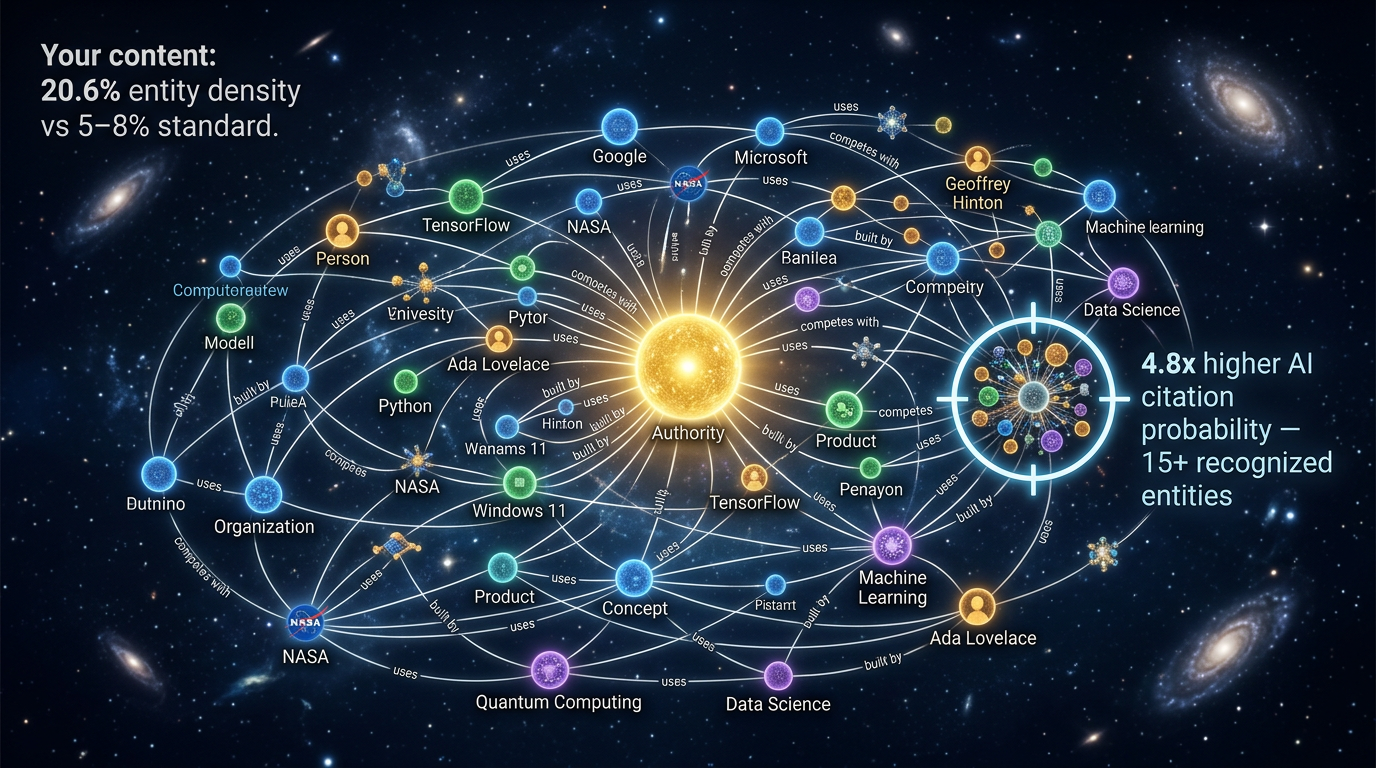
This matters more in 2026 than ever before. Kevin Indig's analysis of 1.2 million ChatGPT responses found that heavily cited content has an entity density of 20.6%, compared to 5-8% in standard English text. Content with 3+ entities per sentence carries significantly more information value for LLMs. Meanwhile, pages with 15+ recognized entities show 4.8x higher selection probability for Google AI Overview citations.
This guide explains how AI engines process entities, what entity salience means for your rankings, and how to use RankDraft's research-first methodology to optimize content for entity-based search.
What Are Entities and Why They Matter
In the keyword era of SEO, we optimized for exact matches. If someone searched "cheap CRM," we included that exact phrase in title, headings, and body text.
AI search engines don't work this way. They build knowledge graphs: maps of relationships between entities (people, places, things, concepts). When Google processes "CRM," it doesn't just see three letters. It understands:
- CRM is a type of business software
- CRM relates to "customer relationship management"
- CRM connects to "sales automation," "marketing automation," "customer support"
- Major CRM entities include Salesforce, HubSpot, Microsoft Dynamics
- CRM serves "small businesses," "mid-market companies," "enterprises"
These relationships form the basis of entity optimization. Rich snippets and knowledge panels tied to entities now appear in 87% of search results, making entity recognition a prerequisite for visibility.
Entities vs. Keywords
Keywords (Traditional SEO):
- Exact match text strings
- No understanding of meaning
- Requires frequency and placement
- Vulnerable to keyword stuffing
Entities (AI Search):
- Meaningful concepts with relationships
- Understanding of context and intent
- Require depth and coverage
- Reward comprehensive content
Example:
Keyword approach: "CRM software, CRM tools, CRM platform, CRM solution"
Entity approach: "HubSpot, Salesforce, Monday.com are CRMs. They help small businesses manage customer relationships through sales automation, marketing workflows, and customer support tools."
The entity approach provides actual meaning and context. Citation-winning content is almost 2x more likely (36.2% vs. 20.2%) to contain definitive language like "is defined as" or "refers to," which naturally introduces named entities with clear attributes.
The 2025-2026 Knowledge Graph Shift
Google made a deliberate, sweeping change to its Knowledge Graph in 2025 that every content team needs to understand. In June 2025, Google removed over 3 billion entities in two closely timed updates, erasing roughly twice the net additions of the entire previous year. The "event" category dropped 76.91%. In August 2025, a second cleanup focused on corporation, organization, and brand entities.
This was not a bug. Google traded volume for clarity: a leaner, higher-confidence dataset to power AI Overviews, AI Mode, and Google Learn About. The March 2026 core update continued this trajectory, strengthening E-E-A-T signals and entity-based authority. Sites with transparent authorship and credible entity signals gained ground; SEO-first content with little real-world entity value took visible hits.
The implication: simply mentioning entities is no longer sufficient. Your entities need to be well-defined, consistently described, and connected to established knowledge bases.
How AI Engines Process Entities
AI engines extract entities from content in several ways.
1. Entity Recognition
AI engines identify entities in your content:
Named Entities: Specific, identifiable things
- Companies (HubSpot, Salesforce)
- Products (HubSpot CRM, Sales Cloud)
- People (Marc Benioff, Dharmesh Shah)
- Locations (San Francisco, Boston)
Common Entities: General concepts
- Software categories (CRM, project management)
- Business concepts (SaaS, B2B, freemium)
- Technology terms (API, cloud-based, integration)
Google's Enterprise Knowledge Graph currently supports three primary entity types for linking: Organization, LocalBusiness, and Person. Understanding which types get formal Knowledge Graph recognition helps prioritize your optimization efforts.
2. Entity Salience
Not all entities have equal importance. AI engines calculate salience: how relevant each entity is to the content's main topic.
Google's Natural Language API scores entity salience on a 0 to 1 scale. The computation considers:
- Frequency (mentioned often = high salience)
- Position (mentioned early = high salience, entities in the first paragraph carry the most weight)
- Semantic distance (close to main topic = high salience)
- Type (named entities usually higher than common entities)
- Contextual importance (how central the entity is to surrounding text)
High salience example: In a "CRM comparison" article, "HubSpot" and "Salesforce" have high salience. "Microsoft" (mentioned as HubSpot's partner) has low salience.
You can test salience scores using Google's Natural Language API. Paste your content in, and the API returns each identified entity with its salience score. This gives you concrete data on whether your intended primary entities are actually registering as primary.
3. Relationship Extraction
AI engines identify how entities relate to each other:
Example relationships:
- HubSpot is a CRM
- HubSpot competes with Salesforce
- HubSpot integrates with Microsoft
- HubSpot targets small businesses
These relationships populate the knowledge graph. According to Google Patent WO2014089776 ("Ranking Search Results Based on Entity Metrics"), Google applies domain-specific weights to entity metrics including relatedness (how often entities co-occur), notable entity type rank, contribution metrics, and even prize metrics. Different entity types (Film, Book, Person, Software) get different metric weightings, meaning the ranking formula literally changes based on the type of entity being evaluated.
4. Knowledge Graph Integration
AI engines connect your entities to their existing knowledge graphs:
External entities: Already exist in the graph
- HubSpot (established company with Wikidata QID)
- Salesforce (established company with Knowledge Panel)
- CRM (established category)
New entities: Not yet in the graph
- Your company name (if you're new)
- Your product name
- Niche concepts you've defined
AI engines assess whether new entities should join the knowledge graph based on:
- How often they appear across the web
- How consistently they're described
- What relationships they have to established entities
- Whether they have a Wikidata item (brands with verified Wikidata items are 3.2x more likely to display a Knowledge Panel)
The concept of an "Entity Home" has become critical in 2026: a central, authoritative reference point (usually an official website) that Google trusts when resolving conflicting information about an entity. If you're building entity recognition for your brand, your website needs to serve as this unambiguous home.
5. Vector Embeddings and Entity Authority
In 2026, entity processing goes beyond keyword matching and knowledge graph lookups. Search engines and LLMs use vector embeddings to measure semantic similarity.
Authors, pages, and entire domains are now vectorized. Google can calculate how consistently an entity writes about a given topic. Publishing in-depth articles within a topical cluster boosts perceived authority because the entity's vector representation becomes more coherent within that topic space.
This is why building topical authority directly supports entity optimization. Nearby vectors signal entity authority, semantic clustering, and user intent alignment. AI Overviews and Bing's AI results rely heavily on vector similarity when synthesizing information from multiple sources.
How Different AI Engines Handle Entities
Each major AI search platform processes entities differently. Understanding these differences is essential for multi-platform optimization.
Google Gemini and AI Overviews
Google uses entity signals most heavily of all platforms. Gemini inherits Google Search's preference for authoritative, well-structured content and is heavily grounded in Google's search index. Optimization changes typically take 4-8 weeks to appear.
By Q1 2026, Conductor's analysis of 21.9 million searches showed 25.11% triggering an AI Overview. Informational queries trigger AI Overviews 39.4% of the time. And here's the critical shift: only 38% of AI Overview citations come from top-10 ranked pages, down from 76% previously. Entity authority now matters more than traditional ranking position.
Pages with proper schema markup are 3x more likely to earn AI citations. Content scoring 8.5/10+ on semantic completeness is 4.2x more likely to be cited. For a deep dive on AIO optimization, see our Google AI Overviews guide.
ChatGPT Search
ChatGPT evaluates entity signals via Bing's index. It dominates AI referral traffic at 55-60% share. Citation patterns vary by industry: in Hospitality, it cites official hotel websites 38.08% of the time, roughly double the rate of other models.
When recommending vendors, ChatGPT typically produces brand mentions without clickable hyperlinks. Changes reflect within 2-4 weeks after Bing re-indexes. The key for ChatGPT visibility: definitive entity descriptions that match the kind of authoritative, factual statements LLMs prefer to cite.
Perplexity
Perplexity uses domain credibility as a proxy for entity authority and performs real-time crawls, so results can appear within days of technical fixes. It drives inline linked citations that convert at 11x the rate of traditional organic search.
In head-to-head testing, Perplexity tied every claim to a specific source in 78% of complex research questions vs. ChatGPT's 62%. For entity optimization, this means Perplexity rewards content that makes clear, specific, attributable claims about entities. See our Perplexity optimization guide for platform-specific tactics.
Claude
Claude relies more on training data quality than real-time retrieval for entity recognition. Content that is well-structured, factually dense, and widely referenced in authoritative sources has the best chance of appearing in Claude's responses.
For a full comparison across platforms, read our AI search engine comparison.
Content Structures That Boost Entity Optimization
Certain content formats help AI engines identify and understand entities.
1. Entity-Rich Introductions
Start content with clear entity definitions and relationships.
Optimized example:
HubSpot is a customer relationship management (CRM) platform founded in 2006. It helps small and mid-sized businesses manage customer interactions through integrated marketing, sales, and customer service tools. HubSpot competes with Salesforce and Microsoft Dynamics in the CRM market.
This introduces multiple entities with clear relationships:
- HubSpot (named entity)
- CRM (category entity)
- 2006 (temporal entity)
- Small and mid-sized businesses (segment entity)
- Marketing, sales, customer service (feature entities)
- Salesforce, Microsoft Dynamics (competitor entities)
2. Structured Product Comparisons
Comparison tables provide clear entity relationships.
Optimized table:
| CRM | Company | Pricing | Best For | Key Features |
|---|---|---|---|---|
| HubSpot | HubSpot, Inc. | Free - $3,200/mo | Small businesses | Marketing automation, CRM, sales tools |
| Salesforce | Salesforce.com | $25-$300/mo per user | Enterprise | Sales Cloud, Service Cloud, AppExchange |
| Monday.com | Monday.com | $24-$48/mo per user | Small teams | CRM, project management, automation |
Each row represents a named entity with clear attributes and relationships. This format is particularly effective because AI engines can parse tabular data into structured entity-attribute pairs.
3. Entity-Focused H2/H3 Structure
Use headings that clearly establish entity relationships.
Optimized structure:
H1: Best CRM for Small Business: Complete Comparison
H2: What Is CRM? (Define the category entity)
H2: Top CRM Platforms for Small Business (Introduce named entities)
H3: HubSpot: Best Free CRM (Deep dive on one named entity)
H3: Salesforce: Best for Scaling (Deep dive on one named entity)
H3: Monday.com: Best for Small Teams (Deep dive on one named entity)
H2: How to Choose a CRM (Relate entities to user needs)
Each heading establishes or explores entity relationships.
4. Entity-Rich FAQs
FAQs provide question-answer pairs that reinforce entity relationships.
Optimized FAQ:
Q: What is HubSpot CRM? A: HubSpot CRM is a free customer relationship management platform from HubSpot, Inc. It helps small businesses manage contacts, track deals, and automate marketing without paying for software licenses.
Q: How does HubSpot compare to Salesforce? A: HubSpot targets small businesses with a free tier, while Salesforce serves enterprise clients with paid plans starting at $25 per user per month. Both offer sales, marketing, and service tools.
Each Q&A reinforces entity relationships. Use the "Entity Echoing" technique: structure your FAQ so the header asks about a topic, and the first word or phrase of the answer directly names the entity. This pattern increases citation likelihood in AI responses.
5. The 15+ Entity Target
Research shows pages with 15+ recognized entities show 4.8x higher selection probability in AI Overview citations. Entity Knowledge Graph Density has an r=0.76 correlation with AI Overview selection.
To hit this target without keyword stuffing:
- Name specific products, companies, and people (not just categories)
- Include pricing figures, founding dates, and geographic locations as temporal and numerical entities
- Reference industry standards, certifications, and frameworks
- Mention integration partners and ecosystem connections
- Cite specific studies, reports, or data sources as entities
The goal is information density, not repetition. Every entity mention should carry new information.
Research-First Entity Optimization
RankDraft's research-first approach is ideal for entity optimization. Start with a solid content brief that maps the entity landscape before writing begins.
Phase 1: Analyze Existing Entity Patterns
Before writing, research how AI engines currently understand entities in your niche.
Search in Google, ChatGPT, Perplexity: "best CRM for small business"
Analyze what entities appear:
- Which CRMs are mentioned?
- What pricing is cited?
- What features are described?
- How are entities related?
- Which sources are cited for entity information?
Identify gaps:
- Missing entities (new CRMs not mentioned)
- Missing attributes (no recent pricing)
- Missing relationships (no integration mentions)
- Inconsistent descriptions (different definitions for same entity)
- Outdated information (pricing from previous years)
Use tools like InLinks, WordLift, or Google's Natural Language API to programmatically extract entity data from competing content. This gives you a baseline entity map to beat.
Phase 2: Map Entity Relationships
Create a visual map of entity relationships before writing.
Example entity map for "CRM for small business":
CRM (category)
├── HubSpot (product)
│   ├── Company: HubSpot, Inc.
│   ├── Wikidata: Q17054335
│   ├── Pricing: Free - $3,200/mo
│   ├── Target: Small businesses
│   ├── Features: Marketing, Sales, Service
│   ├── Competes with: Salesforce, Monday.com
│   └── Integrates with: Slack, Shopify, WordPress
├── Salesforce (product)
│   ├── Company: Salesforce.com
│   ├── Wikidata: Q941127
│   ├── Pricing: $25 - $300/mo per user
│   ├── Target: Enterprise
│   ├── Features: Sales Cloud, Service Cloud
│   └── Integrates with: Microsoft, SAP, MuleSoft
└── Monday.com (product)
    ├── Company: Monday.com
    ├── Wikidata: Q60750883
    ├── Pricing: $24 - $48/mo per user
    ├── Target: Small teams
    ├── Features: CRM, Project management
    └── Integrates with: Slack, Google, Zoom
Including Wikidata QIDs in your research helps you verify that entities exist in formal knowledge bases. This map guides your content structure and ensures you cover the relationship types AI engines care about: is a, competes with, integrates with, targets, founded by, headquartered in.
Phase 3: Write with Entity Salience
Structure content to emphasize important entities.
Salience principles:
- Introduce key entities early (first paragraph)
- Repeat entities consistently (not keyword stuffing, each mention adds new information)
- Connect entities clearly (explicit relationships using definitive language)
- Provide entity details (attributes, pricing, dates, locations)
- Use entity-rich headings (H2/H3s)
- Aim for 15+ recognized entities per 1,000 words
Writing example:
Low salience: "Many companies offer software. Some help with customer relationships. Others focus on sales or marketing."
High salience: "HubSpot, Salesforce, and Monday.com are CRM platforms. HubSpot offers free CRM software for small businesses, founded in 2006 by Dharmesh Shah and Brian Halligan. Salesforce, the largest CRM vendor by market share, provides enterprise sales automation through Sales Cloud and Service Cloud. Monday.com combines CRM with project management for small teams at $24-$48 per user per month."
The high-salience version introduces entities immediately, establishes relationships, and provides specific attributes (dates, people, pricing, product names) that register as additional entities.
Phase 4: Validate Entity Coverage
After writing, verify you've covered entities comprehensively.
Checklist:
- Core entities defined (categories, concepts)
- Named entities introduced (products, companies, people)
- Entity relationships established (is a, competes with, integrates with)
- Entity attributes provided (pricing, features, target audience, founding date)
- Competitor entities included (shows understanding of landscape)
- Entity salience maintained (key entities repeated, prominent)
- 15+ recognized entities per 1,000 words
- Definitive language used ("is defined as," "refers to," "is a type of")
Validation method: Paste your content into Google's Natural Language API or ChatGPT. Ask: "What entities do you identify in this text? How do these entities relate to each other?" Compare the output against your intended entity map. If key entities are missing or have low salience scores, restructure.
Technical Entity Optimization
Beyond content structure, technical signals help AI engines understand entities. For a complete technical breakdown, see our schema markup guide.
Schema Markup
Implement structured data that explicitly defines entities.
Key schemas:
Organization schema:
{
  "@context": "https://schema.org",
  "@type": "Organization",
  "@id": "https://hubspot.com/#organization",
  "name": "HubSpot, Inc.",
  "url": "https://hubspot.com",
  "foundingDate": "2006",
  "founders": ["Dharmesh Shah", "Brian Halligan"],
  "sameAs": [
    "https://www.wikidata.org/wiki/Q17054335",
    "https://en.wikipedia.org/wiki/HubSpot",
    "https://www.linkedin.com/company/hubspot"
  ]
}
Product schema:
{
  "@context": "https://schema.org",
  "@type": "SoftwareApplication",
  "@id": "https://hubspot.com/crm/#product",
  "name": "HubSpot CRM",
  "applicationCategory": "BusinessApplication",
  "offers": {
    "@type": "Offer",
    "price": "0",
    "priceCurrency": "USD"
  },
  "featureList": ["Marketing automation", "CRM", "Sales tools"],
  "provider": {
    "@id": "https://hubspot.com/#organization"
  }
}
FAQPage schema:
{
  "@context": "https://schema.org",
  "@type": "FAQPage",
  "mainEntity": [{
    "@type": "Question",
    "name": "How does HubSpot compare to Salesforce?",
    "acceptedAnswer": {
      "@type": "Answer",
      "text": "HubSpot targets small businesses with a free tier, while Salesforce serves enterprise clients with paid plans."
    }
  }]
}
Note the use of @id and sameAs in the schemas above. The @id property creates consistent identifiers that connect related entities across your website. The sameAs property links to external knowledge bases, especially Wikidata, which is the most powerful disambiguation target because it is a primary input to Google's Knowledge Graph. Organization and Person schema with sameAs identifiers pointing to Wikipedia and Wikidata is the highest-leverage schema implementation type in 2026.
Entity Consistency
Maintain consistent entity descriptions across your content.
Guidelines:
- Use the same canonical name for each entity throughout (not "HubSpot CRM" sometimes, "HubSpot" others)
- Provide consistent attributes (don't list different pricing in different articles)
- Use canonical URLs for entities (same entity, same
@idURL) - Match your entity descriptions to what appears in Wikidata and Wikipedia
Inconsistency confuses AI engines. If your "About" page says you were founded in 2018 but a blog post says 2019, the conflicting signals weaken entity confidence.
Internal Entity Linking
Link between content about related entities. This builds a knowledge graph within your site.
Strategy:
- Link from CRM comparison to individual CRM reviews
- Link from CRM guide to sales automation guide
- Link from small business CRM to enterprise CRM comparison
- Use keyword clusters to identify related entity groups that should interlink
Tools like InLinks can automate entity-based internal linking by analyzing your content, identifying entities, and suggesting link targets based on entity relationships rather than keyword matching.
Entity Optimization Tools for 2026
The entity SEO tool landscape has matured significantly. Here are the platforms purpose-built for entity work:
InLinks: Entity-based SEO platform with automated schema markup, entity-based internal linking, and content gap analysis via its own knowledge graph. CMS-agnostic via JavaScript snippet. Associates target pages with primary entities and automates analysis, linking, and schema generation.
WordLift: WordPress-focused semantic SEO tool. Analyzes text, identifies entities across four categories (Who, What, When, Where), builds a custom vocabulary, and creates an internal knowledge graph for your site.
Kalicube Pro: Built on 25+ billion data points collected since 2015, covering 70+ million brands with in-depth data on 1 million entrepreneurs. Uses "The Kalicube Process" for entity identity management and Knowledge Panel optimization.
Google Natural Language API: Free tool for testing entity salience. Paste your content in and get entity-by-entity salience scores on a 0-1 scale. Essential for validating your entity optimization before publishing.
AI Visibility Tracking (new category in 2026):
- xFunnel: Monitors brand appearances across ChatGPT, Perplexity, Gemini, Claude. Connects GEO visibility to revenue attribution. Used by HubSpot, Monday.com, Wix, Fiverr.
- Otterly AI: Tracks brand visibility inside Google AI Overviews specifically.
- Profound AI: Content source and keyword-level tracking with visibility scores and AI sentiment analysis.
For tools, see our SEO tool stack guide.
Measuring Entity Optimization Performance
Entity optimization performance can be measured through several channels. For detailed measurement tactics, see our AI citation tracking guide.
1. AI Engine Citations
Track how often your content gets cited in AI search responses.
What to monitor:
- Entity mentions in AI responses (use xFunnel, Otterly, or manual testing)
- Position in response (early mentions = better salience)
- Citation context (is your entity definition used verbatim?)
- Citation rate benchmarks (GenOptima published the first industry-wide AI Citation Rate Benchmark Report in Q1 2026)
Key benchmark: xFunnel's optimization playbooks report improvements of +20% to +40% in AI citation rates for optimized brands. Prompt coverage can more than double within two weeks of optimization.
2. Organic Rankings
Monitor keyword rankings for entity-based queries.
Entity-based queries:
- "best CRM"
- "CRM vs. marketing automation"
- "small business CRM software"
- "HubSpot vs Salesforce"
Remember: only 38% of AI Overview citations come from top-10 ranked pages. Track both traditional rankings and AI citation presence separately.
3. Entity Extraction Testing
Test AI engines' entity understanding of your content.
Method:
- Paste your content into ChatGPT or Google's Natural Language API
- Ask: "What entities do you identify in this text?"
- Ask: "How do these entities relate?"
- Compare against intended entity map
- Check salience scores (NL API) to verify primary entities rank highest
4. Knowledge Panel Monitoring
Track whether your entities trigger Knowledge Panels.
Indicators of entity recognition:
- Knowledge Panel appears for brand searches
- Entity information card shows in Google
- Wikidata item exists and is accurate
- "People also search for" shows related entities correctly
5. Search Console Analysis
Check for entity-related search terms.
Look for:
- Entity-based queries (not just keywords)
- Branded queries (your entity names)
- Comparison queries (X vs. Y)
- "What is" queries (entity definition intent)
Common Entity Optimization Mistakes
1. Entity Inconsistency
Using different names for the same entity.
Mistake: Sometimes "HubSpot CRM," sometimes "HubSpot," sometimes "HubSpot platform."
Fix: Choose a canonical name and use it consistently. Use "HubSpot" throughout, with variations only when necessary for clarity (e.g., "HubSpot CRM" when distinguishing the CRM product from other HubSpot products).
2. Weak Entity Relationships
Mentioning entities without explaining relationships.
Mistake: "HubSpot. Salesforce. Monday.com."
Fix: "HubSpot competes with Salesforce and Monday.com in the CRM market. HubSpot targets small businesses, Salesforce serves enterprise clients, and Monday.com focuses on small teams that need CRM combined with project management."
3. Missing Attribute Data
Mentioning entities without providing specific details.
Mistake: "HubSpot is a CRM. Salesforce is a CRM."
Fix: "HubSpot is a free CRM for small businesses, founded in 2006 and headquartered in Cambridge, Massachusetts. Salesforce is an enterprise CRM with paid plans starting at $25 per user per month, founded in 1999 in San Francisco."
Each attribute (pricing, founding date, location, target market) registers as an additional entity signal.
4. Over-Focusing on Keywords Instead of Entities
Optimizing for exact phrases instead of entity depth.
Mistake: Repeating "best CRM for small business" 10 times.
Fix: Cover the entity comprehensively: what CRM is, who needs it, specific options available (named entities), how they compare, pricing, features, and integration ecosystems. A page that mentions "best CRM for small business" twice but covers 15+ named entities with specific attributes will outperform a page that repeats the keyword phrase 10 times.
5. Ignoring Competitor Entities
Not mentioning competing entities.
Mistake: Writing about your product without acknowledging competitors.
Fix: Include major competitor entities in comparisons. This shows AI engines you understand the full entity landscape. Content that mentions only one entity in a competitive category looks incomplete to AI engines that know the full knowledge graph.
6. No External Knowledge Base Connections
Failing to connect your entities to Wikidata, Wikipedia, or other authoritative sources.
Mistake:
Schema markup with no sameAs links. No Wikidata item for your brand.
Fix:
Create a Wikidata item for your brand (if notable). Add sameAs links in your Organization schema pointing to Wikidata, Wikipedia, LinkedIn, and Crunchbase. This anchors your entity in the external knowledge graph that AI engines rely on.
Advanced Entity Optimization Strategies
1. Create Entity Hubs
Build content clusters around core entities. This aligns with topical authority building and creates a site-level knowledge graph.
Structure:
- Pillar page: Comprehensive entity overview
- Supporting pages: Entity attributes, comparisons, use cases
Example CRM entity hub:
- Pillar: Complete Guide to CRM Software
- Supporting: What Is CRM?
- Supporting: CRM Pricing Comparison
- Supporting: CRM vs. Spreadsheets
- Supporting: Best CRM for Small Business
Each page reinforces entity relationships through internal linking. Tools like InLinks can automate entity-based internal linking across your hub.
2. Define Niche Entities
If your product or concept is new, define it clearly so AI engines can add it to their knowledge graphs.
Strategy:
- Create a "What is X?" page that serves as the Entity Home
- Include a clear, definitive definition (use "X is defined as..." or "X refers to...")
- Establish relationships to known entities ("X is a type of Y" or "X competes with Z")
- Add Organization and Product schema with
@idandsameAsproperties - Create a Wikidata item once your entity meets notability criteria
- Get external mentions (other sites referencing your definition consistently)
The Wikidata item is often the tipping point that triggers Knowledge Panel recognition. Even without a full Wikipedia article, a well-structured Wikidata entry with correct properties (instance of, official website, founded by, headquarters location) can establish entity identity.
3. Leverage External Entity Mentions
Get other sites to mention your entities consistently.
Tactics:
- Guest posts on industry blogs (use your canonical entity name)
- Interviews on podcasts (verbal mentions strengthen entity recognition)
- Quotes in comparison articles (positions your entity alongside established competitors)
- Contribute to Wikidata (add structured data about your entity and related entities)
- Get listed in industry directories (G2, Capterra, Product Hunt)
External mentions strengthen entity recognition. The Wikidata Embedding Project, launched October 2025 by Wikimedia Deutschland in collaboration with Jina.AI and DataStax, integrates vector-based semantic search into Wikidata, making well-structured Wikidata entries even more valuable for entity resolution.
4. Monitor Entity Graph Changes
AI engines update their knowledge graphs continuously. Google's 2025 cleanup removed 3 billion entities, demonstrating that the graph is not static.
What to monitor:
- New entities appearing in your niche (new competitors, new product categories)
- Changed relationships between entities (acquisitions, pivots, rebranding)
- Deprecated entities (products discontinued, companies shuttered)
- Merged entities (companies acquired, products consolidated)
- Knowledge Panel changes (new information appearing, information removed)
Update your content when entity relationships change. Stale entity information (outdated pricing, discontinued products, old company names) hurts credibility with both AI engines and readers.
5. Optimize for GEO (Generative Engine Optimization)
Entity optimization is a core component of GEO. AI search engines synthesize information from multiple sources, and entities are the common language they use to connect information across sources.
GEO-specific entity tactics:
- Use definitive, citable language when introducing entities
- Provide specific, verifiable claims (dates, numbers, proper nouns)
- Structure content so entity relationships are extractable as standalone facts
- Maintain factual accuracy (AI engines cross-reference across sources)
For more on optimizing specifically for human-first SEO principles that align with entity-based ranking, see our guide.
Entity Optimization Checklist
Before publishing, verify:
Content Structure:
- Core entities defined in introduction
- Named entities introduced with clear attributes
- Entity relationships explicitly stated using definitive language
- Entity-rich headings (H2/H3s)
- FAQ sections reinforce entity relationships
- 15+ recognized entities per 1,000 words
Entity Coverage:
- Primary entities covered comprehensively
- Competitor entities included in comparisons
- Entity attributes provided (pricing, features, target, founding date, location)
- Entity relationships established (competes with, integrates with, is a, founded by)
- Specific people, dates, and locations mentioned where relevant
Technical:
- Organization schema with
@idandsameAs(Wikidata, Wikipedia, LinkedIn) - Product schema with provider
@idreference - FAQPage schema for Q&A sections
- Canonical URLs and
@idconsistent across pages - Internal linking between entity content based on entity relationships
Salience:
- Key entities introduced in first paragraph
- Key entities repeated consistently (each mention adds new information)
- Key entities appear in headings
- Entity salience validated via Google Natural Language API or ChatGPT testing
Case Study: Entity Optimization Success
Challenge: A B2B SaaS company had a new product in a niche category. AI engines didn't recognize their product as an entity.
Initial approach:
- Product page focused on features
- No category definition
- No competitor mentions
- No schema markup beyond basic website schema
- No Wikidata presence
- Result: 0 AI engine citations, no Knowledge Panel
Entity optimization approach:
Research phase:
- Analyzed how AI engines understood the category across Google, ChatGPT, and Perplexity
- Identified 12 competitor entities and mapped relationships
- Discovered the category lacked a clear Wikidata definition
Content restructuring:
- Added category definition page ("What is [category]?") as Entity Home
- Introduced product as named entity with clear attributes (pricing, features, target market, founding date)
- Added competitor comparison table with 8 named entities
- Created FAQ section with 15+ entity relationships
- Achieved 20+ recognized entities per 1,000 words
Technical implementation:
- Added Product schema with
@idandsameAs - Added Organization schema with Wikidata, LinkedIn, and Crunchbase
sameAslinks - Implemented FAQPage schema
- Created internal entity hub with 6 supporting pages
- Used InLinks for automated entity-based internal linking
- Added Product schema with
External validation:
- Created Wikidata item with correct entity properties
- Contributed category definition to industry blog
- Got mentioned in 3 competitor comparison articles (G2, Capterra, industry review site)
- Secured consistent entity mentions across 8 external sources
Results (6 months):
- 50+ AI engine citations (from 0)
- Product recognized as entity in ChatGPT and Perplexity responses
- Featured in Google AI Overviews for 4 category queries
- Knowledge Panel triggered for brand searches
- 200+ referral visits from AI search monthly
- 30 free trial signups attributed to AI search traffic
Key success factors:
- Clear entity definition with definitive language
- Explicit entity relationships (not just mentions)
- Competitor entities included (positioned product within known landscape)
- Schema markup with
@idandsameAsconnecting to external knowledge bases - Wikidata item as external entity anchor
- Consistent entity descriptions across all pages and external mentions
The Future of Entity Optimization
AI search engines continue evolving entity understanding.
Emerging trends:
Multimodal Entity Recognition AI engines increasingly extract entities from images, video, and audio, not just text. Google's AI Overviews already incorporate visual entity recognition. Action: Include images with proper alt text that names entities, video transcripts with entity-rich descriptions, and infographics that visualize entity relationships.
Real-Time Entity Updates Knowledge graphs update continuously from live sources. Perplexity already performs real-time crawls. Google's Wikidata integration means changes to Wikidata entries can propagate to Knowledge Panels within days. Action: Keep entity information current, especially pricing, features, and team information.
Personalized Entity Salience Entity relevance varies by user context, search history, and location. Google already personalizes AI Overviews based on user signals. Action: Provide entity context for different use cases and audience segments within the same content.
Cross-Language Entity Unification The Wikidata Embedding Project enables semantic entity matching across languages. Same entity recognized regardless of language. Action: Optimize entity pages for multiple languages if you serve international markets, and ensure your Wikidata item has labels in all target languages.
AI-Native Entity Discovery As AI search traffic grows at 130-150% YoY, a new category of "AI-native" entities is emerging: concepts, products, and brands that gain recognition through AI responses before establishing traditional web presence. Action: Monitor AI search responses in your category to identify emerging entities before they appear in traditional search.
Conclusion
Entity optimization is the foundation of AI search visibility. By understanding how AI engines identify, relate, and extract entities, you can structure content that gets recognized and cited.
The data is clear: content with 20.6% entity density gets cited by ChatGPT. Pages with 15+ recognized entities are 4.8x more likely to appear in AI Overviews. Brands with Wikidata items are 3.2x more likely to trigger Knowledge Panels. Entity authority now matters more than traditional ranking position, with only 38% of AI Overview citations coming from top-10 ranked pages.
RankDraft's research-first methodology provides the framework for effective entity optimization. Analyze existing entity patterns, map relationships, write with salience in mind, validate coverage comprehensively, and connect your entities to external knowledge bases.
The keyword era of SEO is ending. The entity era is here.
Ready to research and optimize entities for AI search? Use RankDraft's research tools to analyze entity patterns, map relationships, and structure content that gets recognized.
Start Your Free Research Trial
Frequently Asked Questions
Q: What is the difference between an entity and a keyword? A: A keyword is an exact text string users type into a search engine. An entity is a meaningful concept with context, attributes, and relationships to other concepts. AI engines understand entities, not just keywords. Optimizing for entities means providing depth (specific attributes like pricing, founding dates, locations), establishing relationships (competes with, integrates with, is a type of), and using definitive language, rather than repeating keyword phrases.
Q: How do I know if my entities are recognized by AI engines? A: Use Google's Natural Language API to test entity salience scores (0-1 scale). Monitor AI search responses across ChatGPT, Perplexity, and Google AI Overviews for entity citations. Track Knowledge Panel appearance for brand searches. Tools like xFunnel, Otterly AI, and Profound AI automate AI visibility tracking across multiple platforms.
Q: Should I mention competitor entities in my content? A: Yes. Mentioning competitor entities shows AI engines you understand the full entity landscape. Include competitors in comparison tables and FAQ questions. Kevin Indig's research shows content with 3+ entities per sentence carries significantly more information value for LLMs. Omitting known competitors makes your content look incomplete to AI engines that already have those entities in their knowledge graphs.
Q: How many entities should I optimize for in a single piece of content? A: Research shows pages with 15+ recognized entities per 1,000 words have 4.8x higher selection probability in AI Overview citations. Focus on 3-5 primary entities with high salience, then include additional supporting entities with specific attributes. A CRM comparison might primarily optimize for HubSpot, Salesforce, and Monday.com, with secondary mentions of Zoho, Pipedrive, Freshsales, and related entities like specific features, integrations, and pricing tiers.
Q: Does schema markup help with entity optimization?
A: Pages with proper schema markup are 3x more likely to earn AI citations. Implement Organization, Product, and FAQPage schemas with @id properties for consistent entity identification and sameAs links to Wikidata, Wikipedia, and LinkedIn. The sameAs property linking to Wikidata is the highest-leverage schema implementation in 2026 because Wikidata is a primary input to Google's Knowledge Graph.
Q: How long does entity optimization take to show results? A: It depends on the platform. Perplexity performs real-time crawls, so results can appear within days. ChatGPT Search reflects changes within 2-4 weeks after Bing re-indexes. Google Gemini and AI Overviews typically take 4-8 weeks. Knowledge Panel triggers can take 3-6 months for new entities. GenOptima's research shows prompt coverage can more than double within two weeks for already-indexed brands.
Q: What is an Entity Home and why does it matter? A: An Entity Home is a central, authoritative reference point (usually your official website) that Google trusts when resolving conflicting information about an entity. Your main website page about your product or brand should serve as the Entity Home. It needs consistent, comprehensive entity information that matches what appears in your schema markup, Wikidata item, and across external mentions. When conflicting information exists, Google defaults to the Entity Home.