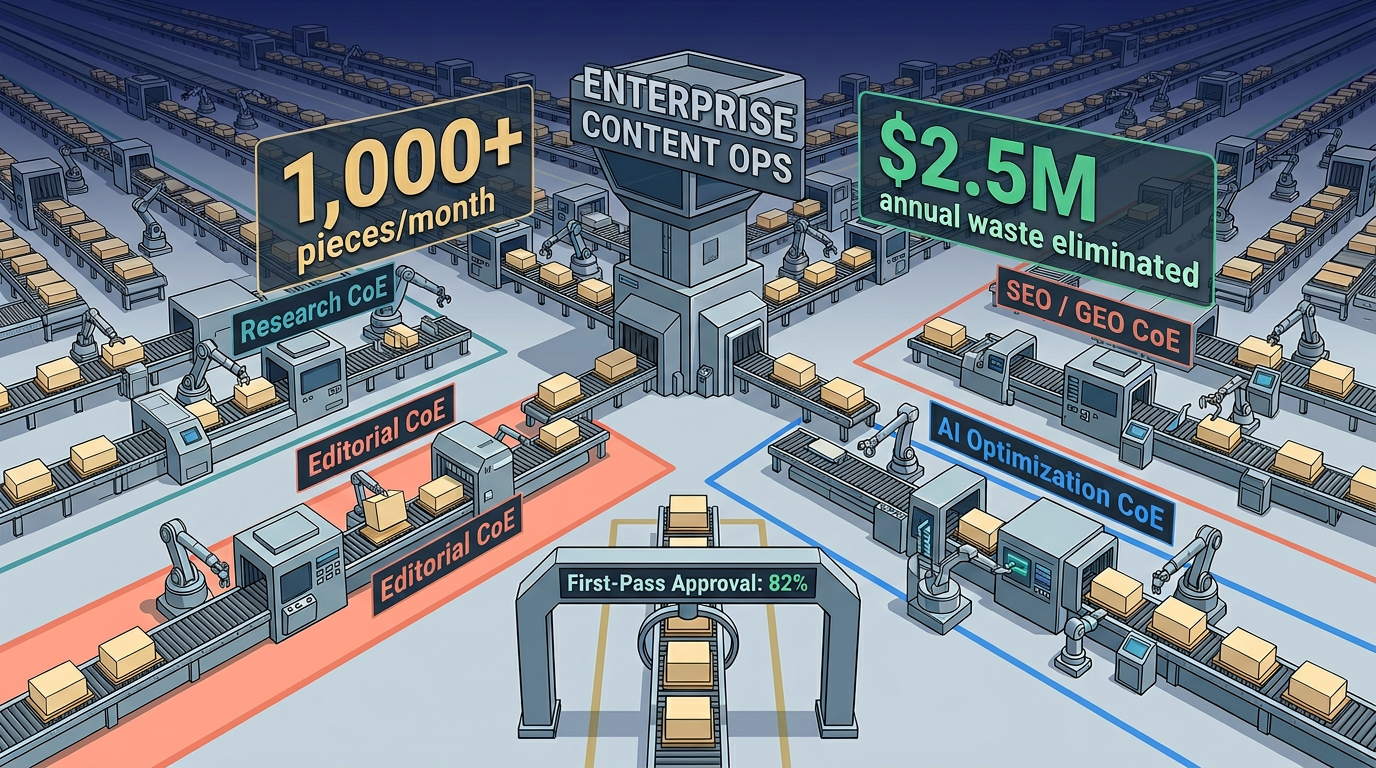
Large organizations waste an average of $2.5M annually on inefficient content processes. Meanwhile, AI-referred search sessions jumped 527% year-over-year in the first half of 2025, and AI Overviews now appear in over 47% of Google searches. The enterprises that win are the ones producing 500 to 1,000+ high-quality pieces per month, optimized for both traditional and AI search, without letting quality slip.
This guide breaks down the systems, team structures, technology, and governance models that make enterprise-scale content operations work in 2026.
Why Enterprise Content Operations Need a System Overhaul
Three forces are reshaping enterprise content in 2026:
AI search is now a primary channel. Over 31% of the US population uses generative AI search tools. Perplexity AI has 15M+ daily active users. ChatGPT processes 100M+ search-like queries per day. Content that earns citations on these platforms drives measurable pipeline, and enterprises that ignore this channel lose ground fast.
AI adoption is accelerating production. 78% of organizations now use AI in at least one business function (Deloitte, 2026), and 94% of marketers plan to use AI in content creation this year. Heavy AI users save over 10 hours per week. But production speed without operational structure creates inconsistency and brand dilution.
Governance is no longer optional. The enterprise AI governance market reached $2.55B in 2026, projected to hit $11.05B by 2036. The EU AI Act and similar regulations have shifted content governance from a nice-to-have to a compliance requirement, especially in regulated industries like finance, healthcare, and life sciences.
For a broader look at how content operations frameworks function at any scale, see our content operations framework guide.
Enterprise Content Operations Challenges
Scale Without Quality Loss
Producing 1,000+ pieces per month across multiple verticals introduces compounding risk. Each additional writer, team, or geography adds variance. Only 12% of Fortune 1000 companies rate their content operations maturity at Level 4 or above (Synchronized), according to VKTR's five-level maturity model. Most (58%) remain at Level 2 (Aware), where processes exist on paper but aren't consistently followed.
The fix isn't more editors. It's tiered review systems, automated quality gates, and clear standards that scale with headcount.
Coordination Across Teams
When four verticals, three regions, and a dozen content managers all publish independently, duplication and cannibalization are inevitable. A centralized strategy layer sets priorities and topic ownership, while distributed teams handle execution. This hub-and-spoke model, used by companies like HubSpot and Salesforce, prevents overlap without creating bottlenecks. We cover this in detail in our content team structure guide.
Technology Integration
32% of marketers report not using their martech stack to full capabilities (Ascend2, 2026). The problem isn't the tools; it's the integrations. A headless CMS, project management platform, analytics suite, and research tool that don't talk to each other create data silos that slow down every team. See our SEO tool stack guide for specific recommendations.
Maintaining Brand Voice at Scale
100+ writers across teams and time zones will drift without guardrails. Voice guidelines alone aren't enough. Enterprises need AI-assisted voice scoring, sample libraries organized by content type, and editorial review layers that catch tone violations before publish.
Enterprise Content Operations Framework
Layer 1: Central Strategy
Purpose: Define enterprise-wide content strategy, standards, and priority allocation.
Team:
- Head of Content Strategy
- Content Strategy Directors (one per vertical or business unit)
- Content Strategists (2-5, handling keyword research, competitive analysis, and editorial calendar)
Key responsibilities:
- Define content pillars, themes, and topical authority clusters
- Set quality standards using a documented content quality checklist
- Own the keyword universe and topic prioritization
- Coordinate across verticals to prevent cannibalization
- Report content performance to executive leadership monthly
Output: Enterprise content strategy document, quarterly content calendar, quality standards manual
Layer 2: Distributed Operations
Purpose: Execute content creation across multiple teams and verticals at target velocity.
Teams:
- Content teams organized by vertical (SaaS, eCommerce, B2B, etc.)
- Regional teams for localized content (APAC, EMEA, Americas)
- Freelance networks for burst capacity during launches or campaigns
How it works in practice:
A B2B SaaS vertical team of 8 writers and 2 editors produces 40-50 pieces per month. Each writer owns 5-6 pieces at various stages. Briefs come from the central strategy layer. Writers follow a standardized process: research, draft with AI assistance, self-review against brief, submit for editorial review. This model, described in depth in our content velocity strategies guide, lets each vertical operate semi-autonomously while staying aligned with enterprise goals.
Output: 40-50 pieces per vertical per month, scaling to 500-1,000+ enterprise-wide across 4-8 active verticals
Layer 3: Specialized Centers of Excellence
Purpose: Provide shared expertise that individual vertical teams can't efficiently replicate.
Research Center (5-10 people):
- Multi-platform SERP and AI search research for every piece
- Standardized content brief creation at scale (150-200 briefs per month)
- Competitive gap analysis and trend identification
- Keyword clustering and topic mapping
Editorial Center (5-10 people):
- Brand voice enforcement across all verticals
- Fact-checking and source verification
- Engagement and readability optimization
- Style guide maintenance and evolution
SEO Center (3-8 people):
- Technical SEO audits and schema markup
- Internal linking architecture (critical at 1,000+ pages)
- Content decay detection and refresh prioritization
- Content pruning for underperforming pages
- Performance tracking across GA4 and search console
AI Optimization Center (3-6 people):
- Platform-specific optimization for Google AI Overviews, Perplexity, ChatGPT, and Claude
- AI citation tracking across all major AI search engines
- Entity optimization and knowledge graph alignment
- Citation rate benchmarking and improvement
Layer 4: Technology Stack
Purpose: Integrated technology that eliminates silos and enables automation.
Core stack for 2026:
| Layer | Tool Category | Example Platforms |
|---|---|---|
| Research | Content intelligence | RankDraft Enterprise |
| CMS | Headless / composable | Contentful, Contentstack, Sanity |
| Project Management | Enterprise PM | Asana Enterprise, Monday.com |
| Analytics | Data warehouse | GA4 + BigQuery |
| SEO | Enterprise suite | SEMrush, Ahrefs |
| AI Assistance | Writing and research | Claude Team, ChatGPT Team |
| DAM | Asset management | Bynder, Brandfolder |
| Governance | Content compliance | Acrolinx, Writer |
Integration architecture:
The technology stack only works if the tools share data. Build integrations around three flows:
Brief-to-publish pipeline: Research tool generates brief, brief auto-populates in CMS, writer picks up from CMS, finished piece routes through review workflow, approved piece publishes automatically with correct metadata and schema markup.
Performance feedback loop: GA4 and search console data flows into BigQuery. Custom dashboards surface declining pages for the content decay detection team. Citation data from AI platforms feeds into the AI Optimization Center's tracking dashboards.
Cross-team coordination: PM tool tracks every piece from assignment to publish. Automated status updates prevent "where is this piece?" messages. Centralized editorial calendar prevents topic overlap.
Layer 5: Governance and Compliance
Purpose: Maintain consistency, quality, and regulatory compliance at enterprise scale.
In 2026, governance extends well beyond style guides. The EU AI Act requires transparency about AI-generated content. Regulated industries face additional disclosure requirements. Enterprises need:
Content Governance Board:
- Quarterly standards reviews
- AI usage policy updates
- Compliance audit oversight
- Cross-functional representation (legal, marketing, product, compliance)
Standard Operating Procedures:
- Documented workflows for every content type
- AI disclosure policies (when and how to label AI-assisted content)
- Source citation requirements (minimum number of sources, recency requirements)
- Approval chains by content type and sensitivity
Quality frameworks:
- Metadata management standards (taxonomy, tagging, categorization)
- Role-based permissions in CMS and publishing tools
- Version control and audit trails
- Cross-channel consistency checks (web, email, social, documentation)
Enterprise Team Structure
Sizing by Output Target
| Monthly Output | Total Team Size | Core Content | Centers of Excellence | Operations |
|---|---|---|---|---|
| 200-300 pieces | 30-50 people | 20-35 | 5-10 | 3-5 |
| 500-700 pieces | 70-120 people | 50-80 | 15-25 | 5-10 |
| 1,000+ pieces | 120-200 people | 80-140 | 25-40 | 10-20 |
These numbers assume moderate AI assistance (40-60% productivity gains on research and drafting). Organizations that invest heavily in human-AI collaboration workflows can achieve the same output with 20-30% fewer people.
Note: Only 9% of content teams plan to hire more people in 2026. Instead, 21% will invest more in technology (CMI Enterprise Research, 2026). The trend is clear: scale through tooling and process, not headcount.
Core Content Team Breakdown (1,000+ pieces/month)
Content Strategy (5-10 people):
- Head of Content Strategy (1)
- Strategy Directors by vertical (3-5)
- Content Strategists handling keyword research and calendar (2-5)
Content Creation (80-140 people):
- Content Managers by vertical, each owning 40-50 pieces/month (10-20)
- Researchers building briefs and competitive analysis (15-25)
- Writers producing 5-8 pieces/month each (40-70)
- Editors reviewing 15-20 pieces/month each (15-25)
Specialists (15-30 people):
- SEO Specialists (5-10)
- Technical SEO (2-5)
- Data Analysts (3-5)
- UX Writers for product-adjacent content (2-5)
- Designers for visual assets (3-5)
Operations (10-20 people):
- Content Operations Manager (1-2)
- Project Managers by vertical (5-8)
- Content Coordinators handling scheduling and logistics (3-5)
- Tools and Integration Specialists (2-3)
Enterprise Workflow: The 4-Week Sprint
Enterprise content operations run best on monthly sprints with weekly milestones. Here's how a single vertical team (targeting 40-50 pieces/month) operates:
Week 1: Research and Briefing
- Research Center completes multi-platform research (Google SERPs + AI search results from Perplexity, ChatGPT, Claude)
- Creates 40-50 detailed content briefs with target keywords, competitor analysis, required sources, and structural guidelines
- Strategy Director reviews and prioritizes briefs
- Briefs distributed to writers with clear deadlines
Week 2: Content Creation (Batch 1)
- Writers produce first batch of 20-25 pieces
- AI assists with research synthesis, outline expansion, and first draft acceleration (organizations report 34% efficiency gains within 18 months of AI adoption)
- Writers self-review against brief requirements and quality checklist
- Completed pieces enter editorial queue
Week 3: Content Creation (Batch 2) + Editorial Review (Batch 1)
- Writers produce remaining 20-25 pieces
- Editorial Center reviews Batch 1 (brand voice, accuracy, engagement)
- SEO Center optimizes Batch 1 (internal links, schema markup, metadata)
- Revision requests returned to writers with specific feedback
Week 4: Final Review and Publishing
- Editorial and SEO review for Batch 2
- Quality Assurance performs final checks on all 40-50 pieces
- AI Optimization Center verifies AI search readiness (entity coverage, citation-worthy structure, source density)
- Publishing team schedules daily batches (8-10 pieces per day)
Ongoing: Performance Monitoring
- Daily: Track new AI citations and SERP movements
- Weekly: Review traffic, engagement, and conversion metrics
- Monthly: Full performance report, identify content for refresh or pruning
- Quarterly: Strategy review, standards update, team training
Enterprise Quality Standards
Tiered Review Process
Each piece passes through four gates before publishing:
| Gate | Reviewer | Focus | Time per Piece |
|---|---|---|---|
| Gate 1: Self-review | Writer | Brief alignment, fact accuracy, completeness | 30-45 min |
| Gate 2: Editorial | Editor | Voice, clarity, engagement, structure | 30-45 min |
| Gate 3: SEO | SEO Specialist | Keywords, schema, internal links, metadata | 20-30 min |
| Gate 4: QA | Quality team | Standards compliance, final formatting, publish readiness | 15-20 min |
Total: 1.5-2.5 hours per piece (efficient enterprises with clear standards hit the lower end)
Quality Benchmarks
Production quality targets:
- First-review pass rate: 75-80% (pieces needing zero major revisions after Gate 1)
- Editorial revision rate: under 20% requiring structural rewrites
- SEO compliance: 100% of pieces meeting minimum standards before publish
- Brand voice consistency score: 90%+ (measured via AI-assisted voice scoring tools)
Performance quality targets:
- 60%+ of pieces ranking in top 20 within 90 days
- 15-25% of pieces earning AI search citations within 60 days
- Average time-on-page: 3+ minutes for long-form content
- Internal link click-through rate: 5%+ from content to product pages
Monitoring cadence:
- Weekly quality scorecards per vertical
- Monthly quality audits (random sample of 10% of output)
- Quarterly training sessions based on recurring issues
- Annual standards review and benchmarking against competitors
Enterprise ROI: What the Numbers Actually Look Like
Production Economics
Cost structure at scale (1,000 pieces/month):
| Cost Component | Per Piece | Monthly Total |
|---|---|---|
| Research and briefing | $50-100 | $50K-100K |
| Writing (human + AI) | $150-300 | $150K-300K |
| Editorial review | $40-80 | $40K-80K |
| SEO optimization | $30-60 | $30K-60K |
| Quality assurance | $20-40 | $20K-40K |
| Technology and tools | $10-20 | $10K-20K |
| Total | $300-600 | $300K-600K |
AI assistance reduces the per-piece cost by 30-40% compared to fully manual operations. Organizations report $3.70 ROI per dollar invested in AI content tools (NVIDIA, 2026).
Performance Metrics at Scale
Enterprises operating at 1,000+ pieces per month with mature operations typically see:
Traffic:
- 500K to 2M+ organic visits per month (varies by industry and domain authority)
- 15-25% quarter-over-quarter growth in the first 12 months
- Multi-platform distribution generating 10-20% of total traffic from AI search referrals
AI Search Citations:
- 300-800 citations per month across Perplexity, ChatGPT, Gemini, and Claude
- First-position citations: 30-45% of all citations
- Citing content with statistics and original data generates 30-40% more AI citations than opinion-based content
Revenue impact:
- Content-attributed pipeline: $2M-10M annually (B2B enterprise)
- 300-500% ROI when measured over 12-month content lifecycle
- Compounding returns: content published in Month 1 continues generating value for 18-24 months
For detailed frameworks on measuring these metrics, see our ROI measurement guide for AI-optimized content.
Enterprise Challenges and Solutions
Challenge 1: Brand Voice Fragmentation
When 100+ writers contribute across verticals, voice drift is the default.
What works:
- Create a voice scoring rubric with 5-7 dimensions (formality, technical depth, sentence structure, vocabulary range, point of view)
- Build a sample library: 20-30 exemplar pieces organized by content type and vertical
- Use AI-powered voice analysis tools (Writer, Acrolinx) to score every piece before publish
- Run quarterly voice calibration sessions where editors from each vertical review cross-team samples
Challenge 2: Content Cannibalization
Multiple teams targeting overlapping topics is the fastest way to undermine your own rankings.
What works:
- Maintain a centralized keyword registry (owned by the Strategy team) where every target keyword is assigned to exactly one piece
- Run monthly cannibalization audits using Search Console data
- Consolidate competing pages through redirects and content merging
- Use topical authority clustering to assign topic ownership by vertical
Challenge 3: Diminishing Returns on Volume
Not every additional piece generates proportional value. Past a certain threshold, you're publishing into diminishing-return territory.
What works:
- Track marginal traffic per additional piece published per month
- Invest 20-30% of capacity in refreshing existing content rather than creating new pieces
- Use content decay detection to identify high-value pages losing rankings
- Apply content pruning strategies to remove or consolidate pages dragging down site quality
- Shift resources toward original research, case studies, and data-driven content that earns disproportionate citations
Challenge 4: AI Compliance and Disclosure
The EU AI Act and emerging US state regulations require transparency about AI involvement in content creation.
What works:
- Establish clear AI usage policies: what AI can be used for (research, drafts, optimization) and what requires human creation (thought leadership, legal content, medical advice)
- Document AI involvement per piece in your CMS metadata
- Create disclosure templates for different content types
- Train all writers on responsible AI usage and disclosure requirements
- Build audit trails showing human review of all AI-assisted content
Scaling from 0 to 1,000: The Maturity Path
Most enterprises don't start at 1,000 pieces per month. Here's the typical progression:
Level 1: Foundation (0-100 pieces/month)
- Small team (5-15 people)
- Basic CMS and project management
- Manual processes, minimal automation
- Focus: establish quality standards and publishing rhythm
Level 2: Growth (100-300 pieces/month)
- Growing team (15-40 people)
- Specialized roles emerge (dedicated editors, SEO specialists)
- Initial automation (brief templates, publishing workflows)
- Focus: systematize processes, build Centers of Excellence
Level 3: Scale (300-700 pieces/month)
- Multi-vertical teams (40-100 people)
- Full Centers of Excellence operational
- Integrated technology stack with API connections
- Focus: efficiency gains through human-AI collaboration and automation
Level 4: Enterprise (700-1,000+ pieces/month)
- Full enterprise operations (100-200+ people)
- Governance board and compliance systems
- Data-driven optimization across all channels
- Focus: marginal gains, AI search dominance, content as competitive moat
Level 5: Optimized (1,000+ pieces/month with declining cost per piece)
- Mature AI integration (AI handles 40-60% of production tasks)
- Predictive analytics driving topic selection
- Content operations as a profit center, not cost center
- Focus: original research, data differentiation, and programmatic content for long-tail coverage
Conclusion
Enterprise content operations at 1,000+ pieces per month are a systems problem, not a hiring problem. The enterprises producing at this scale in 2026 have five things in common: centralized strategy with distributed execution, specialized Centers of Excellence, integrated technology that eliminates manual handoffs, governance systems that satisfy compliance requirements, and AI assistance that amplifies human output without replacing human judgment.
Start by auditing your current maturity level. Build the layer you're missing. Invest in integration before adding headcount.
Start Your Free Enterprise Trial
Frequently Asked Questions
Q: How many people do I need for 1,000 pieces/month? A: 120-200 people total with moderate AI assistance: 80-140 in content creation, 25-40 in Centers of Excellence, and 10-20 in operations. Heavy AI adoption can reduce this by 20-30%. Only 9% of teams plan to grow headcount in 2026; most are scaling through technology instead.
Q: How do enterprises maintain quality at scale? A: A four-gate review process (self-review, editorial, SEO, QA) catches issues before publish. Each piece takes 1.5-2.5 hours of review time. Target a 75-80% first-review pass rate. Use AI-powered voice scoring to maintain brand consistency across 100+ writers. See our content quality checklist for specific standards.
Q: Should enterprises use AI for all content? A: Use AI for research synthesis, draft acceleration, and optimization scoring. Keep humans in control of strategy, fact verification, brand voice, and final approval. Organizations report 34% operational efficiency gains and 27% cost reduction within 18 months of AI adoption, but only when humans remain in the review loop.
Q: How do enterprises handle content cannibalization? A: Centralized keyword registry, monthly cannibalization audits via Search Console, topic ownership by vertical, and topical authority clustering. Prevention (assigning keywords before writing) is far more efficient than fixing cannibalization after publishing.
Q: What technology stack do enterprises need? A: At minimum: content intelligence platform (RankDraft Enterprise), headless CMS (Contentful or Contentstack), enterprise PM (Asana), analytics warehouse (GA4 + BigQuery), SEO suite (Ahrefs or SEMrush), and AI writing tools (Claude Team). The key differentiator is integration, not individual tools. See our full SEO tool stack guide.
Q: How do enterprises measure content ROI? A: Track per-piece production cost ($300-600 at scale), traffic per piece, AI citations earned, conversion events, and revenue attribution. Calculate ROI over a 12-month content lifecycle, not monthly snapshots. Use BigQuery for cross-channel attribution. Detailed methodology in our ROI measurement guide.
Q: What's the biggest mistake enterprises make when scaling content? A: Scaling headcount without scaling process. Adding more writers to a broken workflow produces more low-quality content faster. Fix the system first: standardize briefs, build review gates, integrate your tools, and then add capacity.
Q: How should enterprises adapt content for AI search engines? A: Dedicate 3-6 people to an AI Optimization Center focused on citation tracking, entity optimization, and platform-specific formatting. Content with statistics, original data, and proper source citations generates 30-40% more AI citations. This is a distinct discipline from traditional SEO and needs dedicated resources.