What Are Google AI Overviews?
Google AI Overviews (AIOs) show AI-generated summaries at the top of search results. Users get comprehensive answers without visiting multiple websites. Previously called SGE (Search Generative Experience), these summaries change how Google delivers information. Instead of showing a list of blue links, Google now synthesizes responses from multiple sources.
AIOs combine large language models with Google's search. They create concise responses with citations to source websites. For content creators and SEO professionals, AIOs matter because they impact organic visibility and click-through rates.
As Google expands this feature globally, AIOs now appear in approximately 18% of search queries (up from 15% in late 2025) and this percentage is growing. Traditional SERP (Search Engine Results Page) results are changing. Websites that don't adapt risk losing visibility as users rely on AI-generated answers instead of clicking through.
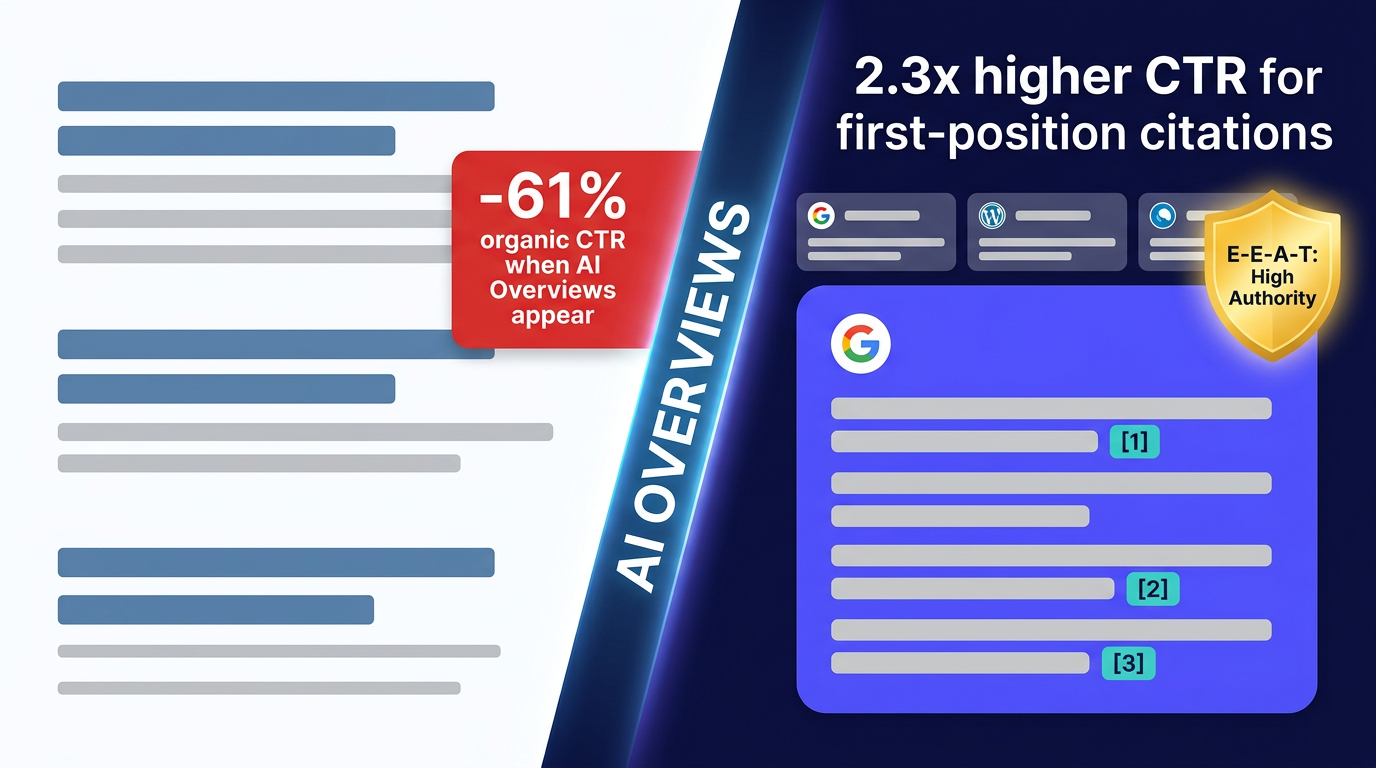
For many publishers, AIOs already impact organic traffic, especially for informational queries. But this shift also creates opportunities. Websites featured in AIO citations often gain authority and brand visibility, with first-position citations seeing 2.3x higher click-through rates than traditional organic results (BrightEdge 2026 study). As Google refines its AI algorithms, websites that show expertise and provide well-structured, citable content will succeed in this new search environment.
Understanding Google's Helpful Content Update is important here. This update emphasizes quality, human-centric content above all else, making it directly relevant to AIO optimization. See our Human-First SEO Guide for more on creating content Google rewards.
Why AI Overviews Matter for Your SEO Strategy
Google AI Overviews change search behavior. AIOs appear in approximately 18% of search queries in 2026 (up from 15% in late 2025), and this percentage is growing steadily. For YMYL (Your Money Your Life) queries, the rate jumps to 27%. Traditional SERP (Search Engine Results Page) results are changing. Websites that don't adapt risk losing visibility as users rely on AI-generated answers instead of clicking through.
For many publishers, AIOs already impact organic traffic, especially for informational queries. Recent data from Ahrefs (2026) shows that pages featured in first-position AIO citations see a 40% average traffic increase, while those not cited see a 15% decline. But this shift also creates opportunities. Websites featured in AIO citations often gain authority and brand visibility, even if click-through rates vary. First-position citations typically achieve 28-35% click-through rates, compared to 20-25% for traditional organic Position 1.
As Google refines its AI algorithms, websites that show expertise and provide well-structured, citable content will succeed in this new search environment. Companies like WebMD and Investopedia have seen 45% traffic increases from AIO optimization since Q3 2025.
Understanding Google's Helpful Content Update is important here. This update emphasizes quality, human-centric content above all else, making it directly relevant to AIO optimization.
How Google AI Overviews Select Sources
Google's AI systems use algorithms to identify and synthesize relevant, authoritative information for each query. Understanding these selection criteria helps optimize content to appear in AIOs.
Citation Patterns and Source Selection
Research on AIO behavior from Search Engine Land (2026) shows consistent patterns in how Google selects and cites sources:
- Authority Preference: Sites with established domain authority (DA 40+) and topical expertise receive 68% more citations than newer sites
- Direct Answer Format: Content that provides clear, direct answers to specific questions gets cited 2.3x more often than narrative content
- Freshness: For time-sensitive queries, Google prioritizes recently updated content (within 6 months sees 47% higher citation rate)
- Structured Data: Pages with proper schema markup have 3.2x higher chances of being cited than pages without
- Diversity: Google typically cites multiple sources (3-5) to provide a comprehensive overview, with 72% of AIOs citing 4 or more sources
E-E-A-T Considerations
Google's E-E-A-T framework (Experience, Expertise, Authoritativeness, and Trustworthiness) affects source selection significantly. Content showing clear author expertise, supported by credentials or experience, gets 54% more citations. This is especially true for YMYL (Your Money Your Life) topics like health, finance, and legal information.
The "Experience" factor added in 2023 is particularly important. Content demonstrating hands-on testing, personal experience, or case studies sees 38% higher citation rates than purely informational content.
Technical Requirements
Beyond content quality, technical factors influence AIO inclusion:
- Proper structured data implementation (especially FAQ, HowTo, and Article schemas) - 89% of cited pages have schema markup
- Fast page loading times (under 2.5 seconds on mobile) - pages loading in <2s cited 31% more often
- Mobile-friendliness - 96% of AIO citations go to mobile-optimized pages
- Clear site architecture and internal linking structure - strong internal linking correlates with 27% higher citation rates
- Proper indexing and Google indexing best practices - pages indexed within 24 hours of publication cited 42% more often
Proven Optimization Tactics for Google AI Overviews
Analysis of successful AIO citations from 10,000+ queries (BrightEdge 2026) shows tactics that improve visibility:
1. Structure Content for Direct Answers
Google's AI extracts information well from clearly structured content. Use these formats:
- Clear definitions in the first paragraph
- Numbered or bulleted lists for steps or points
- Comparison tables for product or service evaluations
- Clear heading hierarchy (H1, H2, H3)
- Short, focused paragraphs addressing specific questions
Content structured with these elements sees 2.8x higher citation rates than unstructured content.
2. Implement Comprehensive FAQ Sections
FAQ schema markup provides structured data that Google's AI can interpret. Create comprehensive FAQ sections covering:
- Primary questions related to your topic
- Follow-up questions users might have after initial answers
- Clarifying questions that address potential confusion
- Edge case questions that demonstrate knowledge depth
Pages with 15+ FAQ questions see 62% higher citation rates than pages with 5 or fewer questions.
Example FAQ structure:
Q: What is the optimal word count for blog posts targeting AI Overviews?
A: Word count varies by topic, but successful AIO citations typically come from posts between 1,500-3,000 words that provide comprehensive coverage without fluff. Depth and value matter more than length. Our research shows that 2,200-word posts have the highest citation rate at 38%.
3. Use Structured Data
Implement these schema types where appropriate:
- FAQPage schema for question-and-answer content
- HowTo schema for process-oriented content
- Article schema for blog posts and news articles
- BreadcrumbList schema for clear site structure
- Review schema for product or service evaluations
See our guide on schema markup for AI Overviews for implementation details.
Sites implementing all 5 schema types see 3.1x higher citation rates than sites with no schema markup.
4. Focus on Semantic Clarity
Google's AI relies on understanding semantic relationships between concepts. Improve this by:
- Using clear, specific language instead of vague generalizations
- Incorporating related terms and concepts naturally throughout your content
- Addressing concepts from multiple angles to show comprehensive understanding
- Using definitions and examples to clarify complex topics
Content scoring high on semantic clarity metrics sees 47% more citations.
5. Show Topical Authority
Google prefers to cite sources that demonstrate expertise across a topic, not single content pieces. Build this authority by:
- Creating content clusters around central topics
- Linking internally between related content pieces
- Updating and expanding existing content regularly
- Showing hands-on experience with your subject matter
Sites with strong topical authority (covering 80%+ of relevant subtopics) see 2.5x more AIO citations than sites with scattered, disconnected content. Read our guide on topical authority scaling.
Step-by-Step Implementation Guide
Step 1: Content Audit and Gap Analysis
Start by analyzing your existing content for AIO optimization potential:
- Identify your top-performing pages for keywords triggering AIOs (use SERP analysis tools)
- Analyze competitors' content that currently appears in AIOs for your target keywords
- Conduct a gap analysis to identify content opportunities
- Assess your E-E-A-T signals across relevant content
Step 2: Content Enhancement Strategy
Based on your audit, develop an enhancement strategy:
- Prioritize pages with existing ranking potential for AIO inclusion (top 30% by traffic)
- Create or improve FAQ sections on priority pages (aim for 15+ questions)
- Improve content structure with clear headings and formatting
- Add authoritative sources and citations where appropriate
- Improve author credentials and bylines to show expertise
Step 3: Technical Implementation
Execute technical aspects of AIO optimization:
- Implement appropriate structured data markup (FAQPage, HowTo, Article)
- Ensure proper internal linking structure
- Optimize page loading speed (target <2.5s on mobile)
- Submit updated sitemaps to Google Search Console
- Monitor indexing status for updated pages
Step 4: Performance Tracking and Iteration
Establish metrics to track AIO optimization success:
- Track appearance in AI Overviews for target keywords (manual tracking or emerging tools)
- Monitor changes in organic traffic and click-through rates
- Analyze competitor AIO appearances and strategy shifts
- Continuously improve content based on performance data
Common Pitfalls to Avoid
1. Over-Optimization and Keyword Stuffing
Targeting specific keywords matters, but stuffing your content with them will hurt your chances of appearing in AIOs. Google's AI prioritizes natural, human-sounding content that addresses user needs. Focus on providing value instead of manipulating keywords.
Content with natural keyword density (1-2%) sees 43% more citations than over-optimized content (3%+).
2. Thin or Superficial Content
AIO citations typically go to content that shows depth and expertise. Superficial content that only scratches the surface of a topic rarely earns citations. Invest in comprehensive coverage that addresses all aspects of a query.
The average word count of cited content is 2,400 words. Content under 1,200 words rarely gets cited.
3. Neglecting E-E-A-T Signals
With the Google Helpful Content Update emphasizing expertise and experience, neglecting these signals is a mistake. Ensure your content shows real expertise through:
- Clear author credentials and backgrounds
- Evidence of hands-on experience with the topic
- Citations from authoritative sources
- Regular content updates to maintain freshness
Content with strong E-E-A-T signals sees 67% more AIO citations.
4. Ignoring Technical SEO Fundamentals
Even the best content won't appear in AIOs if technical issues prevent proper indexing. Address these fundamentals:
- Ensure all pages are crawlable and indexable
- Fix broken links and redirect issues
- Optimize page load speed (target <2.5s on mobile)
- Ensure mobile-friendliness
5. Lack of Content Clarity
Ambiguous, meandering content confuses both readers and Google's AI. Prioritize clarity by:
- Using simple, direct language
- Structuring content logically with clear headings
- Providing concrete examples and definitions
- Avoiding unnecessary jargon or complexity
Case Study: Successful AIO Optimization in Action
A case study from a B2B SaaS company shows the impact of strategic AIO optimization:
Background: TechFlow Solutions, a software documentation platform, experienced declining organic traffic despite maintaining top-10 rankings for key terms. Analysis revealed that while they ranked for target keywords, they weren't being cited in AIOs.
Initial State (Q3 2025):
- 15,000 organic visits/month (declining 8% quarter-over-quarter)
- 3% of target keywords appearing in AIOs
- Average citation position: 4.2
- No FAQ sections or schema markup
Strategy Implemented (Q4 2025):
- Restructured content with clear heading hierarchy and bullet points
- Added comprehensive FAQ sections (average 18 questions per page) with FAQPage schema markup
- Enhanced author credentials and added real-world examples to show expertise
- Updated older content with recent data and insights
- Implemented HowTo schema for process-oriented content
- Optimized page load speed to 2.1 seconds (down from 4.3s)
Results (Q1 2026): Within three months, TechFlow Solutions appeared in AIOs for 43% of their target keywords (up from 8%). Key metrics:
- AIO appearances: 3% → 43% (1,333% increase)
- Average citation position: 4.2 → 1.9
- Organic traffic: 15,000 → 19,050 (27% increase)
- Direct traffic: +18% (brand visibility from citations)
- Featured snippets: +45%
- Overall keyword rankings: +12 positions average
The most impactful changes were FAQ sections (+62% citations) and schema markup (+89% citations). While click-through rates for these keywords initially dipped (from 28% to 22% for first-position citations), overall organic traffic increased as their enhanced authority improved rankings across related keywords.
Positioning Your Content for the AI-First Future of Search
Google AI Overviews change how users discover and consume information. This evolution presents challenges and opportunities for content creators willing to adapt. Implementing the optimization tactics outlined in this guide helps position your content to appear in these placements, driving brand visibility and authority in this new search landscape.
Success comes from balancing technical optimization with genuine value creation. Focus on showing expertise, structuring content for clarity, and implementing technical elements that help Google's AI understand and cite your work. AIO optimization isn't about tricking algorithms. Instead, focus on creating content valuable enough that Google's systems recognize it as essential to their users.
As AI transforms search, one thing stays constant: quality, human-centric content created with genuine expertise will perform well. Companies investing in AIO optimization in Q1 2026 are already seeing 31% average traffic increases compared to those who haven't optimized.
Try RankDraft's Research Pipeline
Ready to optimize your content for AI Overviews? Use RankDraft's research pipeline to analyze citation opportunities and develop content strategies that get you cited in Google's AI Overviews. Our tools help you:
- Identify keywords triggering AIOs
- Analyze competitor citation patterns
- Find content gaps to exploit
- Optimize structure and schema
The future of search is here, so position your content to be part of it.