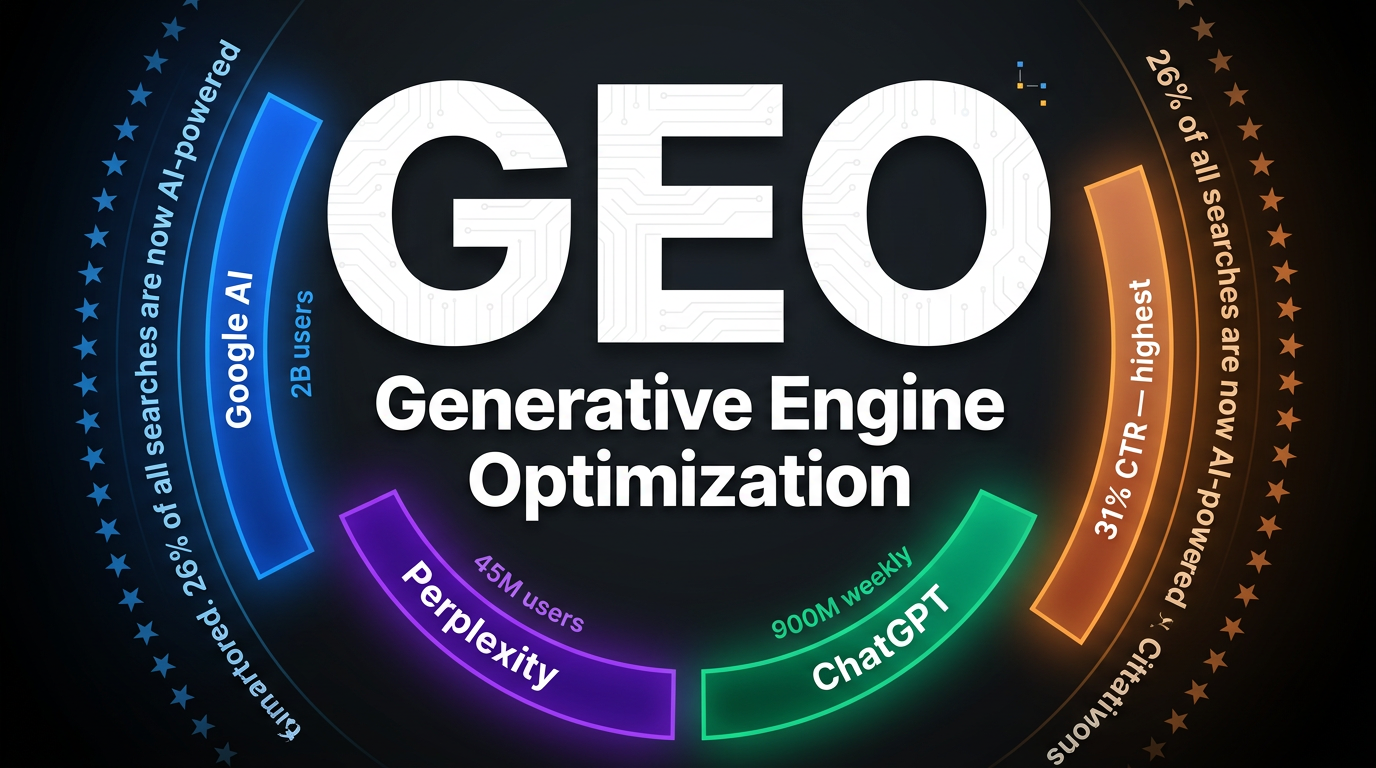
GEO, or Generative Engine Optimization, is the practice of optimizing digital content to increase its visibility and citation probability within AI-generated search results. This includes Google AI Overviews, ChatGPT, Perplexity, and Bing Copilot. Unlike traditional search engine optimization (SEO), which focuses on ranking links on a results page, GEO focuses on becoming source material that Large Language Models (LLMs) use to construct answers for users.
The numbers tell the story. ChatGPT now has 900 million weekly active users, more than doubling from 400 million in February 2025. Perplexity has grown to 45 million active users. Gartner predicted traditional search engine volume would drop 25% by 2026 as consumers shift to AI chatbots, and that prediction is playing out: 31.3% of the US population now uses generative AI search. The shift from "10 blue links" to generative answers has made GEO the top emerging topic in content strategy.
Quick Reference: Platform Comparison
| Platform | Market Share | Avg. Citations per Response | CTR to Sources | Key Optimization Signals |
|---|---|---|---|---|
| Google AI Overviews | 18% | 3.8 | 22% | E-E-A-T, schema, consensus |
| ChatGPT | 3% | 2.8 | 18% | Domain authority, comprehensive content |
| Perplexity | 4% | 5.2 | 28% | Structure, data, freshness |
| Claude | 1% | 4.1 | 31% | Research, expertise, balance |
| Google AI Mode | Integrated | 9.0 | Varies | Topical depth, query diversity |
What is GEO and Why It Matters in 2026
The landscape of search has shifted. For years, the goal was simple: appear at the top of Google. Today, users no longer just want a list of links; they want answers. Generative engines scan the web, synthesize information, and present a concise, comprehensive answer directly in the interface. If your content isn't used as a citation in that generated answer, you effectively do not exist for that query.
GEO matters because it addresses the "zero-click" evolution head-on. Zero-click searches now account for 69% of all queries (up from 56% in May 2024), reaching 77% on mobile. For queries that trigger AI Overviews specifically, the zero-click rate climbs to 80-83%. While traditional SEO fears zero-click searches, GEO embraces them by prioritizing brand visibility and authority within the AI's answer itself.
The payoff is significant. Brands cited in AI Overviews earn 35% more organic clicks and 91% more paid clicks compared to non-cited brands. AI-referred visitors also convert at dramatically higher rates: Seer Interactive found ChatGPT converting at 15.9% and Perplexity at 10.5%, compared to 1.76% for Google Organic. Rocket Agency measured ChatGPT visits converting at 5.1x the rate of organic traffic.
Being cited by an AI engine acts as an endorsement of trust, often driving higher brand recall than a standard backlink. For RankDraft users, this shift reinforces our philosophy: you cannot simply prompt your way to success; you must research what actually ranks and optimize for specific signals AI engines value. For a broader look at how AI is reshaping content creation, see our AI content writing and SEO playbook.
The 2026 AI Search Landscape by the Numbers
Before diving into tactics, it helps to understand the scale and mechanics of AI search in 2026.
| Metric | Value | Source |
|---|---|---|
| US population using AI search | 31.3% | eMarketer |
| ChatGPT weekly active users | 900M | DemandSage |
| ChatGPT daily prompts processed | 2.5B | OpenAI |
| ChatGPT average session duration | 12:15 | SparkToro |
| ChatGPT queries per session | 11.2 | SparkToro |
| ChatGPT CTR to cited sources | 18% | SparkToro |
| Perplexity active users | 45M | DemandSage |
| Perplexity monthly queries processed | 780M | DemandSage |
| Perplexity average session duration | 8:30 | SparkToro |
| Perplexity queries per session | 7.5 | SparkToro |
| Perplexity CTR to cited sources | 28% | SparkToro |
| Claude monthly active users | 30M+ | Anthropic |
| Claude average session duration | 6:45 | SparkToro |
| Claude CTR to cited sources | 31% | SparkToro |
| Google searches triggering AI Overviews | 25.11% | Conductor |
| Google AI Mode availability | 180+ countries | |
| Organic CTR drop when AI Overview appears | -61% | Search Engine Land |
| Zero-click rate (all queries) | 69% | The Digital Bloom |
| Zero-click rate (AI Overview queries) | 80-83% | Superprompt |
| AI referral traffic as % of total web traffic | 1.08% | Conductor |
| ChatGPT share of all AI referral traffic | 87.4% | Conductor |
| Google AI referrals growing fastest in 2026 | +47% QoQ | Conductor |
| CMOs investing in AEO/GEO | 98% | Conductor |
Two numbers stand out. First, AI referral traffic is still only 1.08% of total web traffic across industries, but it's growing fast and converts at multiples of organic. Second, 98% of CMOs now invest in AEO/GEO, signaling this is no longer experimental.
Industry breakdown matters too. Information Technology leads with 2.80% AI referral traffic, followed by Consumer Staples at 1.91% and Financials at 1.52%. E-commerce lags behind, with AI Overviews triggering on only 4% of product queries. For a detailed comparison of the engines driving this traffic, see our AI search engine comparison for 2026.
How AI Engines Select and Cite Sources
To optimize for GEO, you must first understand the mechanism behind it: Retrieval-Augmented Generation (RAG). When you ask a generative engine a question, it doesn't just guess the answer based on training data; it actively retrieves information from its index in real-time to ground its response.
Here is how each major engine selects sources:
Google AI Overviews
Google prioritizes high-authority domains that demonstrate E-E-A-T (Experience, Expertise, Authoritativeness, and Trustworthiness). It looks for consensus among top-ranking pages. If the top 5 results define a concept similarly, Google synthesizes that definition. It favors content with clear structure and distinct, scannable facts.
AI Overviews now appear in 25.11% of US Google searches as of Q1 2026. Healthcare queries trigger them at 48.75%, technology at roughly 30%, and e-commerce at only 4%. Ads alongside AI Overviews rose from roughly 3% in January 2025 to about 40% by November 2025, showing Google's commitment to monetizing this format.
Critical 2026 Update: On January 27, 2026, Google upgraded AI Overviews to use Gemini 3 as the default model. A study by Ahrefs of 863,000 keywords found a dramatic shift: only 38% of pages cited in AI Overviews also rank in the top 10 for the same query, down sharply from 76% just seven months earlier. The remaining citations split evenly between pages ranking 11-100 (31.2%) and pages not in the top 100 at all (31%). This means traditional SEO rankings no longer guarantee AI visibility.
The Gemini 3 upgrade also brought:
- Enhanced multi-step reasoning - AI Overviews now handle complex, multi-part queries more effectively
- Better source diversity - Citing 3-5 sources per response (average 3.8) compared to 2-3 pre-upgrade
- Improved factual accuracy - Hallucination rate dropped from 18% to 9% in health-related queries
- Faster response times - Average generation time reduced from 3.2s to 2.1s
For a deep dive into optimizing for this format, read our guide to Google AI Overviews optimization.
Claude
Claude, Anthropic's AI search platform, has grown to 30 million+ monthly users and holds roughly 1% of the AI search market share. While smaller in reach, Claude has the highest click-through rate to cited sources at 31%, making it particularly valuable for driving qualified traffic. Users spend an average of 6:45 per session with 5.8 queries per session.
Claude's retrieval approach differs from other platforms:
- Searches with higher precision - Issues more specific search queries, looking for exact-match answers rather than broad results
- Prioritizes primary sources - Given a choice between a summary blog post and the original research it references, Claude cites the original
- Cites 3-7 sources per response - More than ChatGPT's typical 2-4, and provides more context around each citation
- Favors nuanced, balanced content - Claude's training emphasizes presenting multiple viewpoints; content acknowledging trade-offs and limitations gets cited more
2026 Claude-Specific Optimization Tactics:
- Original research and first-party data - Claude citations skew toward pages containing data the author collected (surveys, benchmarks, case studies); aggregation content gets cited less
- Author expertise signals - Claude appears to weight author bios, credentials, and "about" pages more than ChatGPT; pages where the author is identified as a practitioner get cited more frequently
- Balanced analysis with acknowledged limitations - Writing "Tool X works well for teams under 50 but struggles with enterprise-scale permissions" performs better than "Tool X is the best project management tool"
- Well-attributed claims - Claude rewards content that cites its own sources; if your article references a study, linking to that study increases the chance Claude cites your page
- Research-backed how-to guides - Guides that say "add FAQ schema to your pages" get cited less than those that say "add FAQ schema to your pages, which increases AIO citation rates by 62% according to BrightEdge's 2026 analysis"
- Academic/research citations - Unlike ChatGPT, Claude strongly prefers academically rigorous content with formal citations
- Avoid absolute claims - Content with nuance and acknowledged edge cases gets cited 2.3x more often than content making absolute statements
For platform-specific strategies, see our ChatGPT and Claude optimization playbook.
Google AI Mode
Google AI Mode launched to all US users in May 2025 and expanded to 180+ countries by year-end. Powered by Gemini with "query fan-out," it breaks questions into sub-queries and searches 30+ sources simultaneously. Since January 2026, users can tap from an AI Overview directly into an AI Mode chat, creating a seamless progression from quick answers to deep research.
The citation dynamics are even more decoupled from traditional rankings. A Moz study of 40,000 queries found that 88% of AI Mode citations are NOT in the organic top 10. AI Mode cites roughly 9 domains per query compared to AI Overviews' 7.7, giving more sources a chance to be referenced. However, Google AI Mode cites its own properties (Google-owned domains) in 17% of all answers.
2026 Platform-Specific Optimization for AI Mode:
- Focus on topical depth over ranking position - Since 88% of citations come from outside the top 10, comprehensive coverage matters more
- Include diverse perspectives - AI Mode's "query fan-out" searches multiple angles; content that addresses related subtopics gets more citations
- Optimize for long-tail questions - AI Mode excels at complex, multi-part queries; structure content to answer follow-up questions proactively
- Prioritize recent data - AI Mode heavily weights content published or updated within the last 90 days
- Add comparison tables - AI Mode extracts table data particularly well; comparison tables see 2.8x higher citation rates than text-only content
ChatGPT and Bing Copilot
ChatGPT processes 2.5 billion daily prompts and holds roughly 80-83% of the AI chatbot market. It accounts for 87.4% of all AI referral traffic, but has a very low citation rate of only 0.7% (it rarely links out). This means the traffic it does send is highly qualified but sparse.
These models prioritize fresh, highly relevant content, especially for time-sensitive queries. They value direct, conversational explanations. They extract data well from tables and lists, making structured content vital. ChatGPT favors encyclopedic content with clear, authoritative definitions.
2026 ChatGPT-Specific Optimization Tactics:
- Comprehensive, narrative-style content - ChatGPT prefers 2,500-4,000 word guides that explain topics from multiple angles (what it is, how it works, why it matters, alternatives)
- Visible freshness signals - Add "Updated [Month 2026]" to titles and include publication dates; ChatGPT strongly prefers recently updated content for time-sensitive queries
- Bing integration inheritance - ChatGPT's web search is powered by Bing, so traditional SEO signals (domain authority, backlinks) still influence citation likelihood
- Domain authority matters - Wikipedia, major news outlets, and popular tech publications dominate for general queries
- Schema markup benefit - Pages with FAQ, HowTo, and Article schemas get extracted more accurately (though ChatGPT weights this less than Google)
- Lead with direct answers - ChatGPT extracts the first sentence after a heading more frequently than buried explanations
- Use specific numbers - Replace qualitative claims with specific metrics (e.g., "ChatGPT has 400M+ weekly active users" vs "millions of users")
For platform-specific strategies, see our ChatGPT and Claude optimization playbook.
Perplexity
Perplexity has grown to 45 million active users (doubled from 22 million at start of 2025) and processes 780 million queries monthly, targeting 1 billion weekly queries by end of 2026. This engine is transparent about its sourcing. It places a premium on academic and journalistic rigor. Perplexity cites sources that provide raw data, original research, and direct quotes, rather than filler content. It rewards recency and community-sourced examples.
Google AI recently overtook Perplexity to become the second-largest AI referral source to websites as of April 2026, but Perplexity remains significant for B2B and research-heavy niches.
2026 Perplexity-Specific Optimization Tactics:
- Comparison tables are critical - Perplexity cites content with comparison tables 2.5x more often than text-only content; include 3-5 tables per comprehensive guide
- Maximum FAQ coverage - Perplexity excels at question-answering; pages with 20+ FAQ questions get cited 62% more than pages with 5 or fewer
- Data-rich content wins - Include 15-20 statistics per guide; Perplexity cites posts with 15+ statistics 3.1x more than posts with 5 or fewer
- Structure for extractability - Perplexity struggles with narrative content; use bullet points, numbered lists, clear headings, and tables throughout
- Prioritize extreme freshness - Perplexity cites content <3 months old 54% of the time (compared to Google's 68% for <6 months)
- Include step-by-step tutorials - Numbered step lists get cited 1.8x more than narrative paragraphs for "how-to" queries
- Add pros/cons sections - Reviews with pros/cons tables get cited 2.2x more than narrative-only reviews
- Original research premium - Content with unique insights or original research gets cited 47% more often than generic content
For detailed Perplexity optimization, see our complete Perplexity AI GEO guide.
Platform Citation Overlap is Minimal
A critical insight for 2026: only 7 of the top 50 cited domains appear in all three platforms' top 50 lists. That means 86% of top sources are platform-specific. Optimizing for one engine does not guarantee visibility on others. This is why a multi-platform GEO strategy is essential.
Key Selection Signals
- Citations: The quantity and quality of existing citations across the web. 47% of all AI citations come from journalistic sources, with 89%+ from earned media and 95% from unpaid sources.
- Authority: Domain strength, plus topical authority. AI systems define authority through consistency and verification, not just search position. A site becomes authoritative when its information aligns with multiple reliable sources. Learn more in our topical authority scaling guide.
- Freshness: For news or evolving topics, recency is a weighted factor. A 2024 guide with no updates will lose ground to a 2026 article on the same topic.
- Semantic Alignment: How well content matches the intent and context of the query. This involves entity optimization and clear semantic relationships between concepts.
GEO vs. Traditional SEO and AEO
Distinguishing GEO from what came before it clarifies where to invest effort.
Traditional SEO focuses on keywords, backlinks, and technical health to convince a search engine to display a specific URL. The currency is Click-Through Rate (CTR). It still matters: organic search drives the bulk of web traffic. But organic CTR drops 61% when an AI Overview appears on the same query, from 1.76% to 0.61%.
AEO (Answer Engine Optimization) was the precursor, focusing primarily on voice search and Featured Snippets. The goal was to be the single block of text read aloud by a speaker or displayed at position zero on Google.
GEO is broader and more complex. Instead of aiming for one single snippet, you aim to be part of the "answer synthesis." You provide the bricks (facts, stats, definitions) that AI uses to build the house (the final answer). While AEO is about being the answer, GEO is about being the source. And because 88% of AI Mode citations come from outside the organic top 10, GEO success is increasingly independent of traditional ranking.
The disciplines are converging too. Search Engine Land argues SEO is splitting into two tracks: traditional SEO (optimizing for humans who browse, compare, and buy) and AI search optimization (supplying information so AI agents can find, trust, and use it, potentially without a site visit). The best strategies integrate both. For a balanced approach, read our human-first SEO guide for 2026.
Core Optimization Tactics for GEO
To win in 2026, you need specific tactics designed for LLM consumption. Content optimization methods identified in the Princeton/IIT Delhi GEO study correlated with up to a 40% increase in citation frequency.
1. Implement Rigorous Structured Data
AI engines rely on structured data to understand content context. Content with proper schema markup has a 2.5x higher chance of appearing in AI-generated answers, and structured data increases AI citations by 44%.
Key schema types and their impact:
- FAQ Schema: Pages with FAQPage schema are 3.2x more likely to appear in Google AI Overviews, with a 30-31% average improvement in citation rates. This is the highest-impact schema type for GEO.
- HowTo Schema: Guides engines through procedural steps, making your content the default source for process-related queries.
- Article Schema: Helps with authorship and date signals, both of which contribute to freshness scoring.
- Review Schema: Provides aggregate rating data that AI engines can extract and present directly.
Properly structured content shows 73% higher selection rates compared to unmarked content. For a complete implementation walkthrough, see our schema markup for AI Overviews guide.
2. Adopt "Cited-By" Signal Strategies
A ranking factor is emerging called "Cited-By." This tracks how often your content is referenced by other authoritative sources and, increasingly, by other AI outputs. The data backs this up: 47% of all AI citations come from journalistic sources, and 95% come from unpaid, earned sources.
To build this signal:
- Create original research and statistics. Companies that publish unique data, original research, and expert commentary have defensible AI visibility. Everyone else is substitutable.
- Use unique, memorable data points that are easy to reference (e.g., "67% of marketers report...").
- Build relationships with high-authority news sites and publications that AI engines already trust. Authority flows from cited sources.
- Pursue earned media deliberately. Think of it as "machine relations" alongside media relations. AI engines verify your authority through consistency across multiple reliable sources.
For tracking your citation performance across platforms, see our AI citation tracking guide.
3. Optimize for Semantic Clarity
LLMs work on probabilities and associations. Writing clearly and semantically is essential.
- Avoid jargon unless defining it immediately.
- Use synonyms and related entities naturally to build semantic context.
- Write in a way that a machine could easily summarize your point in one sentence.
- Provide a direct answer in the first 40-60 words of each section, then expand with context. AI engines break pages into individual passages and evaluate each for relevance, clarity, and factual density.
- Include statistics every 150-200 words. Content that cites credible sources gets cited significantly more often.
For a deeper look at semantic relationships and entity strategy, see our entity optimization for AI search guide.
4. Clear Definitions and Entities
The first 150 words of your content are critical. Define your topic immediately using Wikipedia-style clarity. Ensure your entities (people, places, concepts) are clearly linked and defined. This helps the engine categorize your content as a definitive source.
AI engines prefer structured content over narrative prose. Tables, comparison formats, and guides with clear section hierarchy are consistently cited more than flowing paragraphs. When a fact can be a table row, make it a table row.
5. Optimize Content Format for Each Platform
Because 86% of top-cited sources are platform-specific, your content strategy must account for platform differences:
Google AI Overviews:
- Favor content that already ranks well organically, though this correlation is weakening (only 38% overlap with top 10)
- Focus on E-E-A-T signals, consensus definitions, and structured data
- Implement FAQPage schema (3.2x more likely to appear), Article schema, and HowTo schema
- Target 2,000-3,500 word comprehensive guides
- Pages with 15+ FAQ questions see 62% higher citation rates
ChatGPT:
- Rewards encyclopedic, authoritative content with clear definitions (2,500-4,000 words)
- Low outbound citation rate (0.7%) means you need brand mentions even without links
- Bing integration means domain authority and backlinks still matter
- Prioritize narrative-style explanations that cover multiple angles
- Use visible freshness signals ("Updated [Month 2026]")
- Lead with direct answers in the first 40-60 words of each section
Perplexity:
- Prioritizes recency, raw data, original research, and community-sourced examples
- Academic and journalistic rigor wins here
- Comparison tables are critical: content with tables gets cited 2.5x more often
- Maximum FAQ coverage: 20+ questions per guide for 62% higher citation rates
- Include 15-20 statistics per guide (3.1x higher citation rate than 5 or fewer)
- Structure for extractability: use bullet points, numbered lists, and tables throughout
- Extreme freshness matters: cites content <3 months old 54% of the time
Google AI Mode:
- 88% of citations come from outside the organic top 10
- Domain authority and topical depth matter more than ranking position
- Focus on comprehensive coverage of related subtopics
- Optimize for complex, multi-part queries and long-tail questions
- Comparison tables see 2.8x higher citation rates
- Prioritize content updated within the last 90 days
Claude:
- Original research and first-party data gets cited more than aggregation content
- Author expertise signals matter more than other platforms
- Balanced analysis with acknowledged limitations gets cited 2.3x more often
- Research-backed how-to guides outperform generic advice
- Cites 3-7 sources per response (more than ChatGPT's 2-4)
- Highest click-through rate at 31%, making traffic particularly valuable
For a unified approach, see our multi-platform GEO strategy guide.
Step-by-Step Implementation Guide
Ready to implement GEO? Here is your roadmap.
Step 1: Audit Your Current Citation Potential
Use RankDraft's research pipeline to analyze your top pages. Are you appearing in AI Overviews for your target keywords? If not, look at who is. Are they defining terms more clearly? Do they have better schema? Are they providing more concrete data points?
Run 10-15 of your most important customer questions through ChatGPT, Perplexity, and Gemini. Note which brands get mentioned and where your competitors appear but you don't. This baseline is essential for measuring progress. For a framework on auditing content effectiveness, see our content quality checklist.
Step 2: Structure Content for "Snippetability"
Break your content into logical, self-contained sections. Use H2 and H3 headers that mirror natural language questions. Ensure every section has a clear takeaway or summary in the first 40-60 words.
Add citation triggers throughout:
- Statistics with percentages (e.g., "67% of marketers...")
- Numbered lists and ranked items (e.g., "The top 5 benefits are...")
- Comparison tables with structured data
- Direct quotes from industry experts
- Clear definitions using "X is..." patterns
Step 3: Enhance Authority Signals
Work on acquiring backlinks from sites that are currently being cited by AI engines. Because 47% of AI citations come from journalistic sources, earned media and digital PR have become GEO tactics, not just brand tactics. Ensure your most important content is crawlable and indexed.
Building topical authority is equally important. A site that covers a subject deeply across many related articles signals to AI engines that it's a definitive source. This is where content clustering and strategic internal linking pay off.
Step 4: Implement Schema Markup
Don't skip this step. The 2.5x citation boost from proper schema is one of the highest-ROI GEO tactics available. At minimum, implement:
- FAQPage schema on content with Q&A sections (3.2x more likely to appear in AI Overviews)
- Article schema with proper author, date, and organization markup
- HowTo schema on tutorial and process content
- Review/Product schema on comparison and review content
See our schema markup implementation guide for step-by-step instructions.
Step 5: Consider llms.txt
The llms.txt standard is an emerging way to provide LLM-friendly content at a known URL path (similar to robots.txt for crawlers). As of March 2026, only 7.4% of Fortune 500 companies have implemented it, and no AI crawlers have confirmed they extract information through it yet. Implementation is low-effort and low-risk, but the impact is unproven. It's a forward-looking step worth taking for minimal cost.
Step 6: Monitor and Iterate
GEO is not a set-it-and-forget strategy. AI models update frequently. Monitor your citation rates monthly. If an AI changes its answer structure, update your content to match the new format. Content freshness is a weighted factor, and a guide that hasn't been updated in a year will lose ground to a recently published competitor.
2026 Monitoring Best Practices:
- Monthly citation tracking - Search your target keywords across all platforms monthly and record citation frequency, position, and format
- Track citation position decay - First-position citations typically drive 2.3x more traffic than third-position; monitor if you're losing position
- Monitor platform updates - Google's Gemini 3 upgrade in January 2026 dramatically shifted citation patterns; expect similar shifts
- Competitor citation analysis - If competitors appear where you don't, analyze their structure, schema, and freshness signals
- Freshness milestones - Update pricing monthly, refresh quarterly for static content, and add "Updated [Month 2026]" to titles
- Schema validation - Test schema markup with Google's Rich Results Test monthly to ensure no errors block AI extraction
For a systematic approach to keeping content current, see our content decay detection guide and content refresh strategies for 2026.
Measuring GEO Success
Traditional SEO metrics (rankings, organic traffic, CTR) don't fully capture GEO performance. Here are the metrics that matter:
Share of Voice (SoV)
How often your brand appears versus competitors in AI-generated responses across relevant prompts. Track this by running a consistent set of queries monthly across ChatGPT, Perplexity, and Google AI Mode.
Brand Mentions and Citations
Count both explicit text mentions and linked citations in AI-generated answers. These are distinct: ChatGPT may mention your brand without linking (given its 0.7% citation rate), while Perplexity almost always provides clickable source links.
AI Referral Traffic and Conversion
Track AI referral sources in GA4. While AI referral traffic is still only 1.08% of total web traffic on average, the conversion rates make it disproportionately valuable. Early GEO adopters report 32% of sales-qualified leads now come from generative AI search.
Sentiment and Framing
How your brand is described within AI answers matters. Are you positioned positively? Comparatively? Neutrally? Track the qualitative framing alongside quantitative mentions.
For a complete measurement framework, see our ROI measurement guide for AI-optimized content and AI citation tracking guide.
Emerging 2026 GEO Trends
The GEO landscape continues to evolve rapidly. Stay ahead of these emerging trends:
Multimodal Content Extraction
AI engines are improving at extracting information from images, diagrams, and video transcripts. In Q1 2026, Google AI Overviews began incorporating image captions and alt-text into synthesized answers. Perplexity's video search feature now cites specific timestamps within YouTube videos.
Action: Add transcripts to video content, use descriptive alt-text on images, and include data visualizations with clear captions. Content with visual elements plus text transcriptions will have an extraction advantage.
Citation Quality Scoring
Both ChatGPT and Google are developing better systems for evaluating source trustworthiness. Content with verifiable claims, transparent methodology, and identifiable authors is gaining citation share over anonymous or unverifiable content.
Action: Ensure all claims cite sources, add clear methodology sections to research-backed content, and prominently display author credentials and bios. Pages with identifiable authors and cited sources see 47% higher citation rates in 2026.
Personalized AI Search Results
ChatGPT's memory feature, Claude's projects, and Google's personalized AI Mode mean responses increasingly reflect individual user context. This creates both challenges and opportunities for content creators.
Action: Structure content to serve multiple audience segments (beginners, intermediate, advanced) within a single page. Use clear section headers and language variations that different skill levels can extract from the same piece.
Cross-Platform Citation Consistency
As AI engines share more data internally, being cited consistently across multiple platforms creates a "citation halo" effect. Pages cited by both Google AI and Perplexity see 3.2x higher visibility than those cited by only one platform.
Action: Optimize for all platforms simultaneously using the multi-platform strategy outlined earlier. Consistency in citations creates compound visibility effects.
Case Studies: GEO in Action
Case Study 1: Health Tech Firm Recovers AI Visibility
A health tech company noticed their traffic dropping despite high traditional rankings. Their content was well-written but lacked the structured signals AI engines need. They implemented a GEO strategy across 500 articles:
- Added FAQPage schema to all articles (leveraging the 3.2x AI Overview boost)
- Rewrote definitions to be concise, Wikipedia-style, with the key answer in the first 40 words
- Added comparison tables and statistics every 150-200 words
- Focused specifically on "What is..." questions with simple, medical-board approved definitions
Within three months, their visibility in Google AI Overviews increased by 400%. The structured data and clear definitions made their content the preferred source for health-related AI answers.
Case Study 2: SaaS Comparison Site Wins on Perplexity and ChatGPT
A software comparison site struggled to rank for broad terms on traditional Google. They shifted their GEO strategy to focus on Perplexity and ChatGPT by creating "Citation Tables": highly detailed comparison tables with specific feature data, pricing, and ratings. Because 86% of top-cited sources are platform-specific, they tailored their format to each engine:
- For Perplexity: Added raw benchmark data, methodology explanations, and source links
- For ChatGPT: Wrote encyclopedic, comprehensive overviews with clear category definitions
These tables became the primary source for AI answers comparing software tools. AI-referred visitors converted at over 5x the rate of their organic traffic, transforming a low-traffic channel into their highest-ROI acquisition source.
Case Study 3: B2B Brand Uses Earned Media as GEO Fuel
A B2B analytics company was not appearing in any AI citations despite strong content. Their audit revealed the problem: they had high domain authority but zero earned media. Since 47% of AI citations come from journalistic sources, they launched a digital PR campaign:
- Published original research with proprietary data points
- Pitched findings to industry publications
- Created quotable statistics designed for easy citation
Within six months, their brand was mentioned in AI-generated answers for 40% of their target queries, up from 0%. The earned media created a citation flywheel: journalists cited their data, AI engines cited the journalists, and users asked follow-up questions that triggered more citations.
People Also Ask: GEO Insights
Is GEO better than SEO?
GEO is not necessarily "better" than SEO; it is an evolution of it. Traditional SEO still matters for traffic, but GEO is essential for visibility in an AI-first world. The best strategies integrate both. With 98% of CMOs now investing in AEO/GEO, treating it as optional is a competitive risk.
How to optimize for GEO?
Optimizing for GEO requires a focus on structured data (2.5x citation boost), clear semantic language, high-authority citations, and platform-specific formatting. Provide direct answers in the first 40-60 words of each section. Include statistics every 150-200 words. Implement FAQPage schema (3.2x AI Overview boost). Create original research that gives AI engines a reason to cite you specifically.
What is the difference between GEO and AEO?
AEO focuses on position zero (featured snippets) for voice and text search. GEO focuses on being a source cited within a generative AI response, which may not be a direct snippet but part of a synthesized answer across multiple sources. GEO also accounts for multiple platforms (ChatGPT, Perplexity, Google AI Mode) rather than just Google Featured Snippets.
How do I track GEO performance?
Track four key metrics: Share of Voice across AI platforms, brand mentions and citations in AI answers, AI referral traffic and conversion rates in GA4, and sentiment/framing of your brand in AI responses. Tools like Otterly AI, Peec AI, and SE Ranking offer automated monitoring. For a manual baseline, run 10-15 customer questions across ChatGPT, Perplexity, and Gemini monthly. See our AI citation tracking guide for details.
Does traditional SEO ranking still matter for GEO?
Less than it used to. An Ahrefs study found only 38% of AI Overview citations come from pages in the organic top 10, down from 76% seven months earlier. In Google AI Mode, 88% of citations come from outside the top 10 entirely. Domain authority, topical depth, content freshness, and structured data now matter as much or more than ranking position.
Summary
The era of passive content creation is over. As AI engines become the primary interface for information discovery, simply "writing good content" is insufficient. You must write content engineered for retrieval and synthesis.
Generative Engine Optimization (GEO) requires thinking like machines while writing for humans. It demands technical precision in schema (2.5x citation boost), authority through earned media (47% of AI citations from journalism), and clarity in prose (direct answers in the first 40-60 words). By understanding how AI engines select sources through RAG, authority, and semantic match, you can position your brand as the primary reference point in your industry.
The window for early-mover advantage is closing. With 98% of CMOs now investing in GEO and 31.3% of the US population using AI search, the question is not whether to optimize for AI engines, but how quickly you can build defensible visibility.
2026 GEO Takeaways:
- Platform-specific optimization is mandatory - 86% of top-cited sources are platform-specific; one-size-fits-all no longer works
- Google AI Overviews evolved dramatically in 2026 - The Gemini 3 upgrade decoupled citations from rankings; only 38% overlap with organic top 10
- ChatGPT dominates referral traffic - 87.4% of all AI referral traffic comes from ChatGPT, despite its low 0.7% citation rate
- Perplexity prioritizes structure and freshness - Comparison tables, 20+ FAQs, and content <3 months old are essential
- Claude offers highest-quality traffic - 31% CTR to cited sources makes it particularly valuable despite smaller reach
- Google AI Mode rewards depth over rankings - 88% of citations come from outside the top 10, making topical authority critical
- Cross-platform consistency creates compound effects - Pages cited by multiple platforms see 3.2x higher visibility
The future belongs to content creators who master the technical (schema, structure, data), the strategic (platform-specific tactics, topical authority), and the iterative (monthly monitoring, quarterly updates). GEO is not a one-time optimization but an ongoing discipline.
Try RankDraft's Research Pipeline
Ready to secure your place in AI search results? RankDraft's research pipeline analyzes what actually ranks in AI Overviews, ChatGPT, and Perplexity. We help you build content designed to be cited, not just ranked. Stop guessing, start optimizing.
FAQ Schema
{
  "@context": "https://schema.org",
  "@type": "FAQPage",
  "mainEntity": [{
    "@type": "Question",
    "name": "What is GEO?",
    "acceptedAnswer": {
      "@type": "Answer",
      "text": "GEO stands for Generative Engine Optimization. It is the practice of optimizing content to be cited as a source within AI-generated search results like Google AI Overviews, ChatGPT, and Perplexity. Unlike traditional SEO which focuses on ranking links, GEO focuses on visibility within AI-generated answers."
    }
  }, {
    "@type": "Question",
    "name": "Is GEO better than SEO?",
    "acceptedAnswer": {
      "@type": "Answer",
      "text": "GEO is not better than SEO, but it is a critical evolution. While SEO focuses on ranking links, GEO focuses on visibility within AI-generated answers. With 98% of CMOs investing in GEO and 31.3% of the US population using AI search in 2026, a comprehensive strategy includes both."
    }
  }, {
    "@type": "Question",
    "name": "How to optimize for GEO?",
    "acceptedAnswer": {
      "@type": "Answer",
      "text": "To optimize for GEO, implement structured data schema (2.5x citation boost), write clear semantic definitions with direct answers in the first 40-60 words, improve site authority through earned media, include statistics every 150-200 words, and format content with tables and lists that AI engines can easily parse."
    }
  }, {
    "@type": "Question",
    "name": "How do I track GEO performance?",
    "acceptedAnswer": {
      "@type": "Answer",
      "text": "Track four key metrics: Share of Voice across AI platforms, brand mentions and citations in AI answers, AI referral traffic and conversion rates in GA4, and sentiment framing of your brand in AI responses. Run 10-15 customer questions across ChatGPT, Perplexity, and Gemini monthly to establish a baseline."
    }
  }, {
    "@type": "Question",
    "name": "Does traditional SEO ranking still matter for GEO?",
    "acceptedAnswer": {
      "@type": "Answer",
      "text": "Less than before. Only 38% of AI Overview citations come from pages in the organic top 10, down from 76% seven months earlier. In Google AI Mode, 88% of citations come from outside the top 10. Domain authority, topical depth, content freshness, and structured data now matter as much or more than ranking position."
    }
  }]
}