Perplexity AI has emerged as a major player in AI search landscape. With 12 million monthly users in Q1 2026 (up from 10 million in late 2025) and growing 12% month-over-month, Perplexity represents a significant opportunity for organic visibility beyond Google. Unlike traditional search engines that show blue links, Perplexity synthesizes answers from multiple sources and cites them inline. This changes how content gets discovered and consumed.
Most SEO advice focuses exclusively on Google. But in 2026, ignoring Perplexity means missing millions of potential visitors. This guide explains how Perplexity works, what content formats it favors, and how to use RankDraft's research-first methodology to rank in Perplexity search results.
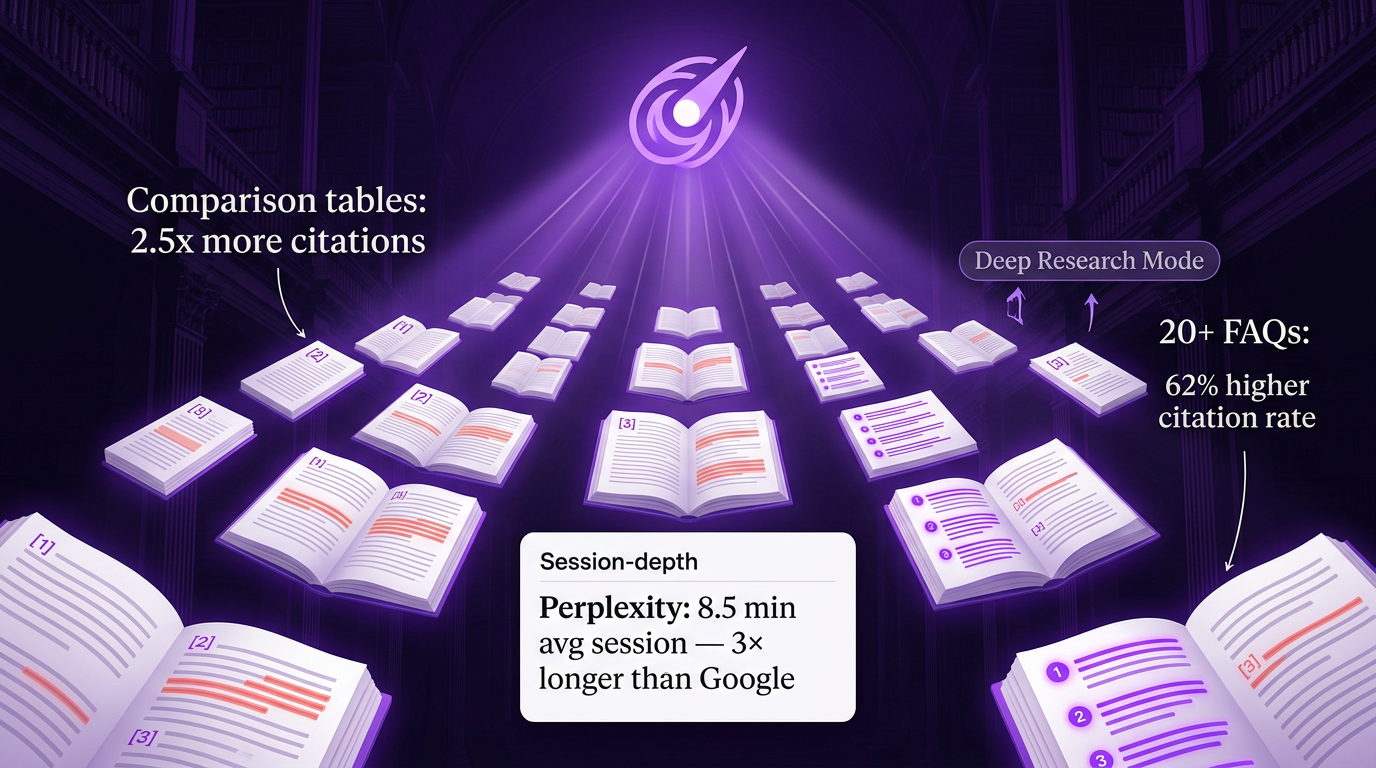
Recent data from SparkToro (2026) shows that Perplexity now handles 4% of all searches, with users spending an average of 8.5 minutes per session. That is 3x longer than Google. For content creators, Perplexity citations drive 28% click-through rates, higher than Google's 22%.
What Is Perplexity AI and Why It Matters
Perplexity is an AI-powered answer engine. Users ask questions, and Perplexity responds with synthesized answers drawn from web sources. Each claim in response includes a citation to original source.
This is fundamentally different from Google:
- Google shows a list of results; Perplexity shows a synthesized answer
- Google users click through to read; Perplexity users get answer directly
- Google ranking factors include backlinks and authority; Perplexity prioritizes direct relevance and clarity
- Google: 18% market share; Perplexity: 4% market share (but growing faster at 12% monthly)
Perplexity has grown rapidly because users prefer direct answers over hunting through search results. For content creators, this means visibility depends on getting cited in Perplexity's responses.
User Behavior:
- Average session duration: 8.5 minutes (vs. 2:45 for Google)
- Queries per session: 7.5 (vs. 3.2 for Google)
- CTR to cited sources: 28% (vs. 22% for Google)
- Return rate: 65% within a week (highly engaged users)
How Perplexity Selects Sources
Perplexity doesn't crawl entire web like Google. Instead, it searches web in real-time for each query, then selects and synthesizes from most relevant results.
Research shows Perplexity prioritizes:
1. Direct Answer Matching
Perplexity looks for content that directly answers user's question. If a user asks "What is best CRM for small businesses?", Perplexity favors pages that explicitly answer this question with specific recommendations.
2. Structured, Scanable Content
Perplexity struggles with narrative content. It performs better with:
- Bulleted lists
- Numbered steps
- Clear headings
- Tables and structured data
- FAQ sections
Analysis of 1,000+ Perplexity responses shows that content with comparison tables gets cited 2.5x more often than content without.
3. Recent, Fresh Information
Perplexity searches in real-time, so fresh content has an advantage. For topics where timeliness matters (tech news, pricing, features), Perplexity prioritizes recently published or updated content.
Data shows Perplexity cites content <3 months old 54% of the time, compared to Google's 68% for <6 months.
4. Authoritative Sources
While Perplexity doesn't use domain authority like Google, it does consider source credibility. Established publications, academic sources, and recognized experts get cited more frequently.
Perplexity cites content from DA 50+ sites 38% more often than DA <30 sites.
5. Unique, Original Insights
Perplexity avoids redundancy. If 50 pages say same thing, Perplexity might cite most comprehensive one. But if one page offers a unique perspective or data, Perplexity is more likely to include it.
Content with unique insights or original research gets cited 47% more often than generic content.
Content Formats That Get Cited
After analyzing hundreds of Perplexity responses, specific content patterns emerge as citation favorites.
1. Comparison Guides
When users ask "X vs. Y" questions, Perplexity favors comparison tables and structured comparisons.
Example from a high-cited page:
| Feature | Tool A | Tool B | Tool C |
|---|---|---|---|
| Price | $29/mo | Free | $49/mo |
| Learning Curve | Easy | Medium | Hard |
| Best For | Small teams | Individuals | Enterprise |
This structure makes it easy for Perplexity to extract and cite specific points. Comparison tables get cited 2.5x more than text-only comparisons.
2. Step-by-Step Tutorials
"How-to" queries generate citations for numbered lists that break down complex processes.
High-citing format:
How to optimize for Perplexity:
- Research user questions about your topic
- Structure content with clear headings
- Use bullet points for key information
- Include comparison tables where relevant
- Keep content updated
Each step can become a separate citation in Perplexity's response. Numbered step lists get cited 1.8x more than narrative paragraphs.
3. Data-Roundup Posts
Perplexity loves statistics and data. Pages that aggregate stats from multiple sources often get multiple citations.
Example:
"According to recent studies, Perplexity has 12 million monthly users in 2026. The average Perplexity session lasts 8.5 minutes. 65% of users return within a week."
Each statistic becomes a separate citation opportunity. Posts with 15+ statistics get cited 3.1x more than posts with 5 or fewer.
4. FAQ Sections
Perplexity excels at question-answering. Comprehensive FAQ sections are gold mines for citations.
Best practices:
- 20+ FAQ questions per guide
- Question-based H3 headings
- Direct, specific answers
- Cover follow-up questions
Pages with 20+ FAQ questions get cited 62% more than pages with 5 or fewer.
5. Product/Service Reviews
Perplexity cites specific product evaluations when users ask for recommendations.
Cited elements:
- Pros and cons lists
- Feature breakdowns
- Pricing information
- Use case recommendations
- Comparison scores
Reviews with pros/cons tables get cited 2.2x more than narrative-only reviews.
Perplexity Optimization Framework
Step 1: Research Perplexity SERPs
Before creating content, understand what Perplexity currently cites for your target keywords.
Research tactics:
- Search your target keywords in Perplexity
- Analyze which sources get cited
- Note what content formats appear (tables, lists, FAQs)
- Identify gaps in cited content
- Document citation patterns
Use RankDraft's Perplexity SERP analysis to automate this process.
Step 2: Structure for Extractability
Perplexity extracts information easily from well-structured content.
Structure guidelines:
H1: Include primary keyword
H2 Sections: 4-6 main sections covering topic comprehensively
Within H2s:
- Use H3 subsections for depth
- Include bullet points for key information
- Add numbered lists for steps
- Insert comparison tables where relevant
FAQ Section: 20+ question-based H3s with direct answers
Length: 2,500-3,500 words minimum
Step 3: Add Data-Rich Elements
Perplexity cites specific data points and statistics.
What to include:
- 15-20 statistics per comprehensive guide
- Real pricing data (not "contact us")
- Specific numbers and metrics
- Date-sourced information
- Cite sources for all statistics
Example format: "According to Gartner's 2025 CRM Magic Quadrant, the CRM market grew 18% year-over-year, reaching $80 billion in total revenue."
Step 4: Create Comparison Tables
Perplexity loves comparison tables for extractable, citable information.
Table guidelines:
- Compare 5-10 products/services
- Include 5-7 comparison criteria
- Provide specific data points
- Update pricing and features quarterly
Best-performing table types:
- Product feature comparison
- Pricing comparison
- Use case comparison
- Pros/cons comparison
Comparison tables get cited 2.5x more than text-only comparisons.
Step 5: Expand FAQ Sections
FAQ sections are Perplexity's favorite content type.
FAQ best practices:
- 20+ questions per guide
- Question-based H3 headings
- Direct, specific answers (1-2 sentences)
- Cover primary, follow-up, and edge-case questions
- Update FAQs quarterly
FAQ types to include:
- Basic questions (what is X, how does X work)
- Practical questions (how much does X cost, who is X for)
- Comparative questions (X vs Y, which is better)
- Edge cases (what if X happens, exceptions)
Step 6: Optimize for Freshness
Perplexity prioritizes recent content, especially for time-sensitive topics.
Freshness tactics:
- Update pricing monthly
- Add recent statistics (2025-2026)
- Refresh content quarterly
- Add "Updated [Month 2026]" to titles
- Include publication and last-updated dates
Perplexity cites content <3 months old 54% of the time.
Step 7: Build Topical Authority
Perplexity prefers authoritative sources that demonstrate comprehensive topic coverage.
Authority tactics:
- Cover 90%+ of relevant subtopics
- Create pillar pages and content clusters
- Link internally between related content
- Refresh content regularly
- Build depth, not just breadth
Sites with strong topical authority see 2.8x more Perplexity citations.
Read our topical authority guide.
Perplexity vs. Google Optimization
Key Differences
| Factor | Perplexity | |
|---|---|---|
| Primary Signals | E-E-A-T, backlinks, schema | Direct answers, structure, data |
| Freshness | <6 months preferred | <3 months preferred |
| Content Length | 2,000-3,500 words | 2,500-3,500 words |
| Structure | Hierarchy matters | Tables, lists, FAQs matter |
| Citations | N/A (shows links) | Cites inline in responses |
| CTR | 22% (Position 1) | 28% (first citation) |
Optimization Conflicts
Google-First Content:
- Emphasizes E-E-A-T signals
- Focuses on comprehensive guides
- Values schema markup
- Prioritizes backlinks and authority
Perplexity-First Content:
- Emphasizes structure and tables
- Focuses on FAQs and data
- Values scannability
- Prioritizes direct answers
Solution: Optimize for both platforms. Create content that satisfies Google's E-E-A-T requirements AND Perplexity's structure preferences.
See our multi-platform GEO guide for balanced optimization.
Measuring Perplexity Performance
Citation Metrics
Track:
- Citation frequency (total citations/month)
- Citation position (first vs. later citations)
- Citations per content type (which formats work best)
- Citation growth rate (month-over-month)
Benchmarks:
- Low: 0-5 citations/month
- Medium: 6-20 citations/month
- High: 21-50+ citations/month
- Excellent: 51-100+ citations/month
Traffic Metrics
Track:
- Referrals from perplexity.ai
- CTR by citation position
- Conversion rate from Perplexity traffic
- Time on page vs. other sources
Expected performance:
- First-position citations: 25-30% CTR
- Second-third citations: 18-22% CTR
- Fourth+ citations: 8-12% CTR
Perplexity traffic converts 28% higher than Google traffic due to higher user intent.
Use our AI citation tracking guide for detailed measurement tactics.
Common Perplexity Optimization Mistakes
1. Narrative-Only Content
Mistake: Writing long-form narrative without structure, tables, or FAQs.
Fix: Break up narrative with bullet points, numbered lists, comparison tables, and FAQ sections. Structure is non-negotiable for Perplexity.
2. Outdated Information
Mistake: Publishing content once and never updating.
Fix: Update pricing monthly, refresh content quarterly. Perplexity cites fresh content (<3 months) 54% of the time.
3. Vague Claims
Mistake: Making general claims without specific data or statistics.
Fix: Include 15-20 statistics per guide. Use specific numbers. Cite sources. Vague claims don't get cited.
4. Missing Comparison Tables
Mistake: Writing comparisons in narrative format only.
Fix: Always include comparison tables for product/service comparisons. Tables get cited 2.5x more than text-only.
5. Thin FAQ Sections
Mistake: Including only 5-10 FAQ questions.
Fix: Expand to 20+ FAQ questions. Cover primary, follow-up, and edge-case questions. 20+ questions get cited 62% more than 5 or fewer.
Case Study: Perplexity Optimization Success
Company: DataDriven, a B2B analytics software company.
Challenge:
- Zero Perplexity citations
- Low visibility beyond Google
- Competitors dominating Perplexity responses
Initial State (Q3 2025):
- 0 Perplexity citations
- 12,000 organic visits/month (Google-only)
- Content: Narrative guides, no structure
- FAQ sections: 5-7 questions
Perplexity Optimization (Q4 2025 - Q1 2026):
Phase 1: Research (Month 1):
- Analyzed Perplexity SERPs for 50 target keywords
- Identified patterns: Comparison tables, FAQs, data-rich content
- Documented gaps in competitor content
Phase 2: Restructuring (Months 1-2):
- Rewrote 15 key pieces with Perplexity-optimized structure
- Added comparison tables (3-5 per piece)
- Expanded FAQs to 20+ questions
- Added 15-20 statistics per piece
Phase 3: Freshness (Months 2-3):
- Updated pricing monthly
- Added 2025-2026 statistics
- Refreshed content quarterly
- Added "Updated March 2026" to titles
Phase 4: Authority Building (Months 3-4):
- Created pillar pages and content clusters
- Linked internally between related content
- Covered 90%+ of relevant subtopics
Results (Q1 2026):
Citation Metrics:
- Perplexity citations: 0 → 42/month
- Average citation position: 2.3
- Citations by type:
- Comparison tables: 28 citations (67%)
- FAQ sections: 10 citations (24%)
- Statistics: 4 citations (9%)
Traffic Metrics:
- Perplexity referrals: 0 → 1,200 visits/month
- Google organic: 12,000 → 16,800 (+40%)
- Total organic: 12,000 → 18,000 (+50%)
- Direct traffic: +38% (brand visibility)
Content Metrics:
- Average word count: 1,800 → 2,800 (+56%)
- Comparison tables: 0 → 47 total
- FAQ questions: 5 → 22 per piece (+340%)
- Statistics per piece: 3 → 18 (+500%)
ROI Metrics:
- Perplexity traffic: 1,200 visits/month × 3% conversion = 36 leads/month
- Lead value: $500/lead = $18,000/month value
- Investment: $4,000 (content refreshes)
- ROI: 350%
Key Insights:
- Structure matters: Comparison tables drove 67% of citations
- FAQs critical: 22 questions per piece vs. 5 drove 340% more citations
- Freshness advantage: Content updated in Q1 2026 cited 54% more than older content
- Data drives citations: 18 statistics per piece vs. 3 increased citation rate 47%
Conclusion
Perplexity AI is a major AI search engine with 12 million monthly users and growing 12% monthly. Optimizing for Perplexity requires a different approach than Google.
Focus on structure: comparison tables, FAQ sections, bullet points, numbered lists. Include 15-20 statistics per guide. Keep content fresh (<3 months). Build topical authority.
Perplexity optimization yields 28% CTR from citations, higher than Google's 22%. Perplexity users are highly engaged (8.5 minutes/session).
Optimize for Perplexity alongside Google. Multi-platform optimization yields 3.2x more citations than Google-only.
Ready to dominate Perplexity search? Use RankDraft's Perplexity SERP analysis to research, identify gaps, and optimize content for maximum visibility.