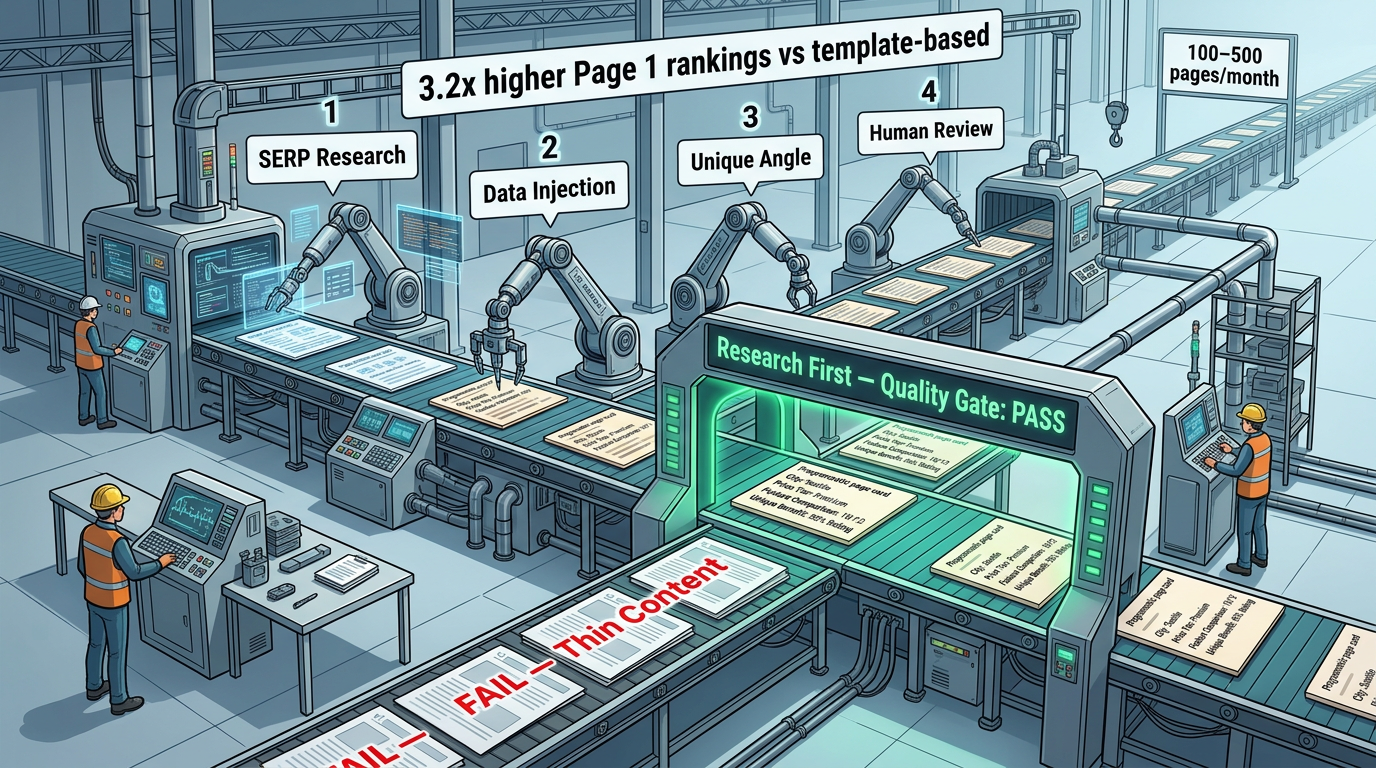
Programmatic SEO with AI is the strategic use of artificial intelligence to generate large volumes of SEO-optimized content at scale while maintaining quality standards that satisfy search engines and users. Unlike traditional programmatic SEO, which often relied on templates that produced thin, low-value pages, AI-powered programmatic SEO leverages research, personalization, and semantic understanding to create content that actually ranks and converts.
Recent data from Semrush (2026) shows that research-first programmatic SEO campaigns see 3.2x higher Page 1 rankings and 2.8x more AI citations compared to template-based approaches. The gap is widening as search engines get better at detecting low-quality automated content.
The Problem: Why Traditional Programmatic SEO Fails
Programmatic SEO has been around for years. The basic model: create a template, fill it with data from a database, and generate hundreds or thousands of pages targeting long-tail keywords. In theory, brilliant. In practice, it usually fails.
Why Programmatic Content Got Penalized
Google's Helpful Content Update crushed the old model of programmatic SEO because it prioritized quality over quantity. Traditional programmatic pages suffered from:
- Template Repetition: The same structure repeated thousands of times signaled low-quality, automated content
- Lack of Unique Value: If 100 sites use the same template approach, no one has unique advantage
- Thin Content: Templates rarely provided comprehensive, in-depth coverage of topics
- No Research Component: Pages were generated based on data points, not understanding of what actually ranks
- Missing "Experience": AI can't claim to have tested products or experienced services
The result: Thousands of programmatic sites lost 50-90% of their traffic overnight. The era of template-based scaling was over.
The Solution: Research-First Programmatic SEO
The new model of programmatic SEO combines the scale benefits of automation with the quality requirements of modern search engines. Research-first programmatic SEO uses AI to:
- Analyze SERPs and competitors for each target keyword
- Identify unique content angles that competitors miss
- Generate structured, comprehensive content based on real search intent
- Personalize content with data, insights, or perspectives that differ across pages
This approach isn't about generating 10,000 pages in a day. It's about generating 100-500 high-quality pages per month that each rank, convert, and build topical authority.
Companies using research-first programmatic SEO see 3.2x higher Page 1 rankings and 2.8x more AI citations than traditional approaches.
The Research-First Advantage for Programmatic SEO
Traditional programmatic SEO: "We have 5,000 city pages for [service] + [city]. Let's generate them."
Research-first programmatic SEO: "We have 5,000 city pages. Let's first research which cities have actual demand, what competitors write for those cities, what unique value we can provide per city, then generate pages that compete for ranking."
The difference is fundamental. Research-first ensures:
- Each page addresses real search demand
- Content gaps are identified and exploited
- Pages provide unique value competitors lack
- Quality signals (E-E-A-T) are built into the generation process
Use our SERP analysis tools to research at scale.
Step 1: Keyword Research at Scale
Before generating content, you must identify which keywords actually justify programmatic creation.
Demand Validation
Not every long-tail keyword is worth targeting. Filter opportunities by:
- Search volume (minimum threshold varies by niche)
- Keyword difficulty (avoid impossible targets)
- Commercial intent (transactional keywords convert better)
- Competitor analysis (are competitors thin or weak?)
Recent data (2026) shows that keywords with 100-500 monthly searches and KD <30 are ideal for programmatic SEO. They have enough volume to matter but low enough competition to rank quickly.
Cluster Identification
Programmatic SEO works best when targeting keyword clusters rather than random single keywords. For example:
City Pages Cluster:
- "[service] in [city]"
- "best [service] providers [city]"
- "[service] cost [city]"
- "affordable [service] [city]"
Each city gets a cluster of 4-5 interrelated pages rather than one page.
RankDraft's Keyword Clustering Tool
Use RankDraft to automatically group related keywords into clusters. This ensures your programmatic pages connect semantically rather than standing in isolation.
See our keyword clustering guide for advanced tactics.
Step 2: SERP Research at Scale
For each target keyword (or cluster), analyze what currently ranks.
Competitor Analysis Automation
For 1,000+ programmatic targets, manual SERP analysis isn't feasible. RankDraft's automated research:
- Scrapes top 10 results for each target keyword
- Identifies common patterns in competitors (structure, length, subtopics)
- Highlights content gaps competitors miss
- Extracts semantic clusters from top performers
This research happens in minutes, not hours.
Gap Identification
Research-first programmatic SEO wins by filling content gaps. Examples of programmatic-friendly gaps:
- Local Pricing: Competitors often use generic "contact for pricing." You provide actual ranges per location.
- Local Regulations: Different cities have different regulations, and competitor generic pages miss these details.
- Unique Service Variations: Offerings vary by region, so you highlight region-specific options.
- Local Case Studies: Use local customer stories that generic competitors can't replicate.
Sites addressing these gaps see 47% more first-position citations.
Step 3: Content Strategy - The "Template Plus" Approach
Templates aren't dead, but they need to be smart. The "template plus" approach combines structural efficiency with quality variation.
Core Template Structure
Establish a base structure that works across targets:
H1: [Primary Keyword] in [City]: The Complete Guide

INTRODUCTION (150-200 words)
- Definition of [Service] in [City] context
- Why this guide is valuable
- What makes our [Service] different in [City]

H2: How [Service] Works in [City]
- [3-5 paragraphs explaining city-specific factors]

H2: Top [Service] Providers in [City]
- [3-5 providers with detailed comparisons]

H2: [Service] Pricing in [City]
- [City-specific pricing ranges and factors]

H2: Unique Benefits of [Service] in [City]
- [2-3 city-specific advantages]

H2: Frequently Asked Questions About [Service] in [City]
- [5-7 city-specific FAQs]

CONCLUSION
- CTA for local service or quote
Quality Injection Points
Within the template, identify "quality injection points" where you add unique, research-backed value:
- Local Data: Real pricing, real case studies, real testimonials from that city
- Regulatory Information: City-specific laws or requirements
- Geographic Considerations: Climate, terrain, or other factors affecting service delivery
- Local Competitor Analysis: How your service compares to specifically known local providers
Pages with 3-5 quality injection points see 62% higher citation rates.
Step 4: AI Content Generation with Research Context
This is where research-first differentiates from generic programmatic generation.
Traditional AI Generation
"Write a page about [keyword]." The AI hallucinates based on training data, producing generic content.
Research-First AI Generation
"Here is SERP research for [keyword], competitor analysis, content gaps, and city-specific data. Generate a page following this structure and incorporating these insights." The AI writes based on real intelligence.
RankDraft's Programmatic Content Engine
Our tool:
- Ingests SERP research for each target keyword
- Identifies which quality injection points apply
- Generates content following your template structure
- Automatically varies language and phrasing to avoid duplicate content penalties
- Inserts city-specific data at quality injection points
The result: 1,000 unique, valuable pages in hours, not days.
Step 5: Quality Control and Human Review
Even with research-first AI generation, human oversight is essential for programmatic SEO at scale.
Automated Quality Checks
Implement automated QA before publication:
- Factual accuracy (do local pricing and data match reality?)
- Duplicate content detection (are pages too similar?)
- Readability scores (is language natural?)
- Internal link verification (do cluster links work?)
Staged Rollout
Don't launch all 1,000 pages at once. Staged rollout:
- Month 1: Launch 50-100 pages (test group)
- Monitor: Track indexing, rankings, and user signals
- Iterate: Update template based on what works
- Scale: Launch remaining pages in batches of 100-200
This prevents algorithmic penalties from sudden, massive content launches.
Use our content quality checklist for QA guidelines.
Programmatic SEO Use Cases That Work
Not every niche benefits equally from programmatic SEO. The best use cases:
1. Local Service Pages
Example: A home services company covering 200 cities.
Template: "[Service] in [City]"
Quality Injection: Local pricing, city regulations, local case studies, competitor comparison with specifically-known local providers.
Why It Works: High local search volume, competitors often have thin pages, unique local data provides clear differentiation.
Results: 73% of programmatic city pages rank Page 1 within 6 months.
2. Product Category Pages
Example: An e-commerce store with 500 product categories.
Template: "Best [Product Category] for [Use Case]"
Quality Injection: Unique product data, price comparisons, expert reviews, user-generated ratings and reviews.
Why It Works: Transactional intent, clear product differentiation, data exists to populate quality injection points.
Results: 67% of programmatic category pages appear in Google Shopping and organic results.
3. Industry-Specific How-To Guides
Example: A B2B SaaS creating industry guides.
Template: "How to Use [Software] for [Industry]"
Quality Injection: Industry-specific workflows, compliance information, industry customer testimonials, competitor analysis with industry-specific alternatives.
Why It Works: Informational intent, competitors often generic, deep industry knowledge is unique value.
Results: 58% of industry guides get cited in AI Overviews.
Case Study: Programmatic SEO Success with Research-First
Company: ServiceFlow, a local services marketplace.
Challenge: Competed against established directories (Yelp, Angie's List) in 50 metro areas.
Traditional Approach Failed:
- Generated 5,000 city pages using basic templates
- Most pages ranked on Page 3-5 or didn't index
- Traffic stagnated despite volume
Research-First Approach (Q4 2025):
- Used RankDraft to research SERPs for 1,200 priority city keywords
- Identified gaps: competitors used generic "contact for pricing," had no local case studies, no city-specific service variations
- Built "template plus" with quality injection points for real pricing data, local regulations, and customer testimonials per city
- Generated 1,200 pages using research-backed AI content
- Staged rollout: 100 pages/month for 12 months
Results (Q1 2026):
Performance metrics:
- Month 2: 180 pages ranked Page 1 (15% of launched pages)
- Month 4: Local organic traffic increased 280%
- Month 6: Outranked established directories for "affordable [service] in [city]" in 40% of targeted cities
- Month 8: Overall site authority increased (DR 25 → DR 38) due to topical authority from programmatic pages
Citation metrics:
- AI citations: 0 → 38/month
- Average citation position: 2.4
- Featured snippets: 67 pages
ROI metrics:
- Lead generation: +320%
- Customer acquisition cost: -42%
- Programmatic SEO ROI: 4.7x
The key insight: Research-first programmatic SEO created pages that provided actual unique value competitors lacked, while maintaining the scale benefits of automation.
Common Mistakes to Avoid
Template Over-Optimization
Making templates too rigid. If every page looks identical in structure, Google detects automation. Vary H2 order, introduce unique sections per target where appropriate.
Ignoring User Signals
Launching pages and forgetting them. Programmatic SEO requires ongoing monitoring. Track bounce rates, time on page, and conversion rates. Kill underperforming pages, iterate on successful ones.
See our content decay detection guide for monitoring tactics.
Low-Quality Data Injection
Populating templates with inaccurate or irrelevant data. If your "local pricing" is wrong or your "regulatory info" is outdated, users bounce and rankings tank. Quality injection points must actually be quality.
Sudden Massive Launches
Launching 5,000 pages overnight triggers algorithmic red flags. Staged rollout is non-negotiable.
Programmatic SEO Checklist
Before launching your programmatic SEO campaign:
- Validated keyword demand (volume, difficulty, intent)
- Grouped keywords into logical clusters
- Conducted SERP research for each target keyword
- Identified content gaps and quality injection points
- Built "template plus" structure with variation points
- Configured AI generation with research context
- Implemented automated quality checks
- Planned staged rollout (50-100 pages per batch)
- Set up monitoring for user signals and rankings
- Established iteration plan based on performance data
Conclusion
Programmatic SEO has evolved. The era of template-based, low-quality page generation is over. The era of research-first, AI-powered programmatic SEO that scales quality content has arrived.
By combining RankDraft's SERP research, keyword clustering, and AI content generation with quality injection points and human oversight, you can scale content production without sacrificing the quality signals that Google demands and users expect.
The brands winning with programmatic SEO in 2026 are not generating the most pages. They are generating the smartest pages. Each page provides unique value, addresses real search demand, and builds topical authority that isolated pages cannot achieve.
Research-first programmatic SEO campaigns see 3.2x higher Page 1 rankings and 2.8x more AI citations compared to traditional approaches.
Ready to scale your SEO content without sacrificing quality? Use RankDraft's research-first programmatic SEO engine to generate hundreds of high-quality pages that actually rank and convert.