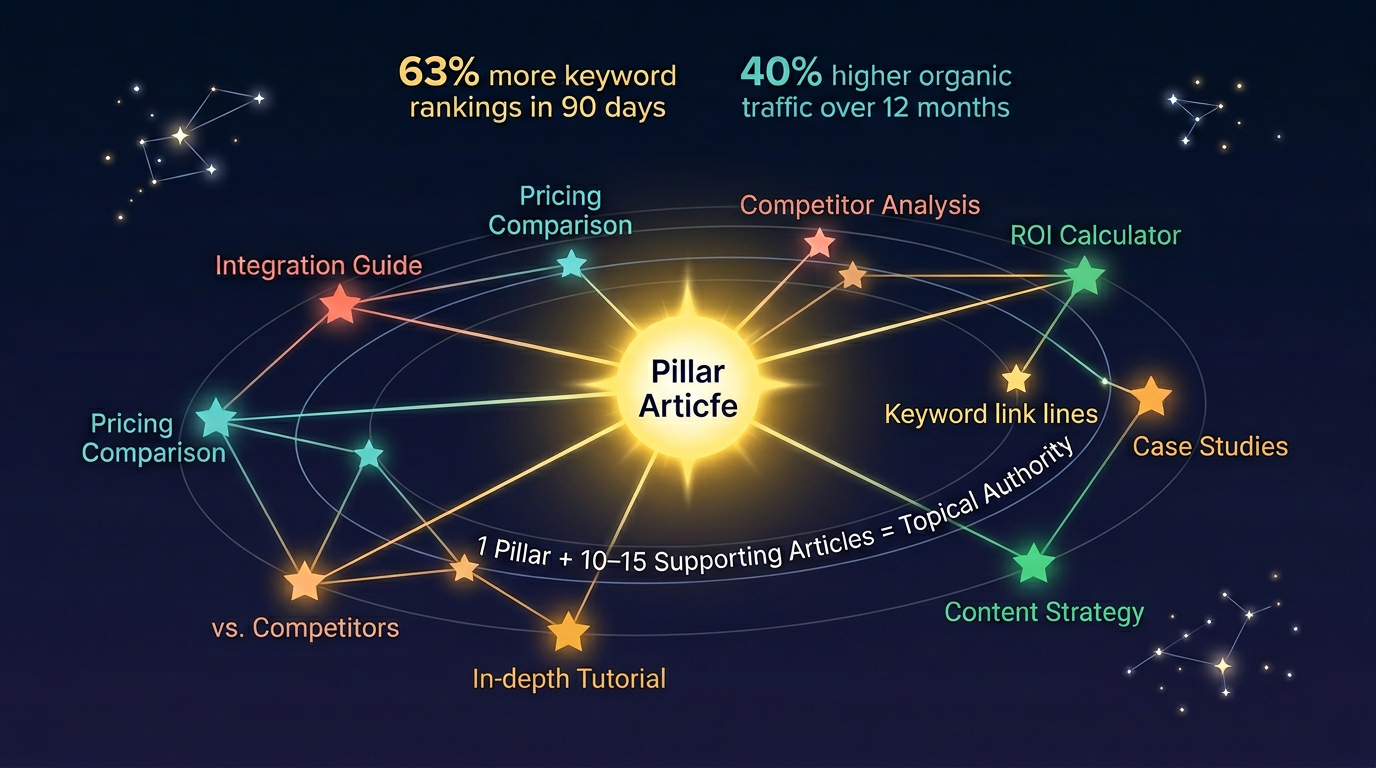
Keyword clustering is the process of grouping semantically related keywords into topic clusters that map to a content architecture. Instead of targeting individual keywords in isolation, you analyze how terms relate to each other and organize them into pillar pages and supporting articles. The result is a site structure that signals topical authority to both traditional search engines and AI search platforms like Google AI Overviews, Perplexity, and ChatGPT.
The data supports this approach decisively. A study of 50 B2B SaaS websites implementing pillar-cluster architecture showed a 63% increase in keyword rankings within 90 days and an average domain authority increase of 8 points over 6 months (Backlinko). Sites sustaining cluster publishing for 12 months or longer see 40% higher organic traffic than comparable standalone-page strategies.
This guide covers everything from the fundamentals of semantic clustering to advanced entity-based and intent-first methodologies emerging in 2026, with concrete examples and step-by-step implementation using RankDraft.
Why Keyword Clustering Matters More in 2026 Than Ever
Google's algorithms have moved far beyond keyword matching. The March 2026 Core Update affected 55% of monitored domains, with explicit evaluation of content originality and information gain. The December 2025 Core Update rewarded sites with deep content clusters (10-15 quality supporting articles) with an average 23% visibility gain, while sites with thin or mass-produced content saw traffic drops of 71-87%.
Meanwhile, AI search has fundamentally changed the game. AI Overviews now trigger on approximately 48% of all tracked queries, a 58% increase year-over-year (BrightEdge). Zero-click searches have reached 80%+ of all queries. The old playbook of ranking for isolated keywords and collecting clicks is breaking down.
When you implement keyword clustering, you gain several critical advantages:
- Topical Authority Signal: Analysis of 250,000+ search results found that topical authority is now the strongest on-page ranking factor, surpassing even domain traffic (Infiflex). Clustering proves you understand the entire landscape of a subject.
- AI Citation Advantage: Pillar pages with topic clusters receive 3.2x more AI citations than standalone posts. Bidirectional internal linking within clusters increases the probability of AI citation by 2.7x (Yext).
- Content Efficiency: One documented topic cluster ranked for 29,000+ keywords and attracted 158,000+ visitors (Backlinko). A single pillar with supporting content outperforms dozens of disconnected pages.
- Reduced Cannibalization: When two pages compete for the same keyword, search engines split authority, often ranking both lower. Clustering assigns clear content boundaries to prevent this entirely.
- Rankings That Last: Content grouped into clusters holds rankings 2.5x longer than standalone pieces (HubSpot/HireGrowth 2025 analysis).
- Better Conversions: Intent-first clustering campaigns show 40% higher organic traffic and 60% better conversion rates versus traditional methods, across analysis of 10,000+ successful content campaigns in 2025.
For RankDraft users, keyword clustering is foundational to our research-first methodology. Our tools automatically identify semantic relationships and suggest cluster architectures based on real SERP data.
How Search Engines Understand Keyword Relationships
Modern search engines build knowledge graphs mapping relationships between entities and concepts. Google's Knowledge Graph has grown to approximately 1.6 trillion facts on 54 billion entities (Princeton/Georgia Tech research). When Google processes "content marketing," it understands connections to "blog strategy," "editorial calendar," "content distribution," and "SEO content." These mapped relationships form the foundation of effective keyword clustering.
Semantic Similarity
Search engines analyze how keywords co-occur across millions of pages. Terms that frequently appear together have high semantic similarity. Modern approaches use vector embeddings, mapping keywords into 768-dimensional dense vector spaces using models like BERT, then measuring cosine similarity to determine relatedness. This is far more sophisticated than simple string matching.
For example, "keyword research" and "search intent analysis" have high semantic similarity despite sharing no words, because they appear together in context across SEO content. RankDraft's clustering uses this embedding-based approach combined with SERP overlap data.
Search Intent Alignment
Keywords within a cluster should share similar search intent. If "content strategy" is informational, related terms like "content planning" and "editorial calendar template" are likely informational too. But "content strategy software" is transactional and belongs in a different cluster, even though it contains the same root phrase.
The 2026 best practice is a three-layer intent framework:
- Primary Intent: The immediate problem the searcher wants to solve
- Contextual Intent: The underlying situation driving the search
- Progressive Intent: The next logical step in the user's journey
73% of content creators still rely on semantic similarity alone rather than behavioral clustering patterns, missing this intent-first opportunity. Incorporating intent layers into your clusters creates content that matches the full user journey, not just surface-level queries.
Entity Salience
Google recognizes entities (people, places, concepts, organizations, products) as distinct from generic keywords. Within a cluster about "email marketing," entities might include "open rates," "click-through rates," "Mailchimp," "automation workflows," and "segmentation." These entities reinforce topical context and signal depth to both search engines and AI models.
Entity-based clustering is one of the biggest methodology shifts in 2026. Rather than grouping words that look alike, you group entities that belong to the same knowledge domain. Hub pages should cover 15-25 entities at overview level, while cluster pages address 2-3 entities deeply and introduce 5-10 additional related entities. Content should reference specific entities every 150-200 words. For a deeper dive, see our guide on entity optimization for AI search.
Step 1: Data Collection: Gathering Your Keyword Universe
Before clustering, you need a comprehensive keyword dataset. Most SEOs start with too few terms, limiting cluster depth and missing long-tail opportunities.
Seed Keyword Expansion
Start with your core business keywords. For a content marketing SaaS, these might include "SEO content tool," "content optimization," "AI writing assistant," and "content brief generator."
Use multiple keyword research sources:
- Google Search Console: Your actual ranking queries reveal how Google already associates your site with topics
- Competitor keyword rankings: Use SERP analysis tools like Ahrefs or Semrush to export competitor keyword profiles
- Keyword research tools: SEMrush Keyword Magic, Ahrefs Keywords Explorer, Moz Keyword Explorer
- Google "People Also Ask" and related searches: These reveal query fan-out patterns, the sub-queries stemming from a single user intent
- AI search queries: Check what questions Perplexity, ChatGPT, and Google AI Overviews surface around your topics
- Reddit, Quora, and niche forums: Real user language often differs from keyword tool suggestions
- Customer support tickets and sales call transcripts: The exact phrasing your audience uses
Target collecting 300-500+ keywords for a comprehensive cluster analysis. For competitive niches, 1,000+ is not uncommon.
Filter and Categorize
Before clustering, clean your dataset:
- Remove branded competitor keywords you don't want to target
- Exclude keywords with conflicting search intent (transactional vs. informational)
- Note keyword difficulty, search volume, and CPC data for prioritization
- Tag high-priority "money" keywords (those with commercial or transactional intent)
- Flag keywords already ranking in positions 4-20 (quick win opportunities)
Step 2: Clustering Methodology: Semantic, SERP-Based, and Hybrid
There are three primary approaches to keyword clustering in 2026, and the best strategies combine all three.
Semantic Clustering
Semantic clustering uses NLP and machine learning to convert keywords into numerical representations (vector embeddings), then groups them by mathematical similarity. Keywords like "SEO tool," "content optimization software," and "search rank analyzer" cluster together because they occupy similar positions in the embedding space, even though they share few words.
Strengths: Catches conceptual relationships that SERP data might miss. Fast to compute across large keyword sets.
Weaknesses: Can over-group keywords with different search intents. Does not reflect how Google actually treats queries.
SERP-Based Clustering
SERP clustering groups keywords based on actual search result page overlap. If "content marketing strategy" and "B2B content strategy" share 3+ of the same URLs in their top 10 results, they belong in the same cluster because Google treats them as the same topic.
Strengths: Reflects actual search engine behavior. Identifies when keywords share enough overlap that separate pages would cannibalize each other.
Weaknesses: Requires live SERP data, which changes over time. May not capture emerging topics with limited search history.
Key threshold: If two keywords share 70%+ overlap in top 10 results, targeting them on separate URLs weakens performance rather than expanding coverage. They must live on the same page. At 30-70% overlap, they can be supporting articles linking to the same pillar. Below 30%, they likely need separate clusters entirely.
Hybrid Clustering (Recommended)
The 2026 best practice combines semantic similarity with SERP overlap data and intent classification. Tools like Keyword Cupid retrained their models in March 2026 to separate keywords that share partial SERP overlap into distinct clusters when they carry different search intent, reducing over-grouping.
RankDraft's clustering tool uses this hybrid approach, analyzing:
- Co-occurrence patterns across top-ranking pages
- Semantic similarity using word embeddings
- Search intent classification (informational, commercial, transactional, navigational)
- SERP structure analysis (do these keywords trigger similar result types, featured snippets, or AI Overviews?)
- Entity overlap between ranking pages
Example Cluster Output
For a content marketing SaaS, RankDraft might generate:
Cluster: Content Strategy (22 keywords)
- Core keyword: content strategy (Vol: 14,800 / KD: 72)
- Primary: content marketing strategy, B2B content strategy, content framework, content strategy template
- Secondary: content planning process, editorial calendar, content governance, content operations workflow
- Long-tail: "how to create a content strategy from scratch," "content strategy for startups with no budget"
- Intent: Informational/Commercial hybrid
- SERP overlap: 65% average across primary keywords
- Entities: editorial calendar, content audit, buyer persona, content pillar, KPIs
- Recommended: 1 pillar page + 8 supporting articles
Cluster: Content Brief Writing (15 keywords)
- Core keyword: content brief (Vol: 5,400 / KD: 45)
- Primary: content brief template, how to write a content brief, SEO content brief
- Secondary: content brief examples, content brief for writers, content brief checklist
- Intent: Informational (with template/tool commercial sub-intent)
- SERP overlap: 58% average
- Recommended: 1 pillar page + 5 supporting articles
Step 3: Cluster Analysis and Content Architecture
Once you have clusters, analyze them to build your content architecture.
Pillar Page Identification
Each major cluster needs a pillar page: a comprehensive guide covering the entire cluster topic. Based on 2026 performance data, effective pillar pages should:
- Target the highest-volume, most competitive keyword in the cluster
- Be 3,000-5,000 words (the optimal range; below 2,000 lacks depth, above 8,000 loses focus)
- Link internally to all supporting articles in the cluster
- Cover 15-25 entities at overview level
- Include structured data and clear heading hierarchy for AI extraction
- Place key claims and definitions in the first 30% of content (44.2% of LLM citations originate from the opening third of text, per Growth Memo)
For the "Content Strategy" cluster above, the pillar might be "The Complete Guide to Content Strategy in 2026," covering the full topic landscape and linking out to deeper dives.
Supporting Content Mapping
Secondary and long-tail keywords become supporting articles. Based on 2026 benchmarks:
- Target specific subtopics or long-tail keywords within the cluster
- 1,500-2,500 words (focused depth on one aspect)
- Link back to the pillar page using keyword-rich anchor text
- Link laterally to 2-3 other supporting articles in the same cluster
- Address 2-3 entities deeply while introducing 5-10 related entities
- Exceed 2,900 words if targeting AI citation (articles above this length average 5.1 AI citations vs. 3.2 for articles under 800 words, per SE Ranking)
For the Content Strategy cluster, supporting articles might include:
- "How to Write a Content Brief" (supports pillar, targets brief-specific keywords)
- "Content Operations Framework" (supports pillar, targets ops keywords)
- "Editorial Calendar Template for 2026" (supports pillar, targets planning keywords)
- "Content Velocity Strategies" (supports pillar, targets production scaling keywords)
Optimal Cluster Size
Research shows the sweet spot is 15-30 keywords per cluster, with 10-20 supporting articles per pillar. Sites with fewer than 10 supporting articles per cluster see diminished topical authority signals. The December 2025 Core Update specifically rewarded sites with 10-15 quality supporting articles per cluster, with an average 23% visibility gain.
The minimum viable cluster: 1 pillar + 5 supporting articles. The ideal cluster: 1 pillar + 12-15 supporting articles published over 6-12 months.
Cluster Priority Matrix
Not all clusters deserve equal attention. Prioritize using this framework:
| Priority | Volume | Difficulty | Strategy | Timeline |
|---|---|---|---|---|
| P0: Quick Wins | High | Low | Publish immediately, capture traffic fast | Weeks 1-4 |
| P1: Strategic Bets | High | High | Build cluster depth over time, establish authority | Months 1-6 |
| P2: Supporting | Low | Low | Fill gaps after pillars are published | Months 3-9 |
| P3: Deprioritize | Low | High | Only pursue if directly relevant to core business | Re-evaluate quarterly |
Add a fifth dimension: AI Overview prevalence. Keywords where AI Overviews trigger (48% of queries and growing) require content specifically structured for extraction. Prioritize clusters where AI Overview optimization creates a dual-channel opportunity: traditional ranking plus AI citation.
Step 4: Creating a Content Blueprint
With clusters analyzed, create a content blueprint that maps your entire publishing plan.
Blueprint Structure
For each pillar cluster, document:
CLUSTER: Content Strategy
Pillar Keyword: content strategy (Vol: 14,800 / KD: 72)
Pillar URL: /blog/content-strategy-complete-guide
Pillar Word Count Target: 4,000
Pillar Target Date: 2026-05

Supporting Articles:
1. How to Write a Content Brief -> content brief template -> P0 (KD: 45) -> 2026-05
2. Content Operations Framework -> content operations -> P1 (KD: 58) -> 2026-06
3. Editorial Calendar Guide -> editorial calendar template -> P0 (KD: 32) -> 2026-05
4. Content Governance for Teams -> content governance -> P2 (KD: 41) -> 2026-07
5. Content Audit Checklist -> content audit -> P1 (KD: 55) -> 2026-06

Internal Linking Map:
- Pillar links to: All 5 supporting articles
- Each supporting article links to: Pillar + 2 lateral articles
- Cross-cluster links: -> [Content Velocity cluster] -> [SEO Strategy cluster]

Entity Coverage:
- Pillar covers: editorial calendar, content audit, buyer persona, KPIs, content pillar,
  distribution channels, content governance, measurement framework
- Supporting articles deep-dive: 2-3 entities each

AI Optimization Notes:
- Place key definitions in first 300 words
- Include 40-60 word summary paragraphs for AI extraction
- Add schema markup (Article, HowTo, FAQ where appropriate)
Competitor Cluster Gap Analysis
Use RankDraft alongside your competitor analysis workflow to identify gaps. Common findings:
- Competitors have a "Content Strategy" pillar but lack supporting articles on content operations or content governance
- They rank for "SEO content" but haven't built a cluster around "AI content optimization" or "GEO"
- Their clusters are shallow (3-4 supporting articles vs. the recommended 10-15)
- They haven't updated cluster content since pre-2025 algorithm changes
These gaps represent your highest-ROI opportunities. A site with 20 interconnected articles on one topic consistently outranks a site with one 5,000-word guide, even when that single article is technically superior in isolation.
Step 5: Execution: Building Content from Clusters
Writing Pillar Pages
Using RankDraft's research-first approach:
- Research the pillar keyword's SERP (top 10 results). Identify which entities competitors cover and which they miss.
- Map entity gaps. Use Google's NLP API or RankDraft's entity analysis to find entities present in top-ranking content but absent from competitors. These are your information gain opportunities.
- Draft the pillar covering all cluster keywords semantically. Don't force-fit keywords; let them appear naturally within comprehensive topic coverage.
- Structure for AI extraction. Place key definitions, statistics, and frameworks in concise 40-60 word paragraphs. The first 30% of your content is where 44% of AI citations originate.
- Include internal links to all planned supporting articles (even unpublished ones, using placeholder URLs you'll activate later).
- Add structured data. Article schema, FAQ schema where relevant, and breadcrumb markup all improve AI citation probability by approximately 30% (AISO).
Writing Supporting Articles
For each supporting article, follow the same research-first process at a narrower scope:
- Research the specific subtopic keyword and its SERP landscape
- Write focused content that goes deep on one aspect (1,500-2,500 words)
- Link back to the pillar page using the pillar keyword as anchor text
- Link laterally to 2-3 other supporting articles in the cluster
- Cover 2-3 entities deeply while referencing 5-10 related entities
- Maintain consistent terminology with the pillar page to reinforce semantic connections
RankDraft automates much of this through our content brief generation, which pre-populates entity targets, internal linking suggestions, and competitor gap data for each supporting article.
Publishing Cadence
Timing matters. The minimum effective cadence is 1-2 articles per month within a cluster. Full authority compounding typically takes 12 months of consistent publishing. A study of high-performing clusters found that ranking gains appear across 80%+ of cluster keywords within 90 days of reaching critical mass (8-10 published articles).
For teams looking to accelerate, see our guide on content velocity strategies that maintain quality while scaling production.
Updating Existing Content
If you already have published content, map it to your new clusters:
- Identify which cluster each existing article belongs to
- Add internal links to connect isolated articles into cluster structures (SearchPilot A/B tests show internal linking expansion produces ~5% organic traffic uplift)
- Merge articles that compete for the same keywords (one site saw a 466% traffic increase after consolidating two cannibalized articles via 301 redirect within 8 weeks)
- Refresh outdated content: content updated within 3 months averages 6 AI citations vs. 3.6 for stale content
- Prune thin articles that hurt cluster quality. Sites where fewer than 7% of pages have under 500 words showed more stability in the December 2025 update
Adapting Clusters for AI Search and Zero-Click
With 80%+ of searches resulting in zero clicks and AI Overviews triggering on 48% of queries, your cluster strategy must account for AI search visibility alongside traditional rankings.
The Citation-Ranking Decoupling
A February 2026 Ahrefs study of 863,000 keywords found that only 38% of pages cited in AI Overviews also rank in the traditional top 10, down from 76% just seven months earlier. For ChatGPT, only 12% of cited URLs rank in Google's top 10. This means optimizing solely for Google rankings is no longer sufficient. Your clusters need to target AI citation as a parallel channel.
The implications for clustering:
- A page that ranks moderately for ten related sub-queries now outperforms a page ranking #1 for the head term alone
- Cluster architecture creates multiple citation entry points across a topic
- Pillar-organized topics achieve a 41% AI citation rate compared to 12% for standalone content (Backlinko)
Structuring Clusters for AI Extraction
AI models extract information differently than traditional search crawlers. Optimize your cluster content for both:
- Concise definition paragraphs (40-60 words) that AI models can directly quote
- Specific entities every 150-200 words: named tools, metrics, companies, and processes
- Statistics with sources: Princeton/Georgia Tech GEO research found that adding statistics and citing sources achieved 30-40% improvement in AI visibility metrics
- Front-loaded key information: Place your most important claims, data, and definitions in the first 30% of each article
- Clear heading hierarchy: Use descriptive H2s and H3s that match the sub-queries within your cluster
For a complete guide to AI search optimization, see our post on optimizing for Google AI Overviews.
The Silver Lining: AI Traffic Converts Better
While zero-click searches reduce raw traffic, AI search traffic that does reach your site converts at dramatically higher rates. AI search traffic converts at 14.2% compared to Google organic's 2.8% (SuperPrompt). ChatGPT referral traffic converts at 15.9% vs. Google's 1.76% (Seer Interactive). This means a well-clustered site that earns AI citations may generate more revenue from fewer visits.
Case Study: Building Topical Authority from Zero
Challenge: A B2B SaaS startup with a DR of 15 had zero organic traffic and no content presence, competing against established sites with DR 60+.
Approach:
- Used RankDraft to identify 340 keywords in their niche across 5 major topic areas
- Clustered keywords into 5 major clusters and 15 sub-clusters using hybrid semantic/SERP methodology
- Prioritized the "Content Strategy" cluster: high volume (38,000 combined monthly searches across cluster), medium difficulty (average KD 48)
- Wrote 1 pillar page (3,800 words) targeting "content strategy" with entity coverage of 22 key entities
- Published 7 supporting articles over 6 months at a cadence of roughly 1.2 articles per month
- Implemented bidirectional internal linking: pillar to all supporting articles, each supporting article back to pillar plus 2 lateral links
- Structured all content for AI extraction with concise summary paragraphs and cited statistics
Results:
| Metric | Month 3 | Month 6 | Month 10 |
|---|---|---|---|
| Pillar page ranking | Page 1 for "content strategy" | Page 1 (position 4) | Position 2 |
| Supporting articles on Page 1 | 1 | 3 | 5 |
| Total keywords ranking | 12 | 28 | 40+ |
| Organic traffic (monthly) | 1,200 | 4,800 | 8,400 (+340% from baseline) |
| AI Overview citations | 0 | 3 articles cited | 5 articles cited |
| Internal PageRank increase | -- | +34% average across cluster pages | Maintained |
The key insight: by building a cluster rather than isolated pages, they signaled topical authority faster than competitors who had higher domain ratings but only single, unconnected articles on the same topics. The cluster structure also earned AI citations that standalone pages at the same DR never achieved.
Common Mistakes to Avoid
Over-Grouping Keywords
Putting keywords with different search intents into the same cluster because they share semantic similarity. "Content strategy" (informational) and "content strategy software" (transactional) need separate clusters, even though they share the same root phrase. SERP overlap analysis catches this: if the top 10 results for two keywords share fewer than 3 URLs, they belong in different clusters.
Cluster Isolation (Missing Internal Links)
Creating pillar pages that don't link to supporting articles, or supporting articles that don't link back to pillars. This breaks the topical authority signal. Internal linking within clusters increases average PageRank by 34% for cluster pages within 60 days and increases AI citation probability by 2.7x.
Going Wide Instead of Deep
Trying to build 20 shallow clusters instead of 5 deep ones. The December 2025 Core Update specifically rewarded cluster depth. Sites losing traffic often had entire content silos (not just individual pages) drop from the top 100. Better to have 5 clusters with 12-15 supporting articles each than 20 clusters with 2-3 articles each.
Publishing Once and Forgetting
Not updating clusters as keywords emerge, search intent shifts, or competitors publish new content. Clusters should be living structures reviewed quarterly. Content updated within 3 months averages nearly double the AI citations of stale content. Use content decay detection to identify when cluster articles need refreshing.
Ignoring AI Search in Cluster Planning
Building clusters exclusively for traditional Google rankings without considering AI citation. With only 38% overlap between AI Overview citations and traditional top 10 rankings, you need to structure content for both channels. This means entity-rich content, cited statistics, and concise extractable paragraphs alongside traditional on-page optimization.
Creating Cannibalization Through Clustering
Ironically, poor clustering can create the cannibalization it's meant to prevent. If two keywords share 70%+ SERP overlap and you put them on separate pages, you're splitting authority. One case study showed that reducing redundant pages from 413 to 85 (and eliminating approximately 15 million URLs) produced a 110% traffic increase almost immediately (Keyword Insights).
Keyword Clustering Checklist
Before launching your cluster strategy:
- Collected 300+ relevant keywords from multiple sources (GSC, competitors, keyword tools, forums, AI search)
- Used RankDraft to generate hybrid semantic/SERP clusters
- Validated clusters against search intent (no mixed-intent groupings)
- Identified pillar keywords for each major cluster (highest volume in the group)
- Mapped supporting keywords to 10-20 articles per cluster
- Prioritized clusters using volume/difficulty/AI-Overview matrix
- Created content blueprint with entity targets, word counts, and target dates
- Planned bidirectional internal linking structure (pillar to supporting, supporting to pillar, lateral links)
- Analyzed competitor clusters for depth and entity gaps
- Structured content for AI extraction (front-loaded definitions, cited statistics, concise paragraphs)
- Established quarterly review cycle for cluster updates and content freshness
- Set up tracking for both traditional rankings and AI citation rates
Conclusion
Keyword clustering is the foundation of modern SEO and AI search strategy. Google's recent core updates have made this explicit: sites with deep, well-linked content clusters gain visibility while isolated pages and thin content lose ground. AI search engines compound this advantage by citing cluster-organized content at 3.2x the rate of standalone pages.
The research-first methodology that RankDraft embodies is inherently cluster-focused. We don't just optimize for keywords. We analyze how keywords relate to each other, map entity coverage gaps, and help you build content architectures that perform across Google, AI Overviews, Perplexity, ChatGPT, and every other search surface.
Start with one cluster. Pick your highest-opportunity topic, build a pillar page and 5-7 supporting articles over 2-3 months, and measure the compounding effect. The data is clear: clustered content outperforms standalone pages on every metric that matters.