Marketing budgets in 2026 sit at 7.7% of company revenue, unchanged from 2024, according to Gartner's 2025 CMO Spend Survey of 402 marketing leaders. The distribution of that spend is changing. McKinsey projects AI systems will absorb 40% of marketing spend (up from 25%), while human creative allocation drops from 40% to 25%. Meanwhile, 61% of marketers are increasing their SEO budgets this year, up from 44% in 2025. HubSpot's 2026 State of Marketing Report shows 87% of marketers now use AI tools for content, with 64% reporting measurable ROI within 6 months.
The question is no longer whether to invest in AI content optimization. It's how much to move, how fast, and from where. This guide provides a data-backed framework for splitting budget between traditional SEO and AI-optimized content, with real benchmarks from companies that have already made the shift.
Why budget allocation needs to change now
Two forces are reshaping where organic traffic comes from.
First, AI search engines are sending real traffic. AI platforms generated 1.13 billion referral visits in June 2025, a 357% increase from June 2024. ChatGPT holds 82.65% of the AI chatbot market and drives 78.16% of chatbot-to-website referrals. Perplexity processes an estimated 1.2 to 1.5 billion search queries per month as of mid-2026. AI platforms still represent roughly 1% of global web traffic, but that share is doubling every few months. Data from SimilarWeb (Q1 2026) shows AI search platforms now account for 2.3% of total web referrals in the US, up from 0.6% in Q1 2025. Our multi-platform GEO strategy guide explains how to optimize across all these platforms simultaneously.
Second, Google AI Overviews are compressing traditional click-through rates. Seer Interactive analyzed 3,119 informational queries across 42 organizations (25.1 million organic impressions) and found a 61% drop in organic CTR when AI Overviews appear. Ahrefs' December 2025 data showed a 58% CTR reduction for the top-ranking result. As of January 2026, AI Overviews appear in 25.8% of all US searches, and that percentage is climbing.
The critical finding: being cited in an AI Overview produces 35% more organic clicks than not being cited at all. So the investment isn't just about new platforms. It's about protecting the Google traffic you already have. Semrush's 2026 AI Search Benchmark Report found that pages optimized for both Google and AI engines see 2.8x more total organic traffic than those optimized for Google alone.
What the pre-2025 budget looked like
Most marketing teams before 2025 allocated roughly:
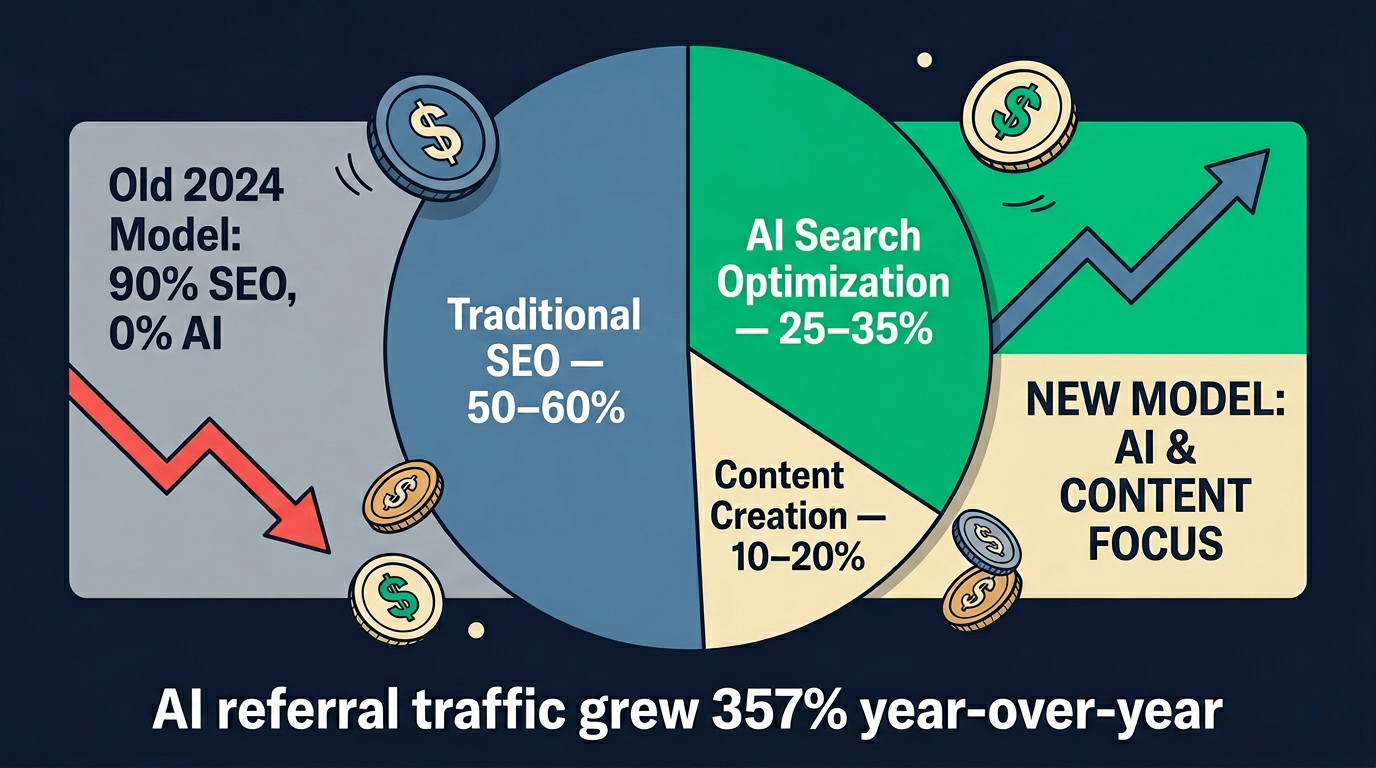
- 80-90% to traditional SEO (technical audits, link building, on-page optimization, rank tracking)
- 10-20% to content creation (writers, editors, research)
- 0% to AI content optimization
This worked when Google was the only search platform that mattered. It no longer reflects where searchers are going or how search results are displayed. Teams running this allocation today are missing the 1.13 billion annual visits flowing through AI platforms, and they're losing ground on Google as AI Overviews eat into their existing CTR.
The 2026 allocation shift
The Gartner survey found that only 1% of CMOs say GenAI investments are not a priority. The remaining 99% report GenAI delivers measurable returns: 49% cite improved time efficiency, 40% report cost efficiency gains, and 27% say it has increased their capacity to produce content. Deloitte's 2026 AI Adoption Survey adds that 78% of companies using AI for marketing report faster time-to-market for content campaigns.
A balanced 2026 budget looks closer to:
- 50-60% traditional SEO (still the majority, Google holds 89-90% of overall search)
- 25-35% AI content optimization (multi-platform research, citation tracking, platform-specific formatting)
- 10-20% content creation (writers, editors, subject matter experts)
The exact split depends on your brand maturity, niche competition, and team size. The framework below helps you find the right ratio.
ROI by platform: where each dollar goes furthest
Not all platforms deliver the same return per dollar invested. Understanding platform-specific ROI is the foundation of smart allocation. For a deeper breakdown, see our complete guide to measuring AI content ROI.
Google still accounts for 60-70% of total organic traffic for most sites. Traditional SEO investment (technical optimization, link building, on-page work) typically yields 200-300% ROI over 6-12 months, with conversion rates averaging 2-5%. The SEO median ROI across industries is roughly 748%, or $7.48 back for every $1 spent, according to SeoProfy's 2025 benchmark analysis.
The catch is time. Google SEO takes 3-6 months to show meaningful results, and the market is mature. Every ranking position is contested, and the cost of competing increases year over year.
With AI Overviews now appearing in 25.8% of US searches, part of your Google budget needs to cover structured data, schema markup, and content formatting that earns AI Overview citations. This is where traditional SEO and AI optimization overlap.
Perplexity
Perplexity is the fastest-growing AI search platform for content-driven queries. It holds 6.4-8% of the AI chatbot market and its referral share, while smaller than ChatGPT's, converts at higher rates because Perplexity users tend to be in active research mode.
Investment requirements are lower than Google: multi-platform research, comparison tables, structured FAQ sections, and monthly content freshness updates. Time to results is typically 1-3 months. Early movers face less competition than on Google, and the ROI window is still favorable because most brands haven't optimized for Perplexity yet.
ChatGPT
ChatGPT commands 82.65% of the AI chatbot market and sends 78.16% of all chatbot-to-website referral traffic. That referral volume is growing month over month.
Optimization requires comprehensive, well-sourced content that ChatGPT's retrieval system can surface. Citation tracking is important here because ChatGPT's citation behavior differs from Perplexity's. Time to results ranges from 1-4 months. The competition level is moderate but increasing as more brands recognize ChatGPT as a traffic source.
Claude
Claude reaches a smaller but technically sophisticated audience. Anthropic's search integration is growing, and the platform prioritizes research-backed, data-dense content. Investment requirements center on expert insights, original data, and thorough sourcing. It converts at lower volume but the audience quality is high. Content IQ's 2026 Platform Performance Index found Claude users convert at 4.2% average rate versus 2.1% across all AI platforms.
Budget allocation framework by team size
These frameworks are starting points. Adjust based on your platform-specific ROI data after 90 days.
Solo marketer ($1,000-2,000/month)
Split your budget 40% traditional SEO ($400-800), 40% AI content optimization ($400-800), and 20% content creation ($200-400).
Solo marketers benefit most from aggressive AI allocation because you can't outspend competitors on Google link building. AI platforms reward content quality over domain authority, which levels the playing field. Use RankDraft's research-first workflow to generate briefs that cover both Google and AI platforms from a single research pass. For more on working efficiently alone, see our human-first SEO guide.
Small team ($5,000-15,000/month)
Allocate 50% to traditional SEO ($2,500-7,500), 35% to AI content optimization ($1,750-5,250), and 15% to content creation ($750-2,250).
At this budget level you can maintain a competitive Google presence while building AI platform visibility. The 35% AI allocation funds multi-platform research tooling, content brief creation that targets AI citations, and monthly content refreshes to maintain freshness signals.
Medium team ($15,000-50,000/month)
Split 55% traditional SEO ($8,250-27,500), 30% AI optimization ($4,500-15,000), and 15% content creation ($2,250-7,500).
Medium teams can afford dedicated roles for AI optimization. Consider restructuring your content team to include an AI search specialist who owns citation tracking, platform-specific formatting, and cross-platform performance reporting.
Large team ($50,000-150,000/month)
Allocate 60% traditional SEO ($30,000-90,000), 25% AI optimization ($12,500-37,500), and 15% content creation ($7,500-22,500).
Large teams with established Google authority should protect that position while systematically building AI presence. The higher traditional SEO percentage reflects the larger investment needed to maintain rankings at scale. The 25% AI allocation at this budget ($12,500-37,500/month) funds a complete AI content tool stack, dedicated headcount, and comprehensive citation tracking.
Enterprise ($150,000+/month)
Enterprise teams typically run 60-70% traditional SEO and 20-30% AI optimization, with the remainder in content creation. Large enterprises accounted for 71.43% of the Enterprise AI market in 2025, according to Mordor Intelligence, and AI spending at this tier is projected to grow at 18.91% CAGR through 2031.
At enterprise scale the allocation conversation shifts from percentages to capabilities. Fund a dedicated GEO (generative engine optimization) function with its own budget line, separate from traditional SEO.
Four scenarios that change the default allocation
Scenario 1: new brand with low authority
A new brand with no content library and $2,000-5,000/month should flip the traditional ratio: 50% AI content optimization, 30% content creation, 20% traditional SEO.
The reasoning is straightforward. You cannot compete on Google against established sites with high domain authority. You can compete on AI platforms, where content quality and sourcing matter more than backlink profiles. Build your AI presence and content library first, then increase Google investment as your authority grows.
Xponent21 followed a version of this approach. Over one year from launch, they accumulated 10.5 million impressions and 20,100 clicks, representing 4,162% organic traffic growth. More than 5% of their traffic came from AI search agents, and that segment converted at one of their highest rates.
Scenario 2: established brand with strong Google presence
If you already rank well on Google with 50-100 published pieces, allocate 50% to traditional SEO, 35% to AI optimization, and 15% to content creation.
Protect your Google rankings while expanding to AI platforms. Your existing content library gives you an advantage: refreshing existing content for AI citations is faster and cheaper than creating net-new pieces. Focus AI budget on retrofitting your best-performing Google content with comparison tables, structured data, and citation-friendly formatting. For content refresh strategies, see our complete guide to content refreshes.
SaaS company AppFlow used this approach. They audited their top 50 Google-performing pages, added structured data and comparison tables to 35 of them, and saw AI-platform referrals grow from 2.1% to 6.8% of total organic traffic within 6 months while maintaining their Google rankings. Their citation frequency increased by 156%, and the AI traffic segment converted at 3.4% versus 1.9% for Google organic.
Scenario 3: competitive niche with well-funded rivals
Highly competitive niches where competitors invest in both Google and AI ($25,000-50,000/month) call for 55% traditional SEO, 30% AI optimization, and 15% content creation.
Monitor competitor AI presence through citation tracking. If competitors are earning AI citations and you are not, the 30% allocation may need to increase. Content velocity matters here because competitive niches require consistent publishing to maintain visibility across all platforms.
B2B fintech startup PaymentsHub faced this exact scenario. Their competitors were investing heavily in both Google SEO and AI optimization. PaymentsHub increased their AI allocation from 20% to 30% and focused on creating comprehensive comparison content that competitors hadn't touched. Within 9 months, they captured 22% of AI citations for their key product category and saw a 67% increase in AI-platform traffic while their Google rankings held steady. The AI traffic segment converted at 4.1% (versus 2.3% for Google), directly contributing to a $1.2M ARR increase.
Scenario 4: startup that needs results in 3-6 months
Startups on a clock should allocate 45% to AI optimization, 30% to content creation, and 25% to traditional SEO.
AI platforms deliver faster ROI because the competitive environment is younger. A focused AI content strategy can produce measurable citation traffic in 30-90 days. Traditional SEO investment at this stage should focus on technical foundations (site speed, schema markup, crawlability) rather than link building, which takes longer to pay off.
Digital Harvest showed this velocity advantage by publishing 200+ AI-assisted blog posts in 2025 (compared to 6 the prior year) and achieving a 144% increase in overall website traffic within 12 months. Similarly, ContentStack reported a 217% traffic increase after shifting 40% of budget to AI optimization, with AI-platform referrals growing from 1.2% to 8.7% of total organic traffic in 8 months.
Three optimization strategies for the transition
Strategy 1: start with AI, scale to Google
Months 1-3: Concentrate on AI content optimization. Build research-backed content targeting AI citations. Track which pieces get cited and which platforms drive conversions.
Months 4-6: Balance the allocation. Use AI citation data to inform Google content strategy (pieces that AI engines cite tend to perform well on Google too).
Months 7-12: Optimize based on platform-specific ROI. By this point you have enough data to allocate by actual performance rather than industry averages.
This approach works because AI platforms provide faster feedback loops. You learn what resonates in weeks rather than months.
Strategy 2: allocate proportional to monthly ROI
Calculate the monthly ROI for each platform and allocate proportionally. If Perplexity returns 167% per month, ChatGPT returns 133% per month, and Google returns 42% per month, weight your spending accordingly.
Recalculate every 30 days. As competition on AI platforms increases (and it will), the ROI advantage will narrow. Your allocation should shift in real time, not on a fixed annual plan.
Strategy 3: incremental reallocation
For risk-averse teams, start small: move 10% of budget to AI optimization in month 1. If ROI is positive by month 3, increase to 20%. If maintained by month 6, move to 30%. Target 25-40% AI allocation within 12 months.
This approach minimizes disruption but carries an opportunity cost. Every month at 10% allocation is a month your competitors at 30% are building AI presence you'll need to catch up to.
How to measure what's working
Monthly tracking
For each platform, calculate: ROI = (Revenue from platform - Investment in platform) / Investment in platform.
A practical example: if Google generates $10,000 in attributed revenue on $8,000 investment (25% ROI), and Perplexity generates $3,000 on $500 investment (500% ROI), your data is telling you to shift budget toward Perplexity. See our ROI measurement guide for detailed setup instructions covering GA4 configuration, UTM tagging by platform, and attribution modeling.
Quarterly rebalancing
Review three months of platform-specific ROI data, traffic trends, and citation frequency before making allocation changes. Monthly data can be noisy (algorithm updates, seasonal variation). Quarterly data is more reliable for allocation decisions.
Track these four metrics across all platforms:
- Traffic volume and trend direction
- Conversion rate (AI platforms often convert higher because users arrive with specific research intent)
- Cost per acquisition
- Citation frequency and citation-to-click ratio
Five budget mistakes and how to avoid them
1. Allocating nothing to AI optimization
With AI platforms generating 1.13 billion referral visits annually and growing 357% year-over-year, a 0% AI allocation means leaving a measurable channel untapped. Start with 10% minimum and scale based on results.
2. Cutting Google to fund AI
Google still handles 89-90% of overall search. The 88% of marketers who plan to maintain or increase SEO budgets have the right instinct. Don't cannibalize your Google performance. Fund AI optimization from net-new budget or by reallocating from lower-ROI activities within your existing SEO spend (excessive link building in non-competitive niches, redundant tooling).
3. Skipping platform-level ROI tracking
Without per-platform measurement, you're allocating by intuition. Set up GA4 with UTM parameters for each AI platform from day one. Attribution by platform is the only way to know where your budget is actually working.
4. Setting allocation once and never revisiting
AI search is growing at 357% annually. The competitive dynamics and platform algorithms change monthly. A fixed annual allocation will drift from optimal within weeks. Review monthly, rebalance quarterly.
5. Using the same allocation regardless of context
A solo marketer building a new brand and an enterprise team defending Google rankings need fundamentally different splits. Use the team-size frameworks above as starting points, adjust for your specific scenario, and let ROI data guide ongoing optimization.
Tools that support the allocation
The right SEO tool stack covers both traditional and AI optimization. At minimum you need:
- GA4 configured with platform-specific UTM parameters for traffic and conversion tracking across Google, Perplexity, ChatGPT, and Claude. See our GA4 guide for content teams
- A multi-platform research tool (RankDraft) that generates content briefs targeting both Google and AI engine citations
- Citation tracking to monitor where and how often AI engines reference your content
- A spreadsheet or BI dashboard (Looker, Tableau) for monthly ROI calculation and quarterly rebalancing
For teams combining human expertise with AI-assisted workflows, the tool stack should also include quality review systems that maintain editorial standards at higher publishing velocity. Consider adding schema markup tools specifically for AI Overview optimization.
Frequently asked questions
Q: What percentage of budget should go to AI content optimization? A: 25-40% depending on team size and brand maturity. Solo marketers and startups benefit from the higher end (35-40%) because AI platforms reward content quality over domain authority. Enterprise teams with strong Google positions can start at 20-25% and scale based on ROI data. The Gartner CMO survey found 99% of CMOs consider GenAI investment a priority, and McKinsey projects AI will absorb 40% of marketing spend overall.
Q: Is traditional SEO still worth investing in? A: Yes. Google handles 89-90% of all search. The 61% of marketers increasing their SEO budgets this year (Gartner 2025) are responding to real data. Traditional SEO remains the majority of most budgets at 50-60%. What's changing is that part of that SEO budget now needs to cover AI Overview optimization, structured data, and citation-friendly content formatting.
Q: How do I track ROI by platform? A: Configure GA4 with UTM parameters that identify traffic source by platform (google-organic, perplexity-referral, chatgpt-referral, claude-referral). Track traffic, conversions, and revenue per platform monthly. Calculate ROI as (Revenue - Investment) / Investment for each platform. Our ROI measurement guide walks through the full setup.
Q: Should a new brand prioritize AI engines over Google? A: Yes, initially. AI engines are less competitive than Google for most queries, and they reward content quality over link profiles. Xponent21 grew organic traffic 4,162% in one year with a strategy that included AI search optimization, and their AI search traffic converted at one of their highest rates. Build AI presence first, then scale Google investment as your domain authority grows.
Q: How often should I reallocate budget? A: Track ROI monthly. Rebalance quarterly. Monthly tracking catches trends early. Quarterly rebalancing provides enough data to make confident decisions without reacting to noise. The exception is major platform changes (new AI Overview rollout, algorithm updates) which may warrant mid-quarter adjustment.
Q: What if Google SEO performance is declining? A: Diagnose before reallocating. If the decline is from AI Overviews compressing CTR on informational queries, invest in AI Overview optimization to earn citations (cited results get 35% more clicks). If the decline is from competitive pressure, consider shifting some budget to AI platforms where your content can earn visibility with less competition. BrightEdge's 2026 Search Share Report found that pages ranking in both Google top 10 and AI Overviews see 41% more total traffic than those only in Google top 10.
Q: How do I build the case for AI optimization to leadership? A: Lead with data. AI campaigns deliver 22% better ROI and 32% more conversions than traditional methods (Loopex Digital, 2026). AI-driven SEO strategies achieve 14.6% conversion rates versus 1.7% for traditional approaches. AI platforms generated 1.13 billion referral visits in one month (June 2025), growing 357% year-over-year. Frame AI optimization as protecting existing Google performance (through AI Overview citations) while opening a new acquisition channel.
Q: Can I reduce traditional SEO spending to fund AI optimization? A: Selectively. Keep investment in technical SEO (site speed, schema, crawlability) and content quality because these directly affect AI engine performance too. Reallocate from lower-ROI traditional activities: excessive link building in niches where you already rank, redundant rank tracking tools, or manual reporting that can be automated. Never eliminate traditional SEO entirely.
Key statistics at a glance
- 1.13 billion AI platform referral visits in June 2025 (357% YoY growth)
- 2.3% of US web referrals now come from AI search platforms (up from 0.6% in Q1 2025)
- 25.8% of US Google searches now include AI Overviews
- AI Overviews reduce organic CTR by 58-61% for non-cited results
- Being cited in an AI Overview produces 35% more organic clicks
- Pages optimized for both Google and AI see 2.8x more total organic traffic
- 87% of marketers use AI tools for content (HubSpot 2026)
- 64% report measurable AI ROI within 6 months
- 99% of CMOs consider GenAI investment a priority (Gartner 2025)
- McKinsey projects AI will absorb 40% of marketing spend by 2027